Covent Garden
A brief history of ballet at Covent Garden
History
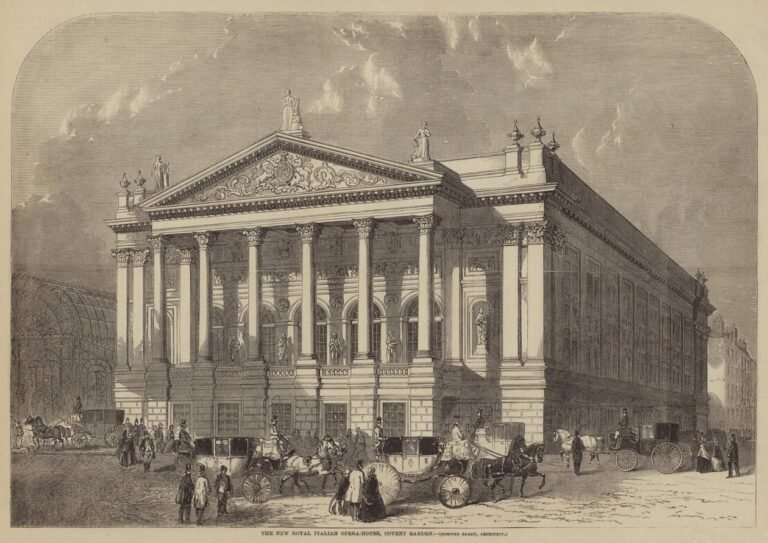
The Royal Italian Opera at Covent Garden (commonly known more simply as “Covent Garden”) was one of the leading opera houses of London during the 19th century. Initially, all operas were presented in Italian, even those written in French, German or English. The theatre was more widely known as Covent Garden, after its location.
William Thompson moved his troupe from Her Majesty’s Theatre to Covent Garden in 1886. This was in large part due to Thompson was already quarrelling with James Henry Mapleson, the manager of Her Majesty’s, who refused to allow him to create a new ballet and insisted he be limited to reviving older works. Thus, when Thompson received an invitation from the Royal Italian Opera to move his ballet troupe he accepted the invitation.
The troupe’s first performance at Covent Garden was Ondine in 1887, the same ballet which had been used to open their residence at Her Majesty’s theatre ten years earlier. The ballet was again a success, with the German première danseuse Marta Draeger as the titular nymph.
Part of Thompson’s move was his wish to create a new ballet, which he did, choreographing the one-act ballet The Amphitrite at breakneck speed so that it could have its première in the 1887 season, and also premièring in the same season was a revival of Thompson’s 1876 one-act ballet The Harvest Festival. Thompson’s troupe would continue to be resident at Covent Garden until the present day, officially being renamed the Royal Ballet in 1892, the same year the Royal Italian Opera became the Royal Opera House.
In 1888 Thompson founded a ballet school at the theatre, the Covent Garden School for Ballet which was renamed the Royal Ballet School in 1892.
Following the 1906 revival of Naïla for Carolina Ferreira, Richard Hague began (partly due to the number of première danseuses at Covent Garden) to present three productions a season, a convention which mostly held until 1914.
Productions
1887
- Ondine
- The Amphitrite
- The Harvest Festival
1888
- Giselle
- The Fairy of the Forest
1889
- The Corsair
- Faust
1890
- Alice’s Adventures in Wonderland
- The Wayward Daughter
1891
- The Beauty of Ghent
- Alice’s Adventures in Wonderland
1892
- The Peri
- Sylvia
1893
- Pygmalion
- The Fairies’ Goddaughter
1894
- Esmeralda
- The Devil to Pay
1895
- Coppelia
- The Sylph
1896
- The Buccaneers
- The Swords of Toledo
1897
- The Corsair
- The Beauty of Ghent
1898
- Giselle
- The Two Pigeons
1899
- Pygmalion
- The Wayward Daughter
1900
- Naïla
- The Beauty of Ghent
- The Devil to Pay
1901
- Ondine
- Esmeralda
1902
- Fairest Isle
- Alice’s Adventures in Wonderland
- The Swords of Toledo
1903
- The Peri
- Tristan and Yseult
1904
- Yedda
- The Corsair
1905
- Giselle
- The Two Peasant Girls
- The Amphitrite
1906
- The Buccaneers
- Sylvia
- Naïla
1907
- Ondine
- The Wayward Daughter
- Naïla
1908
- The Fairy of the Forest
- Coppelia
- The Corsair
1909
- Alcandra or The Amazons
- The Devil to Pay
1910
- Ondine
- Pygmalion
- The Swords of Toledo
1911
- The Corsair
- Esmeralda
- Alice’s Adventures in Wonderland
- The Birth of Aurora
1912
- The Pearl of Iberia
- The Fairy Doll
- The Two Peasant Girls
1913
- The Swords of Toledo
- Giselle
- The Wayward Daughter
1914
- Tristan and Yseult
- The Automaton
- The Choice of Hercules
- The Red Masque