L'Amphitrite
Or The Amphitrite
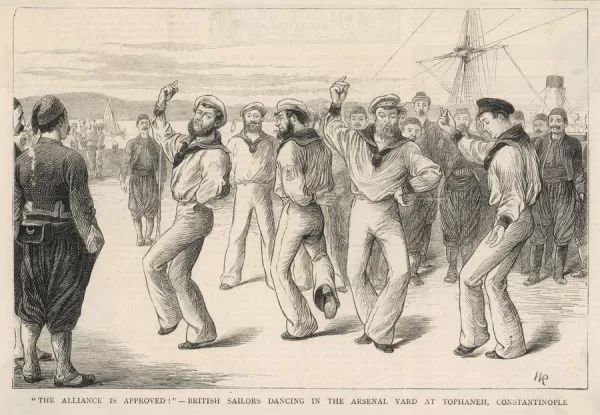
Ballet comique in one act premiered on 23rd June 1887 at the Royal Italian Opera, London
Choreography: William Thompson
Music: François Bardet
Premiers Rôles
Sarah: Emma Ashfield
Martin: Samuel Penrose
Edith: Mary Butler
Philip: Rafael Caravetti
Plot
At dawn the sailors clean the deck of their ship, The Amphitrite. Their captain enters with more men to do his inspections and orders them to clean the deck and leaves. The sailors grow bored and dance to amuse themselves. They spy some ladies and invite them onto the ship, and flirt and dance with them (a Polka-Mazurka led by Edith and Philip). The captain appears to break them up. However, the ladies tease him into relenting and allowing them to say. Sarah and Martin perform a Pas de Deux with one of the sailors and all join together in a general dance. The ladies bid the sailors farewell as they prepare for departure.
History
Original Production
Due to several ongoing disagreements with the management at Her Majesty’s Theatre, Thompson moved his troupe to Covent Garden in 1887. That year two ballets were planned to be presented, the familiar Ondine and a brand new creation set to music by Bardet titled The Amphitrite.
The Amphitrite was one-act ballet was created at breakneck speed. The score and choreography were complete in just over a fortnight, ensuring that the ballet could premiere as part of the 1887 season. The set was hastily built (consisting mostly of a backdrop and some scarce props) and costumes were borrowed from other productions. This was initially meant to replace Thompson’s original plan of reviving his 1876 ballet The Harvest Festival as part of the 1887 season. However the dancers who had been cast in the revival were not pleased to hear their rôles were to be cast aside and so petitioned the theatre management to allow the revival to go ahead. Management eventually agreed, and both The Harvest Festival and The Amphitrite would première as part of the 1887 season.
Though Bardet had tried to enliven the score and Thompson had updated its choreography, The Harvest Festival was not particularly well received, with one particularly harsh critic stating:
“[There was] not a single pleasing air throughout, save for Miss Gregson’s newly introduced variation, which, though an improvement, could scarcely rise above mediocrity.”
The Amphitrite fared better, particularly the central Pas de Deux of Emma Ashfield and Samuel Penrose as Sarah and Martin. This was also to be Penrose’s last season on the stage, as he retired at the end of the 1887 season.
The ballet, being one act, was more easily programmable (being short enough to be performed after a full length opera) and was retained in the repertory until 1893.
Résumé des Scènes et Danses
1) Introduction
2) Scène Première – Le Pont du Navire
3) Scène – Les Marins
a) Entrée des Marins
b) Récit du Capitaine
4) Pas des Balais
a) Danse d’Ensemble
b) Variation à Quatre
c) Coda
5) Scène – Entrée des Femmes
6) Polka-Mazurka
7) Scène d’Action – Rentre du Capitaine
8) Pas de Deux
a) Entrée
b) Adage
c) Variation I – Martin
d) Variation II – Sarah
e) Coda
9) Hornpipe Anglaise
10) Scène Finale
Interpreters of the Rôle
In 1888, due to Ashfield creating the titular rôle in the Thompson-Bardet Élodie or The Fairy of the Forest, she requested to step down from the rôle of Sarah. It was handed to an ambitious sujet, Mary Butler, though Marta Draeger managed to secure a few performances in the 1888 season. Butler would be the only danseuse to portray Sarah until her 1891 retirement. Butler departed as she had attempted to advance herself towards première but Thompson did not seem to have considered such a promotion, instead elevating Sarah Nicholson to the rank of première in 1890. As such, Butler left for La Monnaie in Brussels for better career prospects.
Following Butler’s 1891 departure, the rôle of Sarah was danced by the sujets Marie Saunier and Clara Whitmore. Saunier eventually came out on top, and was the sole interpreter of the rôle by 1893, at the end of which season the ballet was retired from the repertory.
London Revivals
1905 Revival
In 1905, Richard Hague decided to revive his predecessor’s ballet for Louise Grignon and return the ballet to the troupe’s repertory. The score was to be refreshed by a new composer, John Latham.
This was not Latham’s first score for ballet; his ballet The Queen of Carthage had premiered in 1903 at The Alhambra. The ballet in one act and two scenes was set at the court of Dido as she welcomed Aeneas, fell in love with him and convinced him to stay. It was arguably the only success to come out of the Alhambra, with even Covent Garden critics praising the work as “worthy”, “well made” and “tuneful”. Hague even attended a performance and Latham was eager to get his opinion. Hague suggested some modifications to the score, but his strongest critique lay with Dido’s variation. Hague felt that the very feminine and demure variation was not in keeping with Dido’s character, and that it would make sense for her to dance a much more bravura and jump-heavy variation, perhaps set to a voluptuous waltz. Hague also noted that though the danseuse had danced well with grace and technique, even she could not save the ludicrous choreography.
The ballet was given at the Alhambra the following year with almost all of Hague’s suggestions implemented by Latham. Latham had reportedly even clashed with the choreographer on several of the revisions, notably the cutting of the galop-coda of the main waltz (and allowing the waltz to end a waltz) and the addition of a new variation for Dido. Hague was reportedly impressed with Dido’s new variation, and is claimed to have said “the danseuse’s new variation is, in every aspect, that which it ought to be”. The second meeting between Hague and Latham went well, with Hague being even more complementary.
In 1905 when Hague was to choreograph his second ballet The Two Peasant Girls at Covent Garden, Hague, always wishing to encourage new talent, commissioned Latham to provide the score. Latham eagerly accepted but was disappointed at his commission only being for a one-act ballet, so as compensation Hague also commissioned him to revise the score of Thompson and Bardet’s 1887 ballet The Amphitrite. As part of these revisions Latham, provided a music for a new Pas des Cordes (a Pas de Quatre for two ladies and two men) and new variations for both Sarah and Martin in the Pas de Deux. Hague had originally intended to interpolate an existing variation for Sarah (likely Draeger’s 1891 variation from The Beauty of Ghent) but upon Grignon and Latham’s chiding Hague gave in and allowed a new variation to be composed.
The revival was well enough received and the ballet remained in the repertory until 1909.
Grignon remained the sole interpreter of the rôle until 1908, when Hague revived Coppelia for her. As such, she was required to hand over Sarah, which went to a promising sujet, Helen Davenport. Davenport would hold the rôle until the ballet was retired the following year in 1909.
Rôles
Sarah: Louise Grignon
Edith: Jane Wheaton
Musical Revisions
A new pas, the Pas de Cordes was added to precede the Pas de Deux. This comic pas was danced by two ladies and two men.
The Entrée of the Pas de Deux was greatly shortened.
Two new variations were composed for Martin and Sarah in the Pas de Deux.
Résumé des Scènes et Danses
1) Introduction
2) Scène Première – Le Pont du Navire
3) Scène – Les Marins
a) Entrée des Marins
b) Récit du Capitaine
4) Pas des Balais
a) Danse d’Ensemble
b) Variation à Quatre
c) Coda
5) Scène – Entrée des Femmes
6) Polka-Mazurka
7) Scène d’Action – Rentre du Capitaine
8) Pas des Cordes
9) Pas de Deux
a) Entrée
b) Adage
c) Variation I – Martin
d) Variation II – Sarah
e) Coda
10) Hornpipe Anglaise
11) Scène Finale