La Fée des Poupées
Or The Fairy Doll
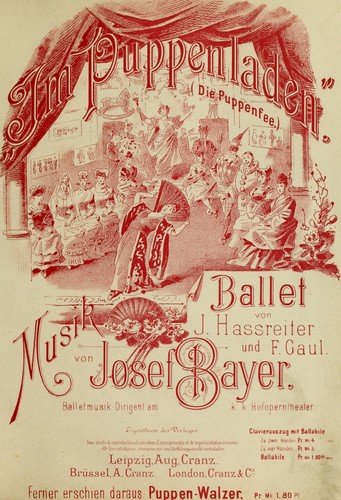
Ballet fantastique in one act premiered on 4th October 1888 at the Wiener Hofoper, Vienna
Choreography: Joseph Hassreiter
Music: Josef Bayer
Premiers Rôles
The Fairy Doll: Camilla Pagliero
Plot
Summary
The curtain rises on a toy shop, where the proprietor is working on a doll’s head, while assistants dust the other dolls. They are interrupted by the arrival of a postman with a package. Other visitors then follow, including a salesman with merchandise, and a girl bringing a broken doll for repair. Then potential customers begin to arrive, headed by a peasant with his wife and daughter. Clumsily the peasant disturbs a toy, which falls to the floor.
Then comes a well-to-do English family, anxious to buy a doll. They are first shown one that fails to work, and they start to leave, but the proprietor urges them to stay. He shows them a doll dressed in Upper-Austrian national costume, which proceeds to dance a Tyrolean Ländler. Then they are shown a baby doll that crawls around, the music clearly evoking its cries of “Papa” and “Mama”. Next the visitors are shown a Chinese doll, which dances a polka, after which a Spanish doll does a fiery Spanish dance complete with castanet accompaniment. Then a Japanese doll dances a slow mazurka, and a Harlequin performs a rousing tarantella. Other toys join in as the music rises to a climax, stirring all the dolls into motion.
Then comes the pièce de résistance in a fairy doll, which dances a graceful waltz. The English family is enraptured. They give an order to buy her and arrange for her to be sent to them. Then they and the peasants leave, and the shop closes for the night. Later, as midnight strikes, the shop magically comes alive. At the centre of the activity is the fairy doll. The other dolls join her in a divertissement, which also features Punchinellos with tiny cymbals. In turn, all the dolls seen earlier take part in a grand waltz, laughing and dancing.
After a brief pause, the toys embark on a triumphal march, followed by a lively galop. Then they all return to their boxes, gathered around their fairy queen. Disturbed by the noise, the shopkeeper now rushes in, but finds everything in order. As he stands puzzled by the disturbance, the ballet ends with a tableau of dolls around their fairy queen.
History
Original Production
In early 1888, the Viennese ballet master Joseph Hassreiter and his friend, the painter Franz Gaul, toyed with the idea of creating a ballet that took take place in a doll shop. The idea, however, was not a new one; as in 1870 Arthur Saint-Léon had choreographed Coppelia to a score by Léo Delibes, an adaptation of E.T.A. Hoffmann’s story The Sandman. Hassreiter and Gaul wrote the libretto together, calling their work Im Puppeladen. For the music, they turned to Josef Bayer, the ballet conductor at the Viennese Imperial and Royal Court Opera Theatre, who enthusiastically accepted the commission.
Technically, the first performance of the ballet was not in October at the Wiener Hofoper, but in early April 1888 as part of a charity event hosted by of Princess Pauline Metternich at the Palais of Prince Johannes Liechtenstein. For this private production, the cast was made up of members of the Viennese aristocracy and the ballet was titled Im Puppenladen. When the ballet was transferred to the Hofoper in October, the title was changed to Die Puppenfee and Hassreiter presumably adapted the choreography for the professionals of the stage.
The ballet was a tremendous success with Bayer’s score being praised and continued to be performed in German-speaking countries for many years. It performed annually at the Vienna State Opera until 2008, culminating in over eight hundred performances of the work and is one of the State Opera’s most frequently performed works. The ballet was also staged in Italy, France and even in England, where it premièred in 1905 at London’s Empire Theatre.
Selected Revivals
12 January 1890
Location: Nationaltheater, Munich
Staged by Franz Fenzl.
31 January 1891
Location: Königliches Hoftheater, Stuttgart
7 February 1903
Location: Imperial Mariinsky Theatre, St Petersburg
Staged by Sergey and Nikolay Legat for Matilda Kschessinskaya with musical revisions by Riccardo Drigo. It was for this revival that Drigo composed the well known Pas de Trois for the fairy doll and two pierrots.
22 May 1905
Location: The Empire Theatre, London
Staged by Katti Lanner for Adeline Genée as The Dancing Doll. Lanner inserted several dances for more dolls, including a Pas Seul subtitled La Folie for Genée.
London Revivals
1912 Revival
In 1912, Richard Hague revived the ballet with minor musical revisions by the conductor of the ballet at Covent Garden, Charles Sawyer. Sawyer expressed that he did not feel particularly up to the task of composition, but Hague assured him that only a few minor revisions to the score would be made and no new additions would need to be composed. Indeed, the only musical change that was eventually made was the insertion of the Pas Robert. Helen Davenport was cast as the Fairy Doll with Sofia Zacchini as second cast.
Though the titular rôle had originally been created as a mime rôle (as Pagliero did not dance), there were soon concerns as to the ballet’s lack of a ballerina rôle and a grand pas. This was initially solved by means of an interpolation; with an example being the 1893 revival at the Königliche Oper in Berlin, where a Pas de Six was interpolated for Antonietta Dell’Era (who famously created the rôle of the Sugar Plum Fairy in The Nutcracker) and the titular rôle was portrayed by Mlle Urbansta, presumably a mime artist.
The first instance of the grand pas rôle and the titular rôle being united seems to be the 1903 revival at the Imperial Mariinsky Theatre in St Petersburg, where a Pas de Trois was interpolated for Matilda Kschessinskaya, who danced the titular rôle. However, this development was not universal, as in German-speaking countries the two rôles remained separate, and when the ballet was revived by Lanner for Genée in 1905 at the Empire Theatre in London, where a Pas Seul (La Folie) was interpolated for Adeline Genée (who also danced the Bébé doll). Hague decided to follow the Russian version, uniting the grand pas rôle and the titular rôle for Davenport.
The ballet, though appreciated for its music, was thought of as childish, immature and lacking in any semblance of a good plot. The ballet was not a great success and was considered to be ludicrously childish by the Upper Class London audience, and it was not at all well attended. Despite this initial bad reception, Hague saw merit in the piece. He revived the ballet in 1913 for the graduating class of the Royal Ballet School, intending to lean into the childish and frivolous nature of the ballet by staging it with a younger cast. Hague’s gamble turned out to be moderately successful, as the audience were much more receptive to the work when it was danced by younger dancers of the Royal Ballet School than the dancers of the Royal Ballet proper, as its childishness became a feature and part of its charm rather than a detriment.
Rôles
The Fairy Doll: Helen Davenport
Musical Revisions
A Pas de Deux was interpolated for the Fairy Doll and her cavalier, dubbed the Tin Soldier.
Hague followed the tradition of including a grand pas by interpolating a Pas de Deux for Davenport into his revival of the ballet. The pas was not new, but was none other than the Pas Robert, a Pas de Deux written for Marta Draeger in the 1890 revival of The Wayward Daughter. The pas was well received at its 1890 premiere, but there were concerns about its suitability for the characters of Lise and Colin and the rest of Hertel’s score. Thus, it was removed from The Wayward Daughter after 1890 in favour of the original Pas de Deux (composed by Bardet for the 1886 London revival of the ballet). Hague also considered reviving the Pas de Flore from The Beauty of Ghent but eventually settled on the Pas Robert.
Résumé des Scènes et Danses
1) Prélude
2) Scène Première
3) Danse de la Poupée Cassée
4) Scène 2e
5) Danse Tyrolienne
6) Scène 3e
7) Danse de la Bébé
8) Scène 4e
9) Danses des Poupées
a) Danse Chinoise
b) Danse Espagnole
c) Danse Japonaise
e) Danse d’Arlequin
10) Scène 5e – Apparition de la Fée des Poupées
11) Valse de La Fée des Poupées
12) Scène 6e
13) Scène 7e – Métamorphose de la Boutique
14) Grand Ballabile des Poupées – Valse
15) Pas de Deux (also called the Pas Robert, a supplemental Pas de Deux written for the 1890 revival of The Wayward Daughter)
a) Adage
b) Variation I – Le Soldat de Plomb
c) Variation II – La Fée des Poupées
d) Coda
16) Marche
17) Galop
18) Scène Finale