Les Aventures d’Alice au Pays des Merveilles
Or Alice's Adventures in Wonderland
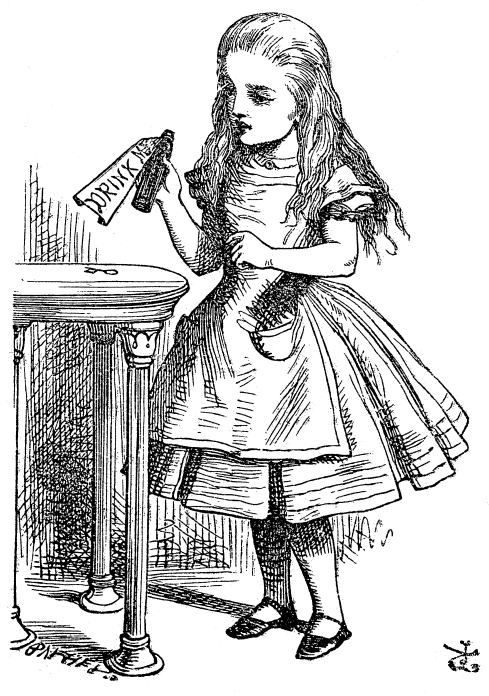
Ballet féerie in three acts and seven scenes premiered on 9th June 1890 at the Royal Italian Opera, London
Choreography: William Thompson
Music: Auguste Péchard
Premiers Rôles
Alice: Marta Draeger
Knave of Hearts: Frederick Hale
Queen of Hearts: Sarah Nicholson
King of Hearts: Rafael Caravetti
Plot
Summary
Acte 1
Scène 1 – Un Jardin en Automne
A garden in autumn, to one side is a swing to the other the house.
Alice and her sisters Charlotte and Edith are in the garden. Their governess tries to get them to concentrate on their lessons but none of them seem to wish to do so. Edith prefers to play on the swing, Charlotte to fly her kite and Alice to read her storybooks.
Try as the governess might, she cannot get the girls to concentrate. Edith and Charlotte play tricks on the governess but Alice does not join in, engrossed in the imaginings of her book.
The governess calls the girls inside to have tea, and Charlotte and Edith quickly depart. Alice asks for some time and the governess gives her a few moments until she will be called again.
Alice lies down on the bench to read until her attention is grabbed by a white rabbit in a waistcoat and with a pocket-watch. She chases after it, falling down the rabbit hole and becoming smaller.
Scène 2 – Une Forêt
A clearing in a forest.
Alice wakes up in a scary forest, concerned as to where she is. She spies the rabbit and goes to him, asking where she is and how to get back. The rabbit does not know, but he is late to attend the Queen of Hearts, who knows all.
As he runs off, Alice happens upon a group of cats. One introduces himself as the Cheshire cat, who points Alice in the direction of the Queen of Hearts. Alice happens upon the Knave of Hearts, who is charmed by the beautiful girl. However, he too soon departs, leaving Alice to her own devices.
Alice happens upon a party: a Hatter, a Dormouse and a March Hare. They invite her first to tea and then to dance, before telling her the direction to travel.
Acte 2
Scène 1 – Un Pavillon de Chasse dans les Bois
To one side is a hunting lodge. On the back is a forest.
The Duchess is ordering her servants about, preparing a grand repast. Her Cook is rather dishevelled and causes many breakages, causing her mistress to reprimand her.
Alice enters, confused as to what she has happened upon. The Duchess introduces herself, her cook and her baby in her arms. She is the hostess of a boar hunt, and so is preparing the repast for the party’s return. She implores Alice to assist with the child as she oversees the preparations and Alice does so.
The guests enter and the Duchess plays hostess. To amuse the guests, the Duchess bids her servants dance and she participates with her Cook. The Duchess implores Alice to dance and she does, until it is revealed that the baby has transformed into a pig.
Misunderstanding this as the work of Alice, she is chased away by the Duchess and her guests.
Scène 2 – Un Jardin Merveilleux
A marvellous garden of flowers.
Alice is lost until she happens upon a marvellous garden. There the White Rose, Queen of the Flowers bids her rest as they entertain her.
Once the entertainment has concluded, Alice is directed to the Queen of Hearts’ castle.
Acte 3
Scène 1 – Au Bord de la Mer
A beach. To one side is the sea, to the other a house.
On the seaside the oysters come to the shore. The mother oyster bids them return to the sea, for it is too dangerous. The young oysters are curious and so refuse their mother.
A Seal and a Carpenter enter, saying to each other how hungry they are. Upon spying the oysters they hatch a plan. They greet the oysters cordially, and they, in their youth and naïveté, are curious. To gain the oysters’ trust, the seal bids them dance and amuse themselves.
Alice enters, seeking direction and once given, departs. The seal and the carpenter, having earned the oysters’ trust, lead them into the house.
Scène 2 – Une Pelouse Devant un Château
A lawn in front of a grand castle.
There is a garden party where the guests play croquet. The Queen of Hearts is among them and is, as a result of everyone’s fear of her, victorious.
Alice enters and wishes to entreat the Queen to return home but the White Rabbit and the Knave inform her she must wait. Aside, the King of Hearts tries to gain her affections, but Alice refuses him, stating she must return home.
The Queen instead wishes to dance and bids the cards do as she commands.
Once she is satisfied, she hears the case of Alice. As she is about to free Alice, the King, still wounded by his rejection, accuses Alice of stealing the tarts. As the Queen in her fury declares Alice must be executed, the cards give chase and Alice flees the scene, the White Rabbit and Knave creating a diversion to aid her.
Scène 3 – Le Jardin en Automne
A garden in autumn, as in Act 1, Scene 1.
Alice awakens to the sound of the governess calling her. It is still time for tea and she appears to have fallen asleep. She at first is frightened, believing she is still being chased. Once she has been calmed by the governess, she eagerly asks the governess of the white rabbit in a waistcoat, but the governess replies there is no such thing and implores her to come inside. Alice insists but the governess concludes it must be a dream. Alice narrates her dream eagerly to her governess as they depart.
History
Original Production
Alice’s Adventures in Wonderland, a ballet féerie in three acts and seven scenes, was created to be a spectacle. It was loosely based on the 1888 revival of the popular West End musical that had originally premièred in 1886, itself based on Lewis Carroll‘s books Alice’s Adventures in Wonderland (1865) and Through the Looking-Glass (1871).
The ballet was choreographed by William Thompson to a score by Auguste Péchard and was a tremendous success, with critics declaring that the ballet rivalled productions staged on Parisian or St Petersburgian stages.
Due to the necessity of Carroll’s permission to stage the ballet, Thompson began work on the scenario in late December of 1888 and had submitted a copy of the libretto by January of 1889. Some adjustments were made by the author and work on the ballet began in earnest by the middle of the year.
Though Thompson had initially planned to have a student portray the rôle of Alice, this idea was quickly dismissed as the Covent Garden School for Ballet was a relatively new institution, meaning the girl would likely not have received enough training to carry the ballet. Thus, Thompson revised the scenario so that Alice would be danced by a danseuse of the troupe, likely Emma Ashfield. Sadly, Ashfield was injured in 1888, and though she returned to dance in Faust in 1889, she indicated that it was to be her final season at Covent Garden. Finally, Thompson turned his attention to Marta Draeger, the second most senior danseuse after Ashfield and selected her to première the ballet.
A notable feature of the ballet was the inclusion of students in the first scene of the third act as the oysters. This was a risky move by Thompson, as he had only recently opened the Covent Garden School for Ballet in 1888. Thompson, wishing to display his new creation, choreographed a polka for the children to dance as the oysters, the Polka des Huîtres, which was well received by the audience and critics.
In 2010, the Royal Ballet planned to revive the 1911 production of Alice’s Adventures in Wonderland for the 2011 season. It was initially aimed to be a faithful reconstruction (as the ballet was notated in Meisenburg notation in 1902 and 1911), but upon piecing together some of the notations the choreography was decided to be too old-fashioned. As a compromise, it was decided to commission Christopher Wheeldon to choreograph a completely new ballet to Péchard’s 1890 score. However, upon closer inspection of the music, Wheeldon did not find its episodic nature suited to his choreographic style nor the story he wished to convey. Thus, the idea of a revival of the Thompson-Péchard work was completely abandoned, as Wheeldon was now to create a completely new ballet on the subject to a brand new score by Joby Talbot. The Wheeldon-Talbot Alice’s Adventures in Wonderland premièred on 28 February 2011 and was a success, and has been performed by several ballet companies since.
Résumé des Scènes et Danses
Acte 1
Scène 1 – Un Jardin en Automne
1) Prélude
2) Scène du Jardin
3) Jeux des Sœurs d’Alice
4) Danse d’Alice
5) Scène – Apparition du Lapin Blanche
6) Scène – La Chute et la Diminution
Scène 2 – Une Forêt
7) Entr’acte et Scène de la Forêt
8) Scène du Lapin Blanc
9) Scène – Apparition de la Chat Cheshire
10) Valse Langoureuse
11) Scène – Alice et le Valet de Cœur
12) Scène – Entrée du Chapelier Fou, du Loir et du Lièvre
13) Pas Bouffon
a) Mazurka Grotesque
b) Variation du Chapelier Fou
c) Variation d’Alice
d) Galop Furieux
14) Scène Finale
Acte 2
Scène 1 – Un Pavillon de Chasse dans les Bois
15) Entr’acte
16) Scène Dansante – Entrée de la Duchesse et la Cuisinière
17) Scène – Entrée d’Alice
18) Pas d’Ensemble
a) Allegretto
b) Variation de la Cuisinière
c) Variation de la Duchesse – Valse Voluptueuse
d) Variation d’Alice
19) Scène – Le Départ d’Alice
Scène 2 – Un Jardin Merveilleux
20) Entr’acte et Scène – Le Jardin des Fleurs
21) Scène – Entrée d’Alice
22) Pas des Fleurs
a) Valse des Fleurs
b) Andante
c) Variation du Tournesol – Allegretto
d) Variation du Muguet – Pizzicato
e) Variation de la Rose Blanche – Valse Moderato
f) Coda
23) Scène Finale
Acte 3
Scène 1 – Au Bord de la Mer
24) Entr’acte
25) Scène – Entrée des Huîtres
26) Scène – Entrée du Morse et du Charpentier
27) Danse des Huîtres – Polka (Les élèves de l’école de danse)
28) Scène – Entrée d’Alice
Scène 2 – Une Pelouse Devant un Château
29) Entr’acte et Scène Dansante – Le Croquet
30) Scène – Entrée d’Alice
31) Grand Pas des Cartes
a) Entrée
b) Adage
c) Valse des Cartes
d) Variation I – le Cinq de Cœur
e) Variation II – le Huit de Cœur
f) Variation III – la Reine de Cœur
g) Coda
32) Scène Dramatique – Le Procès
33) Scène – Le Fuite d’Alice
Scène 3 – Le Jardin en Automne
34) Scène Finale – Le Réveil
London Revivals
1891 Revival
Due to its success, the ballet was revived in 1891 with the same cast as the previous year. Some critics were not appreciative that the ballet was given two years consecutively, though others welcomed the reprise of an enjoyable work.
1902 Revival
In 1902 the ballet was revived for the Coronation season for Sarah Nicholson.
The 1902 revival is notable as being the first appearance of Adeline Genée on the Covent Garden stage. By 1902 Genée was already a notable figure in the world of London ballet, having been prima ballerina at the Empire Theatre of Varieties since 1897 under the balletmistress Katti Lanner. Genée had already seen success in Monte Cristo (1897), The Press (1898) and Les Papillons (1900) and would later be noted for her performances in High Jinks (1904) and Cinderella (1906). In 1906, Genée would stage her version of Coppelia at the Empire, which would receive praise from audiences and critics alike. She would remain at the Empire until 1907, when she would depart for America.
Due to her reputation and apparent desire to try her hand at classical rôles, Richard Hague sought to engage her to dance at Covent Garden. Management proved receptive to Hague’s proposal, and so negotiations were begun with the Empire and Genée herself. One person who was not pleased with this news was Nicholson. Nicholson looked down on Genée’s music hall origins, even reportedly referring to her as “little more than a chorus girl.” Additionally, Nicholson may have disliked Hague’s enthusiasm for Genée’s engagement, given that Genée had not risen through the ranks of Covent Garden like the other premières such as Giulia Moretti and herself. Nevertheless, Hague was determined and Genée was scheduled to make her Covent Garden debut as Alice as second cast. Her performances were well received by the critics, much to Nicholson’s chagrin, as was the comparison between the two danseuses. Genée would appear twice more on the Covent Garden stage: firstly as Médora in the 1904 revival of The Corsair and secondly as Lise in the 1907 revival of The Wayward Daughter.
1904 His Majesty’s Theatre Revival
In 1904, the ballet was staged by François Ambrosiny at His Majesty’s Theatre. The ballet was set by a balletmaster from Covent Garden, but Ambrosiny revised several of the dances, calling on Philip Jenson, the under-conductor and unofficial ballet composer of the theatre, to compose new supplemental additions.
Hague was notably dismissive of the ballet, believing it to be a corrupted version of Thompson’s original that he, at Covent Garden, had duly preserved. The ballet would be retired from the repertory in 1906.
1911 Revival
In 1911 the ballet was revived for Jane Wheaton with Helen Davenport as second cast. The rôle of Alice had been a personal goal of Wheaton’s ever since she had seen Draeger in the rôle in the 1891 production. That performance, witnessed by the fifteen-year-old Wheaton had sparked her interest in Thompson’s troupe at Covent Garden, leading to her aim of joining the troupe and eventually dancing the same rôle. As such, her girlhood dream was finally realised, much to her satisfaction.