Tristan et Yseult
Or Tristan and Yseult
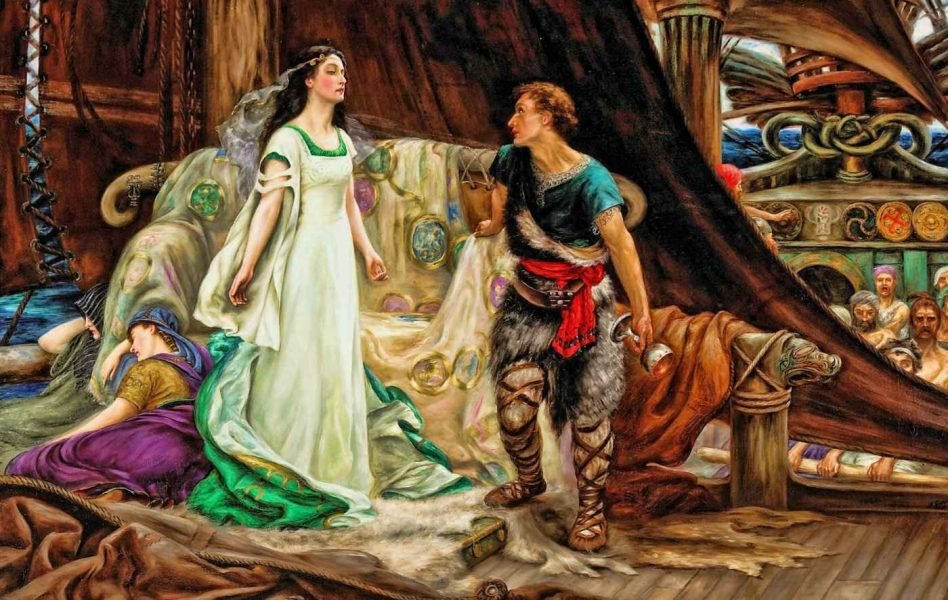
Ballet pantomime in three acts and five scenes premiered on 5th June 1903 at the Royal Opera House, London
Choreography: Richard Hague
Music: Auguste Péchard
Premiers Rôles
Tristan: James Elton
Yseult: Sarah Nicholson
Brangien: Giulia Moretti
Plot
Summary
Acte 1 – The Voyage
The scene represents a dockyard with ships to one side.
The fishermen, dockworkers and townspeople go about their day. The workers spot a ship preparing to dock and go away to receive the ship.
Tristan and his companions enter. Dinadan is pleased that the day has finally arrived for them to return to Cornwall, noting everything there is much finer and to his taste than Ireland. He congratulates Tristan on defeating the Irish knight Morholt, for which he has been rewarded by bringing Yseult the fair back to Cornwall to wed his uncle, King Marc. The men discuss the princess’ rumoured beauty, but as none of them have laid eyes on her it is only rumour. Dinadan inquires of Tristan what he thinks of this but Tristan refuses, saying the princess is for his uncle, not for him, so he has no opinions on her beauty. The men laugh and jest at him as they leave for the tavern.
Yseult enters, pursued by her handmaiden Brangien who begs her not to run. Yseult is determined, she cannot marry King Marc for she will not wed a man who has raised arms against her father. She also detests his envoy Tristan, who killed her betrothed, the knight Morholt, in battle. Brangien begs her to think of her father, mother and kingdom but she is unmoved.
Brangien spies a mysterious stranger who has been listening in and she compels him to reveal himself to the princess. The stranger repeats Yseult’s claims of escape to her, asking if she believes that her flight is dutiful. Yseult believes her duty is to Ireland and so she cannot marry King Marc, no matter what her father says. The stranger reveals that he may help her, but she must be prepared for the consequences. She agrees and he hands her a vial, telling her to give it to the man who is to take her away. He will alter his mind and decide that she need not go with him, that way it will be Cornwall to break the engagement, not Ireland, leaving her and her father blameless. She enthusiastically takes the vial and leaves to return to the castle, despite Brangien’s pleas.
The Cornishmen return with some Irish women, but upon hearing the fanfare begin to compose themselves for the royal caravan.
The King and Queen of Ireland arrive with their suite, including Yseult and Brangien. The Cornishmen pay all the necessary homage and courtesy to the Irishmen. Tristan signs the contract on his uncle’s behalf and Yseult finally reveals her face, lifting her veil to the Cornishmen, who marvel at her beauty. King Anguish declares that the Irish and Cornish are to set aside their weapons in this marriage alliance.
Despite Brangien’s pleas, Yseult, aside, laces a goblet with the contents of the vial. As she is called away by her father, the stranger reappears and, unnoticed by all, mixes the wine in both goblets. Yseult returns and, carefully remembering which goblet is which, hands the laced goblet to Tristan, ostensibly as a gesture of good faith. Tristan takes the goblet and they both drink.
At first, nothing seems to happen, but soon it seems the pair see each other anew. Tristan now seems entranced, to which Dinadan mocks at him. Yseult seems transported, which worries the Queen and King, and Brangien cleverly declares that Yseult is happy to fulfill her marriage and duty. King Anguish gives Yseult’s hand to Tristan and the Cornish party depart for their ship.
Acte 2 – The Deception
Scène 1
The scene represents the chamber of Yseult.
Yseult is in despair. Although Marc is a good husband to her and is attentive to her wishes, she is not content. Marc is distressed by his wife’s melancholy, and he asks Brangien if she has an answer for her mistress’ troubles. Brangien attributes Yseult’s melancholy to homesickness for Ireland, an explanation with which Marc seems to agree. He bids his wife farewell, but tells Brangien that he shall try to concoct an endeavour to please her.
Upon Marc’s departure, Yseult confides to Brangien her continued love for Tristan, saying that she may perish of desire at being apart from him for so long. She reminds Brangien of Tristan’s promise to return today, having been sent on a mission by King Marc. Brangien assures her Tristan will return, but urges her to remember her place as Queen of Cornwall and cease her adulterous relationship.
Yseult, however, is unmoved, and is roused by a sound outside her window. She is ravished to see Tristan climbing, and sends her ladies away as he steals into her bedchamber. The lovers embrace but soon Tristan must part, instructing Yseult to meet him in the garden at midnight.
Marc arrives to bestow upon his wife a tapestry of Ireland, to ease her longing for home. She thanks him, but remains downcast until she spies Tristan in Marc’s retinue. The sight of her beloved lifts Yseult’s spirits, and Marc, ignorant of this, is pleased that his gift should have cheered her.
Scène 2
The scene represents a castle garden at night.
As midnight approaches, Yseult steals into the garden, Brangien accompanying her to keep watch. Tristan is waiting for her and the lovers embrace. Unbeknownst to them, Marc has spied their embrace and heard their fond declarations. In fury, he calls his guards forward to capture them. Tristan, an able knight, fights off the guards, escaping with Yseult. Marc, in his wrath and ire, sentences both his wife and nephew to their death.
Acte 3 – The Tragedy
The scene represents a hall in the castle of Joyous Gard.
Tristan and Yseult have been sheltered by a friend of Tristan’s, Lancelot, at his castle in Joyous Gard. Lancelot tells the lovers that Marc is still searching for them. He will shelter them for now, but it would not be in their best interests to stay for too long.
A knock at the door is heard and it is Brangien. Tristan is concerned at their discovery but Yseult assures him that Brangien is to be trusted, indeed, she sent a message to Brangien instructing her handmaiden where to find her. Brangien confirms Lancelot’s rumour: King Marc has sentenced them both to death and anyone who is found helping them will have committed treason.
A great crash is heard. Lancelot enters and relays that Marc has laid siege to Joyous Gard, having discovered the castle to be the lovers’ location. Brangien also reveals another piece of news: due to Yseult’s infidelity the alliance between Cornwall and Ireland has been broken and the Cornishmen are to soon sail for Ireland to exact retribution. Yseult is distressed by the news, as it is she that has doomed her mother and father to their fate. She could return to Marc and try to convince him to recall his men, but she may not succeed, or worse, be put to death. Tristan refuses to allow Yseult to return to Marc but she declares she must try, for her father, her mother and her homeland. The pair bid a tender farewell and Tristan promises to save Yseult should anything happen. Yseult goes with Lancelot to meet Marc to negotiate peace, as does Brangien.
Tristan, now alone, ponders his fate. To relieve his mind, he plays his harp, but Marc appears from the shadows to stab Tristan as he is harping. Having mortally wounded his rival, he removes Tristan’s ring and leaves.
Lancelot returns, and on seeing the dead Tristan sounds the alarm. Soon Yseult enters, distraught, having been shown the ring and told of her lover’s death by Marc. She clutches Tristan’s lifeless body as Marc enters with his men. Marc triumphantly declares that since his rival is no more, Yseult’s affections must belong to him. Yseult, overcome with love and grief, stabs herself with Tristan’s dagger, preferring to be united with him in death rather than live without him.
History
Original Production
In 1903, Péchard announced that he was to retire from his position as Official Composer of the Ballet Music to the Royal Opera House, a position he had held since 1888. During his tenure he had composed numerous additions and revisions to many ballets, and in fact there was scarcely a single ballet still in the repertory at Covent Garden that did not include some of his contributions. As such, he was given permission by the theatre management to compose a new ballet for his benefit and retirement.
The ballet was to be choreographed by Hague, Thompson’s successor and a man whom Péchard disliked. This dislike was mutual; Péchard regarded Hague as inferior to Thompson and never quite respected him as an equal collaborator while Hague regarded Péchard as old-fashioned, uncompromising and proud. Péchard believed that Hague’s dislike of him was the reason for the relative absence of new scores following Thompson’s retirement in 1896 (when Péchard contributed his last score for the Grand Ballet The Swords of Toledo). Hague primarily limited Péchard to only providing supplemental material and revisions for revivals, though Hague did commission the score from Péchard for the one-act pièce d’occasion Fairest Isle that was created as part of the 1902 coronation festivities. However, even the number of requested supplements seemed to be decreasing, as Hague increasingly repurposed variations from other works rather than commission as many new ones from Péchard as Thompson might have done.
By 1903 Péchard could see the writing on the wall and so was advised to retire rather than be forced out, as Hague may very likely have been planning to. Once Péchard had retired, Hague was able to abolish the position of Official Composer of the Ballet Music, as he had wanted to do so since he became balletmaster in 1896. He began to work with new composers, preferring to give multiple composers the ability to present their work on the Covent Garden stage be it through new scores or revisions of older works.
The plot was to be based on the legend of Tristan and Iseult and was an attempt by Hague to compose a ballet on a truly English subject. The inclusion of Lancelot, Joyous Gard and indeed Dinadan referenced the Matter of Britain and characters that had begun to become part of the public consciousness. J. Comyns Carr‘s 1895 King Arthur was an example of this, with music by Arthur Sullivan and a ballet (a Pas de Six) inserted for Nicholson to music by Péchard.
Tristan and Yseult did not have as smooth a choreographic process as Péchard had had with Thompson. Hague was often unsatisfied with the music and irritated Péchard with his requests for rewrites and changes to greater support the drama. Péchard was neither pleased with Hague’s structure nor choreography, drawing unfavourable comparisons to how Thompson had created The Swords of Toledo in 1896. Nicholson was also unsatisfied with the lack of balance between dancing and drama, believing that she did not have enough to do during the evening. It was through her persistence that a Variation was added for Brangien in the Grand Pas d’Action (as the pas originally only contained variations for Tristan and Yseult) and that she received a variation in the Pas des Dames d’Honneur in the second act (as it was originally planned to be a pas organised by Brangien to cheer Yseult, who originally did not participate). Additionally, Moretti was not Hague’s first choice for Brangien, as she had sustained an injury during the 1901 season and was out for the 1902 season. Hague had initially cast Harriet Linwood as Brangien, but Nicholson intervened on Moretti’s behalf and the casting was changed.
Despite the backstage drama, the première of the ballet was well attended with many ballet-goers turning out to see the final creation of the composer whose name had been synonymous with British ballet for several years.
However, the reviews were not always favourable. Though the mise-en-scène and Péchard’s music were praised, the structure and Hague’s choreography were not as well received. One near-universal criticism was the comparative lack of dancing, especially in relation to the third act. In fact, the opportunities for dance decreased with each act, mirroring the increase in drama as the ballet progressed. Hague was criticised for his “over-realism” in this regard and for creating a plot too tightly wound to support a ballet, with one critic lamenting:
“the opportunities for dancing were so few that one was left to wonder whether Mr Hague believed himself engaged upon a pantomime rather than a ballet.”
There were only two full pas presented in the evening: the Grand Pas d’Action of the first act and the Pas des Dames d’Honneur of the first scene of the second act. The third act drew the most criticism for its lack of dancing, as save for the mournful and somewhat unconventional Pas de Deux of Tristan and Yseult it was almost entirely devoted to pantomime. One notable critic was quoted as saying:
“The third act is dreadfully dull; for when nothing of consequence occurs upon the stage, and the action is conveyed by drawn-out stretches of pantomime unrelieved by the dance, one’s attention, quite involuntarily, wanders elsewhere.”
The second act consistently received the most praise, with Nicholson’s variation in the Pas des Dames d’Honneur (which came to receive the nickname and later subtitled “Mon Cœur”) being considered a fine piece of choreography that displayed Yseult’s longing for her beloved Tristan. The Pas de Deux in the second scene of the second act was also well received, though considered a touch too long by some.
Variation “Mon Cœur” for Miss Nicholson as Yseult in the Pas des Dames d’Honneur, composed by Auguste Péchard (1903)
Résumé des Scènes et Danses
Acte 1
1) Introduction
2) Scène Première – Les quais
3) Hornpipe
4) Scène – Entrée de Tristan
5) Scène – Entrée d’Yseult
6) Gigue
7) Scène – Entrée du Roi et de la Reine
8) Grand Pas d’Action
a) Andante
b) Allegretto
c) Variation de Brangien
d) Variation de Tristan
e) Variation d’Yseult
f) Coda
9) Scène Finale
Acte 2
Scène 1
10) Entr’acte
11) Scène Première – Le Désespoir d’Yseult
12) Scène – Yseult et Brangien
13) Pas des Dames d’Honneur
a) Valse des Dames d’Honneur
b) Andante
c) Variation d’Yseult “Mon Cœur”
d) Reprise de la Valse
14) Scène Dansante – Apparition de Tristan
15) Scène – Entrée de Marc
Scène 2
16) Entr’acte
17) Scène – Le Jardin
18) Pas de Deux
19) Scène Finale
Acte 3
20) Entr’acte
21) Scène Première
22) Scène – Entrée de Brangien
23) Scène – La siège commence
24) Pas de Deux
25) Scène d’Action
a) Le Départ d’Yseult
b) Tristan joue de la harpe
26) Scène d’Action – Entrée de Marc
27) Scène – Rentrée de Lancelot
28) Scène Finale – Rentrée de Marc
London Revivals
1914 Revival
In 1914, Hague decided to revive the ballet for Helen Davenport, commissioning revisions of the score from a Scottish composer Alexander Cairns. Though much of Péchard’s score was retained, Hague aimed to respond to some of the criticisms of the 1903 première and so added new dances to music by Cairns. Cairns contributed new music in a more “modern style” that Péchard, leading to some criticisms of incongruence between the original score and the new additions.
The new production was better received, much to Péchard’s chagrin. Péchard, who during the 1903 rehearsal process had expressed to Hague much the same concerns that were later repeated by the critics, was irritated to see his suggestions implemented eleven years too late. Péchard attended a few performances of the ballet, and was reportedly not pleased with the “butchering” of his ballet. He was particularly displeased with Cairns’ music, considering it too “heavy”, “modern” and “ill-suited to the dance”. He was even reported as having remarked “Mon cher Tristan, what have they done to you?” However, the 1914 run was cut short by the war, preventing any hope of the ballet’s establishment in the troupe’s repertory.
Musical Revisions
Musical revisions were undertaken by Alexander Cairns, who in addition to providing new dances at Hague’s request, took it upon himself to revise some of Péchard’s orchestrations.
A new Coda was added to the Gigue of the first act.
A new variation was written for Tristan in the Grand Pas d’Action. Hague went back and forth between replacing and retaining Péchard’s original variation, but eventually decided on replacing it.
A new Variation Mélancolique was added to the first scene of the second act for Yseult. This was less a technical variation and more a character variation, where Yseult expressed her melancholy while Marc inquired of Brangien what the cause might be.
A new entrance for the ladies in waiting was composed, to add more dancing to the second act. The music had a mixed reception, with some considering it incongruous with the rest of the score and the action it was meant to support.
A new Barcarolle was composed to replace the Adage of the Pas des Dames d’Honneur. Despite the name, it had no nautical association and more referred to the consistent lilting rhythm in the manner of similarly titled salon pieces. It was considered one of Cairns’ finer additions to the score, if not his finest.
In an effort to add more dancing to the third act, an Estampie was composed by Cairns. It was to be a dance organised by Lancelot to try to take the minds of Tristan and Yseult off the situation at hand. It was considered by one critic “rather too boisterous for so sombre an act”.
The Pas de Deux of the third act was rearranged and edited by Cairns to lengthen it.
Music for a brand new battle scene was added to the third act. This was at Hague’s suggestion, who was attempting to respond to the criticism that most of the action of the third act (save Tristan’s death) happened offstage. Thus, the libretto was modified so that instead of Marc stealing in and stabbing Tristan while he was harping, Marc would now breach the castle with his men and a battle scene would take place onstage in which Tristan would be killed. Though described as “perhaps more approaching chaos than choreography”, the new battle scene was noted as adding much needed interest to the third act.
Rôles
Yseult: Helen Davenport
Brangien: Alice Frost
Résumé des Scènes et Danses
Acte 1
1) Introduction
2) Scène Première – Les quais
3) Hornpipe
4) Scène – Entrée de Tristan
5) Scène – Entrée d’Yseult
6) Gigue
a) Gigue
b) Coda
7) Scène – Entrée du Roi et de la Reine
8) Grand Pas d’Action
a) Andante
b) Allegretto
c) Variation de Brangien
d) Variation de Tristan
e) Variation d’Yseult
f) Coda
9) Scène Finale
Acte 2
Scène 1
10) Entr’acte
11) Scène Première – Le Désespoir d’Yseult
a) Action
b) Variation Mélancolique
12) Scène – Yseult et Brangien
13) Entrée des Dames d’Honneur
14) Pas des Dames d’Honneur
a) Valse des Dames d’Honneur
b) Barcarolle
c) Variation d’Yseult “Mon Cœur”
d) Reprise de la Valse
15) Scène Dansante – Apparition de Tristan
16) Scène – Entrée de Marc
Scène 2
17) Entr’acte
18) Scène – Le Jardin
19) Pas de Deux
20) Scène Finale
Acte 3
21) Entr’acte
22) Scène Première
23) Estampie
24) Scène – Entrée de Brangien
25) Scène – La siège commence
26) Pas de Deux (rearranged and edited by Cairns)
27) Scène d’Action
a) Le Départ d’Yseult
b) Tristan joue de la harpe
28) Scène de Bataille – Marc et ses armes
29) Scène – Rentrée de Lancelot
30) Scène Finale – Rentrée de Marc