Les Deux Paysannes
Or The Two Peasant Girls
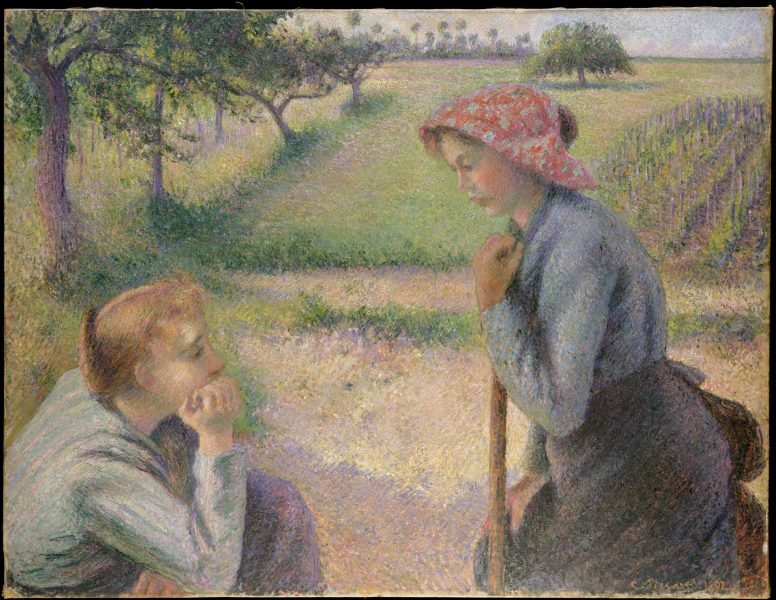
Ballet pantomime in one act premiered on 13th June 1905 at the Royal Opera House, London
Choreography: Richard Hague
Music: John Latham
Premiers Rôles
Justine: Harriet Linwood
Irène: Giulia Moretti
Plot
A village in the French countryside
Justine and Irène are both in love with Mathieu, who cannot decide between the two of them.
Their tranquillity is interrupted by the arrival of a nobleman Laurent and his mother Isabelle with their entourage. They have passed here riding and have decided to rest in the village. The peasants greet the nobles as Laurent notices Irène and becomes smitten with her. He pays her a lot of attention, much to Justine’s chagrin. She tries to flirt with him, but he is fixated on Irène.
To entertain the nobles (and to try and bring attention to herself), Justine implores the peasants to perform a dance. After the dance Irène brings on the children who perform a charming dance for the nobles. Laurent requests Irène dance and she refuses. Justine says she will dance instead to the horror of Mathieu. Irène now agrees to dance to annoy Justine. They dance a mazurka.
Isabelle decides it is time for them to leave and the party departs. Laurent gives Irène a kiss before he leaves.
After they have left, Justine confronts Irène who just says she is jealous about her new admirer. They fight and are interrupted by the arrival of Mathieu who stops them. Neither of them seems to want him anymore, not even Justine, who had been so smitten with him an hour before. Some of their friends arrive to show a beautiful cape that Laurent has left behind. The girls are excited as that means that Laurent will soon be back. They fight over the cape as to who will give it back to Laurent when he enters. Justine gives him the cape and he thanks her. He notices Irène on the other side of the scene and goes to her and they run off together. Justine is about to run after them when Mathieu catches her. He implores her to remember their love and she does, deciding to choose him over Laurent.
Laurent and Irène re-enter and one of their friends asks them to dance. Laurent also asks Justine and Mathieu to dance. They dance together. The friends celebrate with a lively galop.
As a horn is heard, Laurent realises he must go. He promises to see Irène again, giving her a ring as proof. He leaves and the peasants wave him goodbye.
History
Original Production
The Two Peasant Girls was created to be a diversion following an opera. Such diversions had been common since Thompson first re-introduced The Vivanidere and Diavolina in 1877. Since then, other diversions had been rotated in and out of the troupe’s repertory and Hague wished to add his contribution.
John Latham was commissioned by Hague as the composer, following Hague’s newly introduced strategy of abolishing the position of Official Composer of the Ballet Music (which he abolished in 1903 following the retirement of Auguste Péchard) to diversify the music for ballet.
Hague had met Latham as a consequence of the latter’s 1903 ballet The Queen of Carthage that premiered at The Alhambra. Latham was reportedly eager to get Hague’s critique of his work, and met with him after a performance that Hague attended. Hague suggested some revisions and debated intent and impact with Latham. The ballet was revived at the Alhambra the following year in 1904, and Hague was pleased to see that most of his suggestions had been actioned, and was especially pleased with Dido’s new variation.
Thus, in 1905 when Hague was to choreograph his third ballet The Two Peasant Girls at Covent Garden, Hague, always wishing to encourage new talent, approached Latham to provide the score. Latham eagerly accepted the commission, but was soon disappointed that his commission was to only be for a one act diversion. As compensation, Hague also commissioned him to revise the score of Thompson’s 1887 ballet The Amphitrite, for which his additions and revisions were similarly well received.
Hague deliberately included students in the ballet, choreographing the Danse des Enfants for them. However, records show that the pas was not always performed; as in some performances it appears to have been cut and in others it appears to have been danced. There is little indication as to why the inclusion of the pas fluctuated, but one might reason that it was due to time constraints (needing to shorten the ballet due to a long opera) or personal constraints (a student being ill or absent, for example).
The ballet was well-received and put Linwood in better standing than the revival of Yedda the previous year in 1904. The straightforward and pastoral narrative, though called trite by some, was generally considered to be engaging enough, especially so due to the dynamic between the four lead dancers.
Linwood refused to let anyone else dance Justine, but following her 1906 retirement the rôle of Justine was danced by Giulia Moretti and Jane Wheaton in the 1907 season, after which it was retired from the repertory.
Résumé des Scènes et Danses
1) Introduction
2) Scène Première
3) Scène – Entrée des Nobles
4) Valse Paysanne
5) Danse des Enfants
6) Petite Scène et Mazurka
7) Scène – Le Départ des Nobles
8) Scène – La Jalousie
9) Scène Dansante – La Réconciliation
10) Grand Pas de Quatre
a) Adage
b) Allegretto
c) Variation I – Laurent
d) Variation II – Irène
e) Variation III – Mathieu
f) Variation IV – Justine
g) Coda
11) Galop
12) Scène Finale
London Revivals
1912 Revival
In 1912 the ballet was revived for Jane Wheaton. Wheaton retired at the end of the 1912 season, dancing in The Pearl of Iberia for her benefit.
The following year in 1913 the promising sujet Alice Frost debuted in the rôle of Justine. The year of 1913 contained several debuts of sujets in leading rôles to whom Hague was giving opportunities: the debut of Frost as Justine in The Two Peasant Girls, the debut of Mathilde Casterman as Kathi in The Vivandiere and the debut of Johanna Overbeck as Mab in The Enchanted Island.