Fairest Isle
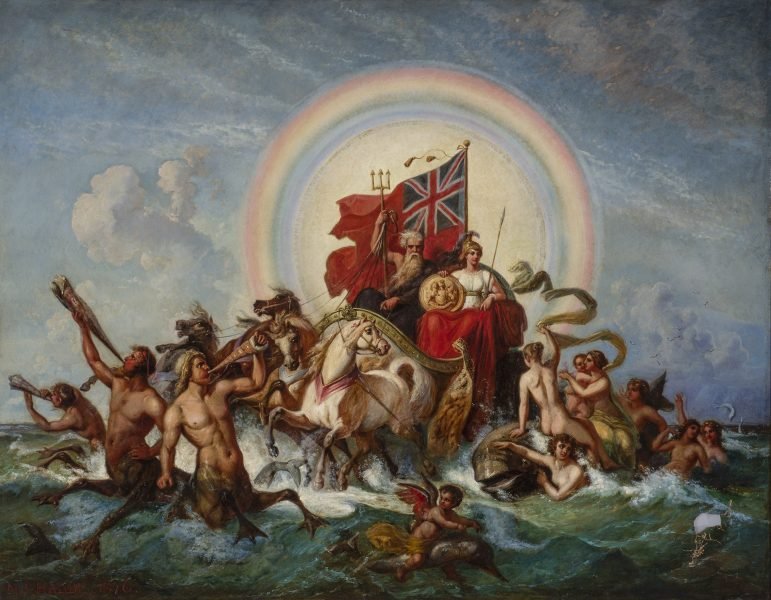
Ballet allégorique in one act premiered on 16th August 1902 at the Royal Opera House, London
Choreography: Richard Hague
Music: Auguste Péchard
Premiers Rôles
Britannia: Sarah Nicholson
Her Cavalier: James Elton
The Four Winds: Teresa Montoro, Elisabeth Charron, Helen Davenport, Sofia Zacchini
Commerce: Lily Clifford
Agriculture: Jane Wheaton
Science: Harriet Linwood
Art: Louise Grignon
Plot
Summary
The gods are assembled at Olympus.
Mercury enters with his suite, heralding the arrival of Britannia, having risen from the waves as the Fairest Isle.
Britannia enters with her suite. Included are her attendants: Commerce bearing a golden chest, Agriculture bearing a sheaf of wheat, Science bearing a cogwheel and Art bearing a palette.
Apollon prophesies the greatness that the island shall achieve as sovereign of the world.
The gods bestow gifts to Britannia. Neptune bestows her the trident, a symbol of dominion over the waves. Mars bestows her shield and helmet, a symbol of her martial victory. Minerva bestows her a lion, the symbol of kingship and courage.
Britannia displays before the god the wealth of her isle, that of Caledonia, Cambria, Hibernia, Albion and finally Britannia herself.
Jupiter and Juno herald Britannia as the greatest of all isles, crowning her with glory as the curtain falls on the final tableau: the Fairest Isle in her Olympean glory.
History
Original Production
Fairest Isle is a ballet allégorique in one act. The pièce d’occasion was created as part of the 1902 Coronation festivities at Covent Garden. The ballet was choreographed by Richard Hague to a score by Auguste Péchard.
Hague had initially not planned to create a new ballet for the coronation season. This was ostensibly due to the troupe’s wider repertory but also due to the fact that Hague did not much like Péchard and found him difficult to work with. Hague instead planned three revivals of existing works: Alice’s Adventures in Wonderland, The Swords of Toledo and The Corsair.
However, when he was informed that His Majesty’s Theatre was preparing a new ballet, the lavish three act Albion Triumphant (for Péchard had composed the music for one of the three acts) and The Alhambra Theatre was preparing to revive Arthur Sullivan’s Victoria and Merrie England, it became clear that Hague would be obliged to arrange a new ballet for the coronation festivities.
Thus, the revival of The Corsair was pushed to 1903 (later to 1904 due to Péchard’s retirement in 1903) and work on Fairest Isle was begun. Hague developed a scenario, gave Péchard instructions as to the music and began to choreograph the ballet. Nicholson, the most senior première at the time, was cast in the rôle of Britannia.
Péchard’s score included quotations of Purcell’s well-known song of the same name, as well as quotations of Rule Britannia!, The British Grenadiers and God Save the King.
Hague was notably detached from the production, delegating several dances to be arranged by his other balletmasters, though still overseen by him. His neglect initially drew the contempt of the theatre management, but Hague soothed their irritation by stating that he was aiming to give each of the balletmasters a chance to contribute to the glory of the nation. Nevertheless, Hague was not freed from creative oversight and was noted as still arranging some of the dances himself.
Originally, the ballet was intended to have its première at a gala held on the 3rd of July, a week after the planned coronation date on the 26th of June. However, when the coronation was postponed to the 9th of August, the gala had to be re-organised. The managers of the various London theatres met in haste to devise a plan to ensure that multiple galas would not be rescheduled to fall on the same date, allowing the royal family and upper classes to attend each in turn. Thus, it was decided that Covent Garden should hold its gala on the 16th of August, retaining the one week separation from the new coronation date.
The ballet was considered suitable, if a little uninventive, and functioned adequately as part of the gala performance.
Résumé des Scènes et Danses
1) Prélude
2) Grand Scène d’Olympe
3) Valse Mythologique
4) Scène – Entrée de Mercure et les vents
a) Entrée de Mercure
b) Danse de Mercure – Scherzo
c) Entrée des Vents
5) Scène Dansante – Entrée de Britannia et sa suite
a) Entrée de la Commerce
b) Entrée de l’Agriculture
c) Entrée de la Science
d) Entrée de l’Art
e) Entrée de Britannia
6) Scène Mimique – La Prophétie d’Apollon
7) Scène d’Action
a) L’Offre de Neptune
b) L’Offre de Mars
c) L’Offre de Minèrve
8) Les Peuples de l’île la plus belle
a) Les Calédoniens
b) Les Cambriens
c) Les Hiberniens
d) Les Albioniens
9) Grand Pas Classique
a) Entrée
b) Adage
c) Ballabile
d) Variation I [Mr Elton]
e) Variation II [Miss Nicholson]
f) Coda
10) Apothéose