Pas de Deux Valsé
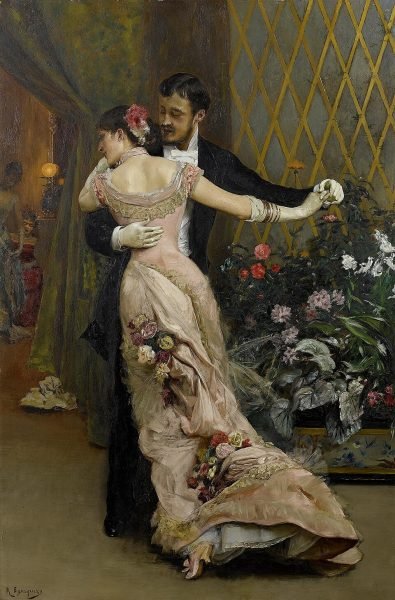
Premiered c. 1865 at the Celeste Theatre, London
Choreography: William Thompson
History
Original Production
The Pas de Deux Valsé is believed to have been choreographed by William Thompson early in his career. The composer is unknown but the pas is believed to have been staged c. 1865 during Thompson’s time at the Celeste Theatre.
Thompson revived the pas for Marta Draeger in 1890, where the pas was interpolated into the second act of a revival of Arthur Goring Thomas’ 1883 opera Esmeralda. The Covent Garden records mention that Thompson revised much of the choreography for Draeger and her partner Frederick Hale (which modern scholars believe to be plausible as both technical skill and choreographic tastes would have moved on from the 1860s to the 1890s). However, there is no record of the choreography and the pas only exists in a hastily scribbled-down reduction of a single melody line, assumed to be a rehearsal score for a lone violin. The music is just about readable (with some extrapolation), but only the melodic line is present in full, with sporadic references to the accompanimental figures and no dynamic markings or references to the orchestration.
The pas was digitised and published online in 2015 but the composer of the pas was still unknown. However, a blog post in 2025 detailed the theory that it might not have just been a waltz for a couple (as had been previously thought) but a classically structured four part Pas de Deux set to waltz music. The blog post noted that the waltz could be split quite neatly into four sections, which both musically and structurally could correspond to four parts of a classical Pas de Deux (an opening duet, a variation for the male dancer, a variation for the female dancer and a coda). There have even been a few attempts by interested amateurs to fill in the accompaniment, with one enthusiast publishing his rendition of the work arranged for piano (with his theorised accompaniment), though the video does not seem to have gained much traction.
This fragment offers scholars a rare glimpse into Thompson’s early career, which he seems to have rarely revisited (save for the 1887 revival of his 1876 ballet The Harvest Festival) after moving his troupe to Her Majesty’s Theatre.