Auguste Péchard
Successor of François Bardet, composer of William Thompson's mature works
History
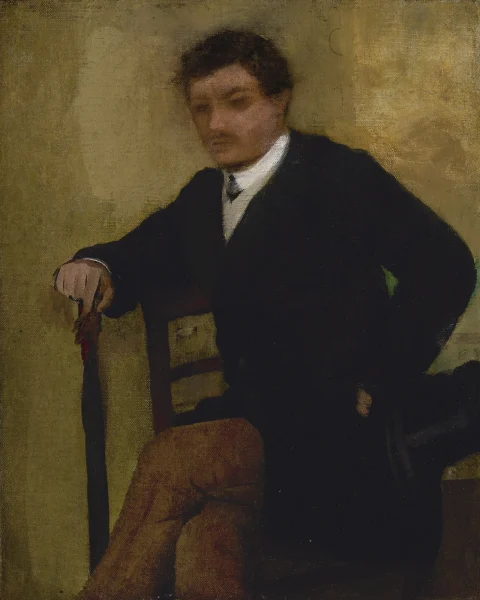
Auguste Péchard was born in Toulouse, France in 1853. He trained first in Toulouse, then Paris, before moving to London in 1876. He worked at various London theatres until 1881, when he secured a position as a copyist at Her Majesty’s Theatre under François Bardet. He eventually became Bardet’s main assistant and when Bardet moved to Covent Garden in 1887 with William Thompson, Péchard, along with the vast majority of the troupe, moved theatres.
Following Bardet’s departure in 1888, Thompson (at Bardet’s suggestion) appointed Péchard to the position of Official Composer of the Ballet Music to The Royal Italian Opera at Covent Garden. He, like Bardet, was principally required to revise, rearrange and supplement scores for Thompson, shaping them to be more in line with Thompson’s artistic vision. Bardet’s revisions were always used as a starting point, due to both the public’s and Thompson’s familiarity with them, and in such cases Péchard was principally required to embellish them with new pas or variations rather than making further large structural changes.
However, Péchard was not to be relegated purely to revivals and also supplied the music for some of Thompson’s and later Richard Hague‘s (Thompson’s successor) original ballets. Following the warm reception of Thompson and Bardet’s 1888 Élodie or The Fairy of the Forest, the Covent Garden theatre management saw that there would be an audience for newly created works rather than revivals of previously established works. The first ballet that Thompson and Péchard created together was Alice’s Adventures in Wonderland in 1890. The ballet féerie in three acts and seven scenes aimed to emulate the spectacle of the St Petersburgian masterpieces, a goal which was moderately well achieved. Following this, the pair created the ballets of Pygmalion in 1893 and The Swords of Toledo in 1896, the latter of which was arguably considered to be both Thompson and Péchard’s magnum opus.
Péchard, though formally attached to Covent Garden, also wrote music for other theatres. He was, through Thompson, acquainted with Jean D’Auban, balletmaster at the Gaiety Theatre (from 1868 to 1891) and The Theatre Royal, Drury Lane (from 1876 the early 20th century). D’Auban would occasionally commission Péchard to provide supplemental pieces for new revivals (principally at Drury Lane) but unlike Thompson, D’Auban preferred not to attach himself too strongly to one particular composer.
In 1883 Péchard married Susan Gill, a seamstress at Covent Garden. They had two children together: Matilda (b. 1885) and Charles (b. 1888). Though Péchard insisted on retaining the accent on his surname (something which he continually fought with journalists and printers over), his children eventually dropped the accent.
In 1896 Thompson retired as balletmaster and was replaced with Richard Hague. Hague and Péchard did not get along well; Hague regarded Péchard as old-fashioned, uncompromising and proud, while Péchard regarded Hague as inferior to Thompson and never did come to quite respect him as he had done his predecessor. This dynamic was largely to blame for the absence of new scores following Thompson’s retirement, as Hague chose to focus on revivals rather than new works, for which Péchard contributed supplemental additions and revisions. However, Hague also began to rely more and more on the Royal Ballet’s (as the troupe had been renamed in 1892) existing repertoire, interpolating older variations and pas into new works instead of commissioning them from Péchard.
In 1903 Péchard decided (amidst backstage pressure from management due to Hague’s complaints) that it was time for him to retire. For his benefit, a new ballet was to be created to his music. Hague, despite his personal grievances, was obliged to choreograph the ballet. Péchard had held the position of Official Composer of the Ballet Music since 1888 and had contributed additions to nearly every ballet in the repertoire. Thus, a new ballet for his farewell benefit was an expected concession, one the theatre management was not likely to deny Péchard.
The creation of Tristan and Yseult (as the ballet was decided to be called) was not nearly as smooth as Péchard’s collaborations with Thompson had been. Hague was more forward-thinking than Thompson, and annoyed Péchard with his repeated requests for rewrites of sections of the music that Péchard provided. As such, the première of the ballet had to be delayed by two weeks, but it still played to a full house. The ballet was unfortunately not as well received as Péchard might have hoped, with critics lamenting Hague’s choreography and “over-realistic” structure. Nevertheless, no fault was found with Péchard’s music, though its lukewarm reception was noted as less than a fitting end to the career of a man who had contributed so much to British ballet.
Ballets
Works for Covent Garden
Original Scores
- Alice’s Adventures in Wonderland (1890)
- Pygmalion (1893)
- Bacchus and Ariadne (1895)
- The Swords of Toledo (1896)
- Fairest Isle (1902)
- Tristan and Yseult (1903)
Revisions to Existing Works
- The Corsair (1889, 1897) – original score by Adolphe Adam (1856) in Bardet’s 1881 revision
- Faust (1889) – original score by Giacomo Panizza (1848) in Cesare Pugni’s 1854 revision
- The Wayward Daughter (1890) – original score by Peter Ludwig Hertel (1864) in Bardet’s 1886 revision
- The Beauty of Ghent (1891) – original score by Adolphe Adam (1842)
- The Peri (1892) – original score by Friedrich Burgmüller (1843)
- Sylvia (1892) – original score by Léo Delibes (1876) in Bardet’s 1886 revision
- The Fairies’ Goddaughter (1893) – original score by Adolphe Adam (1849) in Bardet’s 1882 revision
- Esmeralda (1894) – original score by Cesare Pugni (1844) in Bardet’s 1878 revision
- The Devil to Pay (1894, 1900) – original score by Adolphe Adam (1845) in Bardet’s 1883 revision
- The Sylph (1895) – original score by Jean Schneitzhoeffer (1832)
- The Harvest Festival (1895) – original score by John Plummer (1876) in Bardet’s 1887 revision
- The Buccaneers (1896) – original score by Theodore Labarre (1853) in Bardet’s 1883 revision
- The Enchanted Island (1896) – original score by Arthur Sullivan (1864)
- Giselle (1898) – original score by Adolphe Adam (1841) in Bardet’s 1888 revision
- The Two Pigeons (1898) – original score by André Messager (1886)
- Naïla (1900) – original score by Léo Delibes and Léon Minkus (1866)
- Ondine (1901) – original score by Cesare Pugni (1843) in Bardet’s 1887 revision
- Yedda (revised 1903, premièred 1904) – original score by Olivier Métra (1879)
Works for Other Theatres
- Variation for Lapis Lazuli (1892)
- For the Pas des Bijoux of a revival of Georges Jacobi’s Ali Baba (1882) at The Theatre Royal, Drury Lane, revived by John D’Auban
- Divertissement: Bacchus and Ariadne (1893)
- Interpolated into Act 4, Scene 2 of Gounod’s Roméo et Juliette for the state performance of the Wedding of the Duke of York and Princess Mary of Teck. Later expanded as a one-act ballet anacréontique for the Royal Ballet School in 1895
- Two Variations for Juliana (1894)
- For a revival of Jean Morel’s Her Ladyship’s Joke (1873) at The Theatre Royal, Drury Lane, revived by John D’Auban. The variations were requested by the Italian première danseuse herself, as she was dissatisfied with the original music and was impressed by Péchard’s 1893 score for Pygmalion
- Pas de Six (1895)
- For the second act of J. Comyns Carr’s King Arthur at The Lyceum Theatre
- Pas de Deux (1895)
- Originally written for Sarah Nicholson for the 1895 revival of Coppelia at Covent Garden but never used, later interpolated into the 1900 revival of The Devil to Pay
- Valse des Rêves (1896)
- For a revival of Paolo Redolfi’s La Rosa d’Argento (1876) as The Silver Rose at The Theatre Royal, Drury Lane, revived by John D’Auban
- Incidental Music (1897)
- For the premiere of the English translation of Victorien Sardou’s Madame Sans-Gene at the Lyceum Theatre with Ellen Terry and Henry Irving. Péchard had originally been selected to provide incidental music for the 1896 revival of Shakespeare’s Cymbeline. However, the manager of the theatre decided instead to arrange a pastiche score of pre-existing music, and as compensation for losing the Shakespeare, Péchard was compensated with the Sardou
- Dances of the Snowflakes (1899)
- For a A Journey Through Winter, a Christmas pantomime choreographed by John D’Auban for The Gaiety Theatre
- Pas de Deux (1900)
- For a revival of Katti Lanner and Hervé’s Cleopatra (1889) at The Theatre Royal, Drury Lane, revived by John D’Auban
- Albion Triumphant (1902)
- Composed the second act, titled The Georgian Era, a lavish three act pièce d’occasion created the Coronation Gala at His Majesty’s Theatre. Each the music of each act was supplied by a different composer, with Péchard supplying the music for the second act