Ellinor oder Träumen und Erwachen
Or Ellinor or Dreaming and Awakening
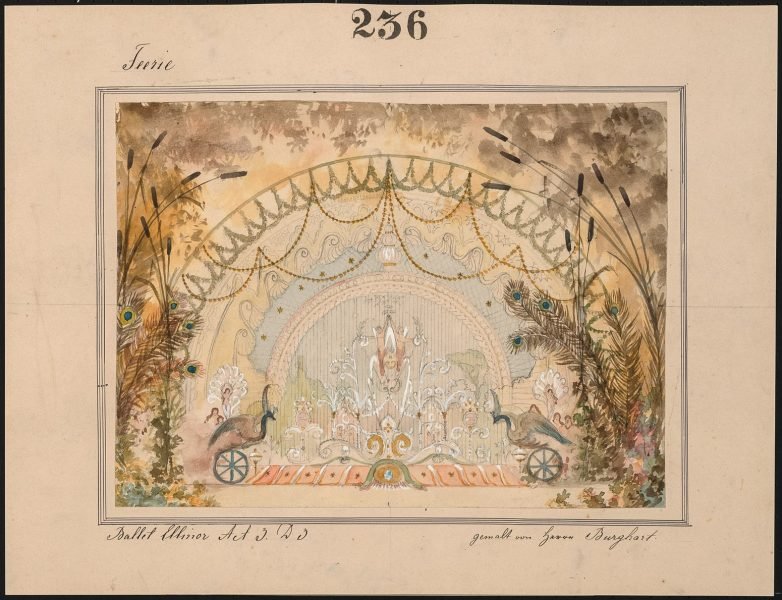
Ballet fantastique in three acts and seven scenes premiered on 19th February 1861 at the Königliche Oper, Berlin
Choreography: Paul Taglioni
Music: Peter Ludwig Hertel
Premiers Rôles
Lady Ellinor: Marie-Paul Taglioni
Plot
Summary
Acte 1 – In Holland
Scène 1 – The Ideal – An atelier
Men and women, serving as models for the painters, form groups. Painters’ assistants are busy with grinding paints, preparing palettes, and the like, while idle models rest or are engaged in games and conversation. Master Van Baaker explains the composition of a painting to some students. Other students are busy sketching the tableau formed by the models. The master withdraws, whereupon the students throw aside their brushes and palettes and carry out all sorts of foolish pranks, in which the assistants participate. Only the dreamy Albert remains standing thoughtfully before his easel.
One of the girls serving as models, Rosa, questions an assistant about Albert’s dreamy nature, whereupon the assistant remarks that the young man suffers from the siren dream of having to see Naples and, lacking the means to travel there, has almost lost his mind.
Meanwhile, a model dressed as a judge has seized a violin and begins to play merry tunes, whereupon students, assistants, and models begin a joyful revelry.
Then the clock strikes three. Instantly, the group puts aside their studio suits and costumes, hurries to the dressing room, and returns in ordinary clothes to leave.
Albert remains alone. The boisterous activity has only briefly awakened him from his reverie; he hardly notices his companions leaving and remains standing thoughtfully before his portrait.
Then, Master Van Baaker appears with a young lady, Lady Ellinor, who is accompanied by her ardent, foppish admirer, the Marquis di Monte-Fiore.
The master lets the strangers look at some paintings, especially the one Albert is painting, during which Lady Ellinor reveals a particular interest in the painter; Albert reciprocates this interest.
After the strangers have departed for the adjoining rooms, Rosa returns with a friend; both invite Albert to join them at the fair, an invitation Albert declines, whereupon they depart again, making snide remarks about Albert’s eccentric mood.
Albert is scarcely alone when he falls back into his old melancholy, especially because the strangers have not bought his painting, and the deepest desire of his soul—to see Naples, Italy—must remain unfulfilled.
In vain he tries to summon himself to work again; he lacks the strength and desire. Exhausted, he sinks down and buries his head in his hands.
(The Vision)
Then, suddenly, fantasy appears to him in an enchanting form, bearing the features of Lady Ellinor and she holds a lyre in her arms, from whose strings she coaxes gentle chords.
She approaches Albert, who, as if revived, rises and enthusiastically seizes brush and palette.
Imagination encourages the artist and follows his work with sympathy; Albert himself is delighted with the success of his work, and while he continues to paint with growing enthusiasm, genius appears. This genius seizes the lyre, which imagination bestows upon it, and coaxes magical tones from it—from which both apparitions suddenly vanish again, and the gloomy reality of before surrounds him.
Rosa enters and approaches Albert with sympathy, indicating that she is well aware of the reason for his melancholy; at the same time, she pulls out from his portfolio a view of Naples, beneath which, in large print, are the words: “Vedi Napoli e poi muori” (See Naples and then die). She believes she has comforted him by the sight of the picture and begs him to now forget the idea of the trip.
Van Baaker returns to the studio with Lady Ellinor and the Marquis. The latter sees the painting Albert has just completed and, to his surprise, recognises Lady Ellinor’s features in it, scrutinising the artist with jealous glances. Then he notices the attractive figure of Rosa and approaches her with coquettish flirtation; but Rosa hardly notices him.
He, however, is not deterred, and conceives the idea of persuading Lady Ellinor to take Rosa into her service; he flatters himself that he will later succeed in winning this girl. Lady Ellinor seems to agree to the Marquis’s proposal, but her interest remains primarily focused on the young painter, and scarcely is his wish and longing to see Italy and Naples revealed to her, when she steals his painting and thus creates the means to carry out the project.
With ironic condescension, the Marquis hands the painter the money and hastened to take the lady away with him; but before he could do so, Ellinor once again cast a sympathetic glance at Albert. This attention did not escape him, and he was filled with delight. Only when Ellinor had departed did Albert turn his attention back to the gold pieces and display the most unrestrained joy. Hastily, he now grabbed his coat, hat, and sword, hurried to his portfolio, pulled out the sheet with the inscription: “Vedi Napoli e poi muori” (See Naples and then die), triumphantly raised the sheet and gold as a sign that his ideal would soon be achieved, and hurried off.
Scène 2 – The Love Token – A public square at the port
Lively movement. Domestic and foreign sailors, soldiers, citizens, women, girls, children, etc., enliven the scene.
Jugglers and quacks seek to attract the attention of the people.
Albert steps forward, prepared for his journey.
He turns to some sailors for information about the departure of a ship; they refer him to the current captain, who quickly consults with Albert and agrees on the fare.
A group of merry companions from the painter’s studio arrives and surrounds Albert, hearing with astonishment that he intends to leave the country.
While Albert explains the purpose and destination of his journey, Lady Ellinor emerges from the background, where she has overheard Albert’s conversation with the captain, and approaches the latter.
She tells him of a request concerning Albert, and the captain most readily agrees to fulfil her wish.
Ellinor happily goes to the nearby hotel and soon appears on its balcony.
Here she sees Albert, after he has barely managed to fend off his sympathetic friends, and immediately recognises her as the charming lady to whom he is so deeply indebted. Longingly and gratefully, he looks up at the adored apparition, and Lady Ellinor also turns her attention to him. Then her fan falls from her hand, and Albert hurries under the balcony to retrieve it.
But when he tries to return it to the beautiful stranger, covered in kisses, she has vanished from the balcony, and he tries in vain to enter the locked hotel.
Unhappy about this, he is surprised by a rushing throng of dancers and his plan to reach the hotel is interrupted.
(Dance Divertissement – National dances)
Meanwhile, evening has fallen. The crowd disperses. Then, with renewed vigour, Albert feels the desire to see his beautiful stranger once more before he is to board a ship, and he knocks again on the hotel’s door; it opens, and out steps the Marquis, gruffly asking what Albert is doing there.
Albert is outraged by the provocative nature of the question and manfully rebuffs the Marquis’s haughty behaviour, which prompts the latter to draw his sword and brandish it threateningly at the painter.
But he defends himself so well against the attack that the Marquis recoils in fear and calls for help.
Servants, armed with sticks, rush forward and press Albert, who bravely defends himself; but he soon receives help from friends who rush to the scene, and the Marquis and the servants are driven back into the hotel.
Then the ship’s bell rings, those waiting hurry to the ship, and Albert must follow it so as not to miss its departure.
Once more he casts longing glances back at the balcony, where Lady Ellinor has meanwhile reappeared, and boards the ship, which immediately sets sail with full sails.
Acte 2 – In Italy
Scène 1 – The Attack – A wooded area
Lady Ellinor’s steward appears with several servants disguised as bandits. Armed gangs follow.
Casini informs them that a young painter will be coming along the road whom they are to ambush and rob of his cash.
He rewards them generously in advance for their assistance.
No sooner has this been done than a boy posted as a sentry reports that the young traveler is approaching. At the same time, the jingling of a mule’s bell is heard.
Casini and his companions hide.
Albert enters. He indicates to the mule driver who is escorting him that he wishes to rest for a while in this romantic landscape; the mule driver, meanwhile, may also find a place to rest nearby.
Left alone, Albert pulls out his sketchbook and begins to sketch furtively. A wistful grin for the ideal of his heart overcomes him.
Then a shrill whistle sounds. Those recruited by Casini rush out, ambush the young painter, rob him, and flee.
Albert is stunned with shock for a few moments. When he recovers, he soon realises the full extent of the misfortune that has befallen him. He misses his purse—and with it, the means to continue his far-reaching journey.
To his pain is added a deep melancholy at the treachery of humankind, for even the mule driver has deserted him;—only from afar can one still hear the sound of its bells. In this misfortune, it is of little comfort to Albert that the noughts at least left him his sword. He takes it and regains his courage; so he decides to continue his journey.
As he departs, the lady’s steward reappears with the disguised servants and instructs the latter to follow Albert unnoticed and to watch over him with the utmost care.
Scène 2 – The Reunion – Ellinor’s villa
The young gondoliers and their girls celebrate Lady Ellinor’s happy return and offer their homage.
After them, the Marquis appears; he presses the Lady to finally explain herself and give him her hand in marriage. Lady Ellinor makes it clear to him that she permits his company, but feels no love for him yet.
Monte-Fiore is embittered by this indifference and suggests that he suspects the reason for it: her rash affection for the young painter is to blame for everything. The Lady quickly puts an end to these accusations, withdraws to the pavilion, and locks the door behind her. During this, Rosa appears to deliver an important secret message, but cannot reach the Lady in the Marquis’s presence.
Only after the Marquis has departed does she hurry after the Lady into the pavilion.
The steward appears, casting searching glances at the scene; he hides himself.
Soon after, Albert arrives, exhausted by exertion, his only remaining solace in the thought of his beloved. He sinks down, weak, on the steps of the pavilion. Then it seems to him as if he hears enchanting sounds of a harp; sweet memories surface, he feels as if he is being invoked and lifted by new strength; but the sounds fade away again and Albert collapses without restraint.
Lady Ellinor and Rosa emerge from the pavilion. The former is deeply moved to see the young painter in such a state. Rosa and the approaching steward reassure the Lady that it is only exhaustion that has put Albert in this sad state. A tonic is administered, and the Lady and Rosa retire to the pavilion. Albert recovers, feels invigorated, and wants to continue his walk. Then, as if by chance, the steward appears, hospitably invites him into the house to rest, and Albert gratefully accepts the invitation. The two have scarcely entered the villa when the Marquis Monte-Fiore appears, carrying a flower basket and a white dove. He intends to serenade the Lady and then release the dove, with a dish tied around its neck, through the open bedroom window. He beckons some musicians, and the serenade begins.
(Serenade)
Immediately, spurred on by the music, playful girls appear and disturb the stall, which the Marquis initially finds very inconvenient; but when he takes a closer look at the charming children, he himself joins in their jests and their playful banter. In this amusement, the Marquis is suddenly interrupted. He sees Albert in the background. Beside himself, he rushes towards him and orders them to leave the scene immediately. The mutual excitement reaches a high level when Rosa appears, in the magnificent gown of a lady, while Ellinor herself wears the simple dress of a peasant girl. The Marquis is surprised and confused by this double disguise, the purpose of which he cannot explain. Albert intently observes the two women and takes Rosa for the lady, with whom, he suspects, the Marquis has a close relationship.
Meanwhile, Lady Ellinor has given her servant a nod and signalled to the Marquis to accompany Rosa. He initially resists, but must obey the Lady’s command; he departs angrily, having to return the young painter to Lady Ellinor. Albert then discovers with astonishment the resemblance in the supposed peasant girl to the feminine ideal of his heart. Lady Ellinor is touched; she presents him with his portfolio, from which she produces a fan, in which she recognises the one Albert had received from her on the day of his departure. At her question as to where he got this treasure, he presses the fan to his heart and swears that this gift comes from a being who appears to him as the highest in this world and who bears a striking resemblance to the Lady. Lady Ellinor takes the fan and begins a playful dance.
Then the Marquis returns with Rosa. The sight of Albert arouses his envy anew. Ellinor seeks to put an end to the jealous scene and departs, followed by the Marquis. Rosa approaches Albert and invites him to participate in a small celebration. Both step onto a veranda.
(Dance Divertissement)
After the dance, Albert thanks them for their hospitality and intends to continue his journey. At the Lady’s command, he is offered a farewell drink; however, it contains a sleeping potion. Albert empties the glass, takes his leave, and prepares to depart; but scarcely has he taken a few steps when he is overcome by slumber and has the following vision: He believes he sees the otherworldly figure of Lady Ellinor as she had first appeared to him in the painter’s studio.
Longingly, he spreads his arms towards her and wants to sink down at her feet; then his senses
leave him, he becomes unconscious. At a signal from the housekeeper, a barge appears in the background; the gondoliers carry the slumbering Albert into it and row him away, while Lady Ellinor, touched and loving, follows the barge with her eyes.
Acte 3 – In Naples
Scène 1 – The Dream – The Gulf of Naples
The barge with the sleeping Albert and the two gondoliers, guided by the goddess of the fine arts, approaches. She leaves the barge, conjuring up rapturous images in Albert’s mind, and sinks into the sea. Large and small ships enliven it, and the most interesting spots of the gulf appear; first Pozzuoli and Punta di Posilipo. Further in the distance comes Mergellina, then the Villa Reale and Giardini Publici, Castel dell’Ovo, Naples in its entirety, Portici, Torre del Greco, Mount Vesuvius, Torre dell’Annunziata, Castella Mare, Vico, and Sorrento; finally, the mighty cliffs of Capri. Albert’s enchanting dream takes another turn.
Dream figures appear, among whom Albert believes he recognises his enigmatic lover. He hastily leaves the boat, but already the apparitions have vanished again.
Saddened by his dashed hopes, he staggers back to the boat; then the rocks open, and the Blue Grotto of Capri reveals itself in its full splendour.
Scène 2 – The Dream Continues – The Blue Grotto
Albert had barely recovered from the surprising sight of this natural wonder when his attention was drawn to the dream figures that had reappeared, now shrouded in veils. They playfully toy with him, a veil lifting here, then there, revealing the image of his beloved, only to quickly hide behind it again as soon as he hurried towards it. Several times he thought he had caught sight of his beloved, lifted the veil, but was always deceived. Finally, his ardent wish was fulfilled; he held his longed-for woman in his arms, gazed into her precious garment, and the stolen ribbon she held out to him convinced him that he saw his ideal before him. Finally, Albert grew weary; he staggered towards the boat and sank into it; the beautiful dream was over, and deep sleep took hold of him.
The dream figure ties the ribbon to his arm, guides the barge, and while her companions disappear, groups of nymphs rise from the water, surround the barge, and accompany it as it glides gently over the waves.
Scène 3 – The Awakening – View of Naples from Capo di Monte
In the foreground is the richly flowered shrine of the Madonna dell’Arco, where a wedding (as Madonna dell’Arco is the protector of brides) is to take place. Merchants of all kinds await the people, who arrive noisily and in a festive procession. Suddenly, the ringing of bells announces the approach of a bridal procession. Lady Ellinor is the bride.
She has decided to give her hand to Albert, but first to receive the blessing of the saints.
She descends to the Madonna and offers her prayer. Hardly has it finished when the steward, Casini, announces Albert’s arrival.
He hurries over. Overcome with confusion and wonder at the sight of the festive gathering, the heavenly scene, he is bewildered; he believes himself still surrounded by wondrous dreams.
Then Lady Ellinor appears to him as a charmingly adorned bride. He falls at her feet. Lovingly, she raises him up and gives him her heart and hand.
The people enthusiastically show their joy, and a tempestuous tarantella concludes the jest and the ballet.
History
Original Production
Ellinor oder Träumen und Erwachen is a ballet fantastique choreographed by Paul Taglioni to a score by Peter Ludwig Hertel. The ballet originally premièred on 19 February 1861 in three acts and six scenes, with Taglioni’s daughter Marie-Paul Taglioni (also known as Marie the younger) as Ellinor. Paul Taglioni was the brother of the legendary Marie Taglioni of La Sylphide fame, making her the aunt of Marie-Paul.
Ellinor was a popular ballet and remained in the Berlin repertory until 1872, when it was performed for the final time in its original staging and would be staged into other European cities.
Selected Revivals
1861
Location: Teatro alla Scala, Milan
Staged for Amina Boschetti under the title of Ellinor, ossia Vedi Napoli e poi mori. The ballet was expanded to three acts and eight scenes.
1873
Location: Teatro Regio di Torino, Turin
Staged for Carolina Pochini under the title of Ellinor, ossia Vedi Napoli e poi mori. The ballet was staged in three acts and six scenes.
24 March 1873
Location: Wiener Hofoper, Vienna
Staged for Guglielma Salvioni under the original German title. The ballet was staged in three acts and six scenes. It was retained in the repertory until 1880.
1877
Location: Teatro alla Scala, Milan
Staged by Josè Mendez for Rosita Mauri under the title of Ellinor. The ballet was expanded to three acts and eight scenes.
Berlin Revivals
1890 Revival
In the summer of 1890, Emil Graeb, director of the ballet in Berlin at the Königliche Oper, had travelled to London to see Marta Draeger dance at the Royal Opera House in London. He attended performances of Les Aventures d’Alice au Pays des Merveilles and La Fille mal gardée, in which Draeger portrayed the rôles of Alice and Lise respectively.
Graeb was impressed by her performance, and sought an introduction with her. Over the course of several conversations, he offered her a contract to dance in Berlin for the 1890/1891 winter season. Draeger was, of course, delighted by the offer, and having cleared the necessary permissions with the Royal Opera House she eagerly accepted the invitation to return to her native theatre.
Her debut was set to be in Ellinor oder Träumen und Erwachen, a ballet revived for her by Graeb in three acts and seven scenes. It was a Taglioni-Hertel ballet and was successful in its own time, remaining in the repertory for several years and being exported to other cities.
As the ballet had not been seen in Berlin since 1872, it was an ideal candidate for her debut as it had faded from the public memory. The reigning prima ballerina in Berlin, Antonietta Dell’Era, had no objections to the revival, as the ballet was not within her repertoire nor did she have any wish to obtain it.
Unlike five years prior, Dell’Era seems to have shown little hostility to Draeger when she arrived in Berlin in the winter of 1890. Draeger had in fact begun her career in Berlin, but due to no ballerina positions being available at the time (in no small part due to Dell’Era’s apparent dislike for Draeger) she had taken a leave of absence in 1885 to tour Europe with a touring ballet troupe, leading to her being invited by William Thompson to become première danseuse at Covent Garden in 1886 and thus not renewing her Berlin contract.
In fact, Dell’Era’s response could be more appropriately called indifference. This could potentially stem from the fact that Draeger was already secured as a première danseuse at the Royal Opera House in London, and so, as a guest, she was no longer a threat to Dell’Era’s own position of prima ballerina in Berlin.
Draeger did well in Ellinor and in the Walpurgisnacht scene of Gounod’s Faust, in which she also danced during the 1890/1891 winter season. She received good reviews for her performances, and as such she was invited to return the following year, when Satanella oder Metamorphosen was revived for her in the 1891/1892 winter season.
Rôles
Lady Ellinor: Marta Draeger
Musical Revisions
A new Pas de Deux was added for Draeger in the second scene of the second act, replacing Hertel’s original Pas de Deux.
A new Variation was added for Draeger in the Ballabile des Voiles of the second scene of the third act.
Résumé des Danses
Acte 1
Scène 1 – The Ideal – An atelier
Scène Dansante des Modèles
- Rosita, Albert
- Corps de ballet
La Vision
- Ellinor
Scène 2 – The Love Token – A public square at the port
Ballabile Caractéristique
- Corps de ballet
Tarentelle – Pas de Caractère
- Ellinor, Cavalier
Acte 2 – In Italy
Scène 2 – The Reunion – Ellinor’s villa
La Mandolinata
- Monte-Fiore
- Corps de ballet
Ballabile des Fleurs
- Corps de ballet
Pas de Deux
- Ellinor, Cavalier
Acte 3 – In Naples
Scène 2 – The Dream Continues – The Blue Grotto
Ballabile des Voiles
- Ellinor, Albert
- Corps de ballet
Scène 3 – The Awakening – View of Naples from Capo di Monte
Grande Marche Dansée et Tarentelle
- Tout le monde