Satanella oder Metamorphosen
Or Satanella or The Metamorphoses
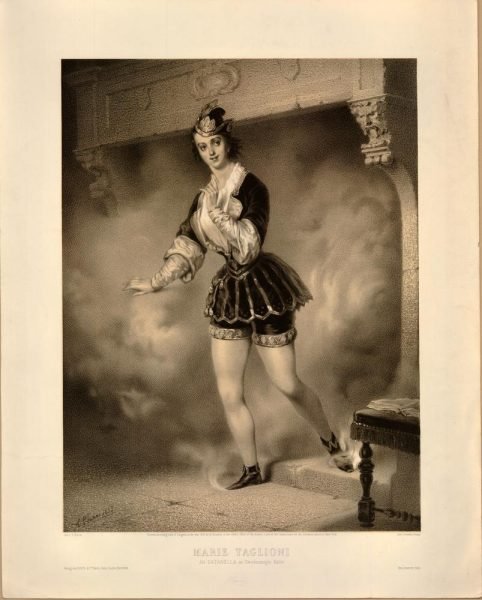
Ballet fantastique in three acts and four scenes premiered on 28th April 1852 at the Königliche Oper, Berlin
Choreography: Paul Taglioni
Music: Cesare Pugni and Peter Ludwig Hertel
Premiers Rôles
Satanella: Marie-Paul Taglioni
Plot
Summary
Acte 1
A high and wide hall belonging to the student Carlo’s apartment. On the left, a bookcase. Below it, a writing desk. Next to it, an armchair.
In the background, a cupboard; above it hangs a picture depicting the devil in full figure. Then, a large Gothic door with two leaves. Above the door, a window. This door leads into the vestibule, where the banister to the staircase leading to the Count’s apartment is located.
In the background, a clock with a wooden case. To the sides and on the walls are pistols, crossed rapiers, fencing gloves and a mask, a cloak and a student’s beret. To the right, a fireplace. Close by, a table and chairs covered with a green carpet. On the table, books.
The act opens in Carlo’s study, filled with symbols of his dual life: books and fencing gear alongside a portrait of the devil. From a sudden burst of flames in the fireplace, Satanella emerges. She ransacks Carlo’s desk and finds a Kabbalistic talisman, the only thing that could make her dependent on a mortal, and hides it. She vows revenge on Carlo for past wrongs before vanishing as he arrives.
Carlo enters in a state of ruin, having gambled away all his money. His empty pockets drive him to a mix of despair and forced bravado. He is soon confronted by Stephano, an officer seeking payment for a gambling debt. Carlo promises to pay once he marries Bertha, the daughter of Count Montenero.
When the Count and Bertha arrive, the Count is disgusted by the sight of cards and dice. He threatens to break off the engagement due to Carlo’s lifestyle. Bertha pleads for him, but the Count remains unconvinced. Shortly after they leave, a rowdy group of students and girls burst in to drag Carlo to a masked ball. Though he initially resists, they force him into a dance. The Count returns, sees the chaos, and looks upon Carlo with total contempt, further ruining Carlo’s reputation.
Left alone and locked in his room (at his own request to prove his fidelity to Bertha), Carlo is visited by Satanella, now disguised as a charming young girl claiming her candle went out. She seduces him into dancing and invites him to the masked ball, giving him a red ribbon as a signal.
After she leaves, Bertha returns. She is jealous, having seen the girl depart, but Carlo distracts her with wedding gifts he has supposedly prepared. To prove his commitment, he has her lock him in his room from the outside.
Now truly alone, Carlo realizes the Kabbalistic page is missing from his book. In a rage, he shoots the portrait of the devil. The image transforms into Satanella. She reveals a mystical inscription: If Carlo remains faithful to his bride for just three hours, his soul will belong to Satan. Satanella mocks him and displays her supernatural power. When Carlo grows hungry, she conjures a magical, albeit terrifying, banquet served by a troop of demons. Flames shoot from wine bottles and devil heads pop out of the fruit baskets.
Exhausted, hungry, and intoxicated by the magical wine, Carlo succumbs to a heavy sleep. As he drifts off, the little devils surround him. They begin to magnetise him with gestures and, while he is still unconscious in his armchair, they carry him away to the masked ball to face his fate.
Acte 2
A richly decorated flower garden. A masked ball.
The act begins in a richly decorated flower garden filled with masked dancers. Carlo, masked, arrives in a state of high anxiety, searching for the “young girl” from his room. When Satanella appears in her red and black domino, he is overjoyed and dives into the festivities with her. In a fit of reckless abandon, he publicly renounces Bertha, declaring to his mocking student friends that he has no bride but this “charming little devil.”
The plot thickens when Count Montenero arrives and sends a domino costume to his daughter, Bertha, so she may join the ball. She overhears Carlo and Satanella’s antics and so seeks to prove Carlo’s infidelity and debauchery.
This begins a trap of mistaken identity as both Bertha and Satanella are wearing identical costumes.
As the Quadrille begins, Stephano escorts Bertha (though he does not know her identity) and Carlo escorts Satanella. Meanwhile, Satanella exchanges places with Bertha and begins flirting with Stephano to provoke Carlo’s jealousy. She continues alternating places with Bertha so as to further confuse Carlo. Carlo becomes increasingly distracted during the quadrille, making mistakes in the dance in growing frustration as his partner “Satanella” (who is actually Bertha) acts with cold reserve, while the other woman (the real Satanella) animatedly receives Stephano’s affections. Thus, Carlo begins to believe that the lady he is dancing with is in fact not Satanella, but that Satanella is instead on the arm of Stephano and had thus been unfaithful to him.
The climax occurs when Satanella, in a calculated move of contempt, obliges Stephano’s request and tears off the red ribbon Carlo gave her and throws it to the ground. Carlo believes Satanella to have betrayed him, and so, blinded by rage and jealousy, rushes forward and forcibly unmasks the lady beside Stephano.
However, the lady is revealed to be Bertha, who is humiliated by the unmasking. Stephano then unmasks the lady that Carlo was with, who is revealed to be Satanella, who feigns confusion. As such, it is revealed to all that Carlo has escaped his locked room and has appeared at the ball with another lady other than his fiancée, attracting contempt from Bertha and Count Montenero.
The Count is final in his contempt and judgement, rejecting Carlo’s pleas for mercy. Bertha, heartbroken, turns away from Carlo and leaves with her father.
Left humiliated and vulnerable, Carlo’s fury turns toward Stephano. The two men exchange a challenge for a duel after Stephano strikes Carlo with his glove.
As Carlo stands in utter despair, watching Bertha walk away without a single backward glance, Satanella reappears. She mocks his misery with a smile and opens her arms to him. Broken and having lost his chance at redemption with Bertha, Carlo finally surrenders and sinks into Satanella’s embrace as the ball continues around them.
Acte 3
Scène 1
Carlo’s bedroom. In the background, a bed enclosed by curtains.
The act begins in Carlo’s room, where he is haunted by the memory of the insult he received at the ball. Satanella appears, disguised perfectly as the officer Stephano. She provokes Carlo into a duel, during which Carlo believes he has mortally wounded the officer. “Stephano” collapses behind the bed curtains and appears to die. Carlo is struck by genuine remorse and horror at becoming a murderer.
As Carlo prepares to dispose of the body, the real Stephano arrives to demand the duel. Carlo is paralyzed with confusion, insisting that he has already killed him. When the real officer dismisses this as a cowardly excuse, Carlo, driven to a state of mental derangement, he seizes his sword to fight again.
At this moment, Bertha and the Count enter. Seeing Carlo in a state of violent fury, the Count prepares to banish him forever. In a desperate attempt to hide his “crime,” Carlo tries to block anyone from approaching the bed. Suspecting something is wrong, the real Stephano flings open the curtains.
Instead of a corpse, everyone sees Satanella in a “fantastic costume.” To Bertha and the Count, this is the final proof of Carlo’s depravity: they believe he has been hiding a lover in his room while pleading for Bertha’s hand. The Count leads a devastated Bertha away, leaving Carlo completely abandoned.
Broken and alone, Carlo sinks into despair. Satanella drops her mockery and adopts a persona of deep, seductive love. She uses her supernatural grace to captivate him one last time. Overwhelmed by her charms and having lost everything else, Carlo finally yields, embracing her and kissing her.
The moment Carlo chooses Satanella over his mortal life, the room undergoes a terrifying transformation: The fireplace erupts with flames as devils emerge, the furniture comes to life with hidden ghouls and the mirror shatters to reveal the shadow of Satan.
The scene ends with a procession of devils and gnomes surrounding Carlo with lanterns, leading him away as the mortal world disappears behind them.
Scène 2
The stage presents an enchanted garden. In the distance, as well as to the right and left, are large, hundred-year-old trees, their crowns forming a leafy canopy.
Here and there are groups of marble statues in seductive poses. Through the centre of the background, one can see the continuation of the garden. A water feature leaps upwards and falls in cascades, surrounded by tall leaves and all manner of aquatic plants. The moon illuminates the whole scene.
The setting begins as a paradise: a moonlit, enchanted garden filled with ancient trees, marble statues, and cascading waterfalls. Carlo, now fully under Satanella’s spell, is enraptured by the beauty surrounding him. He wanders through the grounds with Satanella on his arm, feeling a sense of ultimate joy and love. They perform a celebratory dance with a group of nymphs, eventually resting on a grassy bench to revel in their apparent happiness.
The illusion shatters precisely at midnight. With a sudden thunderclap, the atmosphere shifts from celestial to hellish: the moon is swallowed by clouds and the nymphs flee in terror, the graceful marble statues are toppled by emerging devils and the once-beautiful waterfalls erupt into streams of fire.
In the midst of this chaos, Satanella sheds her lovely disguise. Carlo watches in horror as she transforms back into her true, diabolical form. She forces him to look toward the background of the stage, where a final, painful vision appears: Bertha and Stephano are seen together, exchanging wedding rings.
The realisation that he has lost his soul for a lie and lost Bertha to his rival forever drives Carlo into a state of absolute despair. As he collapses to the ground in rage and grief, Satanella completes her revenge. The curtain falls on the tableau as she places her foot upon the back of Carlo’s neck, a final gesture of total triumph and domination over the mortal who once wronged her.
History
Original Production
Satanella oder Metamorphosen (Satanella or Metamorphoses) is a ballet fantastique in three acts and four scenes choreographed by Paul Taglioni to a score by Cesare Pugni and Peter Ludwig Hertel. The sets were designed by Karl Wilhelm Gropius and the machinery by Friedrich Wilhelm Daubner (a Royal Inspector). The ballet premièred on 28 April 1852 at the Königliche Oper in Berlin.
The libretto is based on Jacques Cazotte‘s novel Le Diable amoureux. Cazotte’s novel also inspired the similarly named ballet Le Diable Amoureux, created by Joseph Mazilier in 1840 at the Paris Opéra. Le Diable Amoureux was set to music by François Benoist and Napoléon Henri Reber. Somewhat confusingly Jean-Antoine Petipa and his son Marius Petipa staged a revival of Le Diable amoureux in St Petersburg in 1848 under the title of Satanella.
The plot centres on the dissolute student Carlo who abandons his fiancée Bertha and succumbs to the temptations of the devilish Satanella, who appears to him in various guises, driving him to madness. The ballet enjoyed great popularity in Berlin (207 performances were given until 1885) and also in Vienna (premièred in 1853).
This was not Taglioni’s first version of the ballet, as the ballet was based on his earlier one-act work Les Métamorphoses, choreographed for Carlotta Grisi in 1850 at Her Majesty’s Theatre in London with music by Cesare Pugni. It can be speculated that Hertel expanded on the Pugni score, but Hertel could also plausibly have produced a completely new score. Marie-Paul Taglioni (daughter of Paul Taglioni and niece of the legendary Marie Taglioni of La Sylphide fame) considered the role of Satanella to be one of her greatest successes, as, in this Faustian ballet, she was able to portray a devilish figure and a seductress.
In 1889, William Thompson, balletmaster of the Royal Italian Opera in London, wished to stage Satanella for his première danseuse Emma Ashfield. However, due to disagreements about the price of the score, Thompson did not end up staging Satanella, and instead staged the Panizza-Pugni Faust.
Selected Revivals
1853
Location: Wiener Hofoper, Vienna
1861
Location: Wiener Hofoper, Vienna
Revived for Claudina Couqui (Cucchi) after a presumed absence from the repertory, with Louis Frappart as Carlo.
20 October 1870
Location: Wiener Hofoper, Vienna
Revived for Guglielma Salvioni after a presumed absence from the repertory, with Louis Frappart as Carlo. The ballet was retained in the repertory until 1897.
Carlotta Brianza danced the titular rôle in 1892, when returning from her time at the Mariinsky in St Petersburg, where she had, amongst other roles, created the rôle of Aurora in the new ballet La Belle au Bois Dormant (1890) and created the rôle of Nisia in the grand revival of Le Roi Candaule (1891).
1874
Location: Teatro Regio di Torino, Turin
Revived for Carolina Pochini with Ferdinando Pulini as Carlo.
1874
Location: Teatro La Fenice, Venice
Revived by José Mendez for Paolina Künzler with Bernardo Pulini as Carlo.
Berlin Revivals
1891 Revival
In the winter of 1891/1892, Marta Draeger was invited by Emil Graeb to return to the Königliche Oper in Berlin for the winter season. She had first been invited to return to Berlin in the 1890/1891 winter season, where she had portrayed the titular rôle in the revival of Ellinor oder Träumen und Erwachen.
The following year, Satanella oder Metamorphosen was to be revived for Draeger for the 1891/1892 winter season. Draeger had had her eye on the ballet since she began her career in Berlin, and had danced the second ballerina rôle of Bertha prior to her 1885 departure.
Satanella had not been given in its entirety since 1885, when it was last given with an Italian danseuse who departed Berlin at the end of the 1884/1885 season. As with Ellinor, the ballet had survived longer in Vienna, where after its introduction in 1853 it fell in and out of the repertory and was performed for the final time on 19 March 1897.
Antonietta Dell’Era, the reigning prima ballerina at the Königliche Oper, had danced the first and second acts of Satanella during her 1886 tour to St Petersburg (in which she also danced Acts 1 and 3 of Sylvia and Act 1 of Coppélia). Therefore, though she had never danced the rôle in Berlin, Dell’Era could technically still claim the ballet as her repertoire. However, it did not seem that Dell’Era had much attachment to the ballet as she had never attempted to have the full-length ballet revived for her in Berlin, nor did she object when Graeb asked her permission to pass the ballet to Draeger.
The reviews for Draeger’s performances would again be positive, save for a notably rocky performance, where she fell not once but three times during the course of the evening. Draeger would return to Berlin for the 1892/1893 and 1893/1894 winter seasons, dancing in her ballets of Ellinor and Satanella.
Rôles
Satanella: Marta Draeger
Musical Revisions
The Scène d’Agaceries of the first act was greatly expanded into a full pas, the Ballabile Diabolique, complete with a newly composed variation for Draeger.
New variations were introduced into the Grand Pas d’Action of the second act (also called the Grand Pas de Quadrille), including a new variation for Draeger.
The Ballabile des Nymphes of the second scene of the third act was greatly expanded.
Résumé des Danses
Acte 1
Danse des Étudiants et Grisettes
- Corps de ballet
L’Invitation au Bal
- 16 dames du corps de ballet
Scène Dansante – La Diabolotine
- Satanella
Ballabile Diabolique
- Satanella
- Dames du ballet
Acte 2
Introduction et Valse
- Corps de ballet
Mazurka Infernale – La Fantastique
- Satanella, Carlo
Ballabile des Mousquetaires
- Corps de ballet
Ballabile des Bouquets
- Dames du ballet
Grand Pas d’Action / Grand Pas de Quadrille
- Satanella, Bertha, Carlo, Stephano
- 2 dames, 2 hommes
Acte 3
Scène 2
Ballabile des Nymphes
- Corps de ballet
Grand Pas et Finale
- Satanella, Carlo
- Corps de ballet