Pierrot Macabre
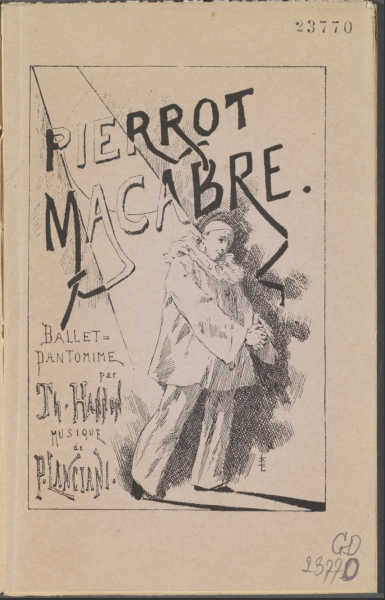
Ballet pantomime in one act and two scenes premiered on 18th March 1886 at the Théâtre Royal de la Monnaie, Brussels
Choreography: Joseph Hansen
Music: Pietro Lanciani
Premiers Rôles
Laetitia: Mlle A. Rossi
Colombine: Mlle Magliani
Arlequine: Mlle L. Rossi
Arlequin: Gaetano Saracco
Pierrot: Joseph Hansen
Plot
Summary
Scène 1 – The Cemetery of the Pierrots
The tableau opens in a brand-new cemetery under a convulsive moon. A carefree Gravedigger is digging a grave for Columbine, singing mockingly about how “tender” the earth is. Laetitia (a personification of cheerfulness or life) appears and summons the dead from their shrouds. Incensed by the Gravedigger’s lack of respect, the corpses take their revenge by seizing him and burying him in the very hole he just dug.
A funeral march announces the arrival of Columbine’s body. The procession includes professional mourners, a master of ceremonies plotting a long-winded speech, and a Priest who secretly snorts tobacco from a hidden compartment in his prayer book. Pierrot follows, dressed in mourning, genuinely devastated and sobbing for his lost love.
During the service, Pierrot catches the Priest and a friend cheating with the tobacco and lashes out at their lack of tact. The Master of Ceremonies then delivers a tedious, interminable oration that eventually puts the entire funeral party to sleep.
As everyone sleeps, the “deceased” Columbine suddenly wakes up from what was merely a lethargic sleep. She tries to rush to Pierrot, but Laetitia stops her. Laetitia wants to test Pierrot’s grief to see if his pain is truly lasting or just fleeting. She leads Columbine away, leaving Pierrot alone among the snoring guests. Pierrot wakes the sleepers with kicks and fists to drive them away.
Alone in the cemetery, Pierrot is overcome by memories of his romance with Columbine. He becomes so despondent that he calls upon Death to take him too. His wish triggers a series of supernatural hauntings.
The first to appear are the spiders who swarm him but he fiercely fights them off. The second to appear are the Will-o’-the-Wisps who taunt him with flickering flames but he threatens to blow them out like candles. The third to appear are spectres, a group of skeletons who perform a macabre saraband around him. The last to appear are the phantoms, among whom Pierrot perceives the shade of his beloved Columbine. Paralysed by fear, Pierrot is nearly claimed by them until Laetitia reappears. She commands the corpses to return to their graves, declaring that she will not let Pierrot die.
As owls swoop down, the most sinister owl atop the mausoleum is transformed by Laetitia into an enticing amphora. On the amphora is written the word: FORGETTING.
Pierrot, his natural gluttony and curiosity piqued, forgets his sorrow and drinks the entire bottle of “wine” (the water of Lethe). The drink immediately goes to his head, resurrecting his spirits. When the image of Columbine rises before him, he no longer feels grief; instead, he is overcome with a fever for Laetitia. He seizes her, and in a final “miracle of intoxication,” the gloom of the cemetery vanishes, replaced by gold, perfumes, and joy. The mourning is over.
Scène 2 – The Garden of Laetitia
The scene shifts to a lush, hedonistic garden where Pierrot is surrounded by a “playful swarm” of tempters. Having drunk the wine of forgetfulness in the previous tableau, he has completely abandoned his grief. He indulges in “forbidden fruit” and revels in the company of various women: Pierrettes, Polichinelles, and Harlequins. He feels invincible, fuelled by wine and lust, declaring that he has no fear of rivals or remorse.
The atmosphere changes when the familiar refrain of Punchinello echoes through the garden. Pierrot’s rival approaches, but to Pierrot’s shock, he is accompanied by Columbine. Seeing her alive and “gay in the arms of two gallant men,” Pierrot initially tries to deny it is her, calling it a deceiving phantom. Once he realises she is truly alive, he falls to his knees in a dazzled, repentant state, swearing he loves her madly. Columbine, however, is no longer the submissive lover; she mocks his “eight-day oaths” and turns back to her suitors, wounding Pierrot’s pride.
Driven by jealousy, Pierrot challenges his rival to a duel. An enormous sword is brought out, and the valiant Pierrot quickly turns into a coward as the cold iron nears him. Punchinello relentlessly presses the attack and stabs Pierrot through his breastplate.
As Pierrot staggers and loses blood, Harlequin mockingly offers him a candle (a nod to the famous folk song Au clair de la lune). Pierrot blows it out, utters the line “My candle is out, I have no more fire,” and falls dead.
Seeing Pierrot dead, Columbine’s resentment vanishes. She rushes to his side, weeping and cursing his murderer, declaring that she will die if he does not wake. Laetitia, the benevolent guide of the story, takes pity on Columbine. She instructs her that a single kiss of love can restore him.
Columbine kisses Pierrot, and he is instantly resurrected. The story ends in an Apotheosis. Laetitia (now as a fairy) ensures the lovers are united in a servile happiness, ending the high-drama romance with the lighthearted, tidy conclusion typical of a vaudeville stage play.
History
Original Production
Pierrot Macabre is a ballet pantomime in one act and two scenes. It was choreographed by Joseph Hansen to a score by Pietro Lanciani. The scenario was developed by Hansen and M Th. Hannon and premiered at the Théâtre de la Monnaie in Brussels on 18 March 1886. The ballet was moderately well received, but did not make enough of an impression to remain in the repertory for very long.
The mise-en-scène was designed by Hansen, the costumes by M Frignaert and the sets by M H Bodart. The conductor at the première was Léon Jehin.
Brussels Revivals
1897 Revival
In the summer of 1896, Sarah Nicholson received an invitation to dance at La Monnaie in Brussels for six weeks in January to March of 1897. She was very enthusiastic about the invitation, and so rearranged her other commitments (including cancelling her appearance in the Christmas pantomime at Manchester’s Theatre Royal which had been agreed upon since early 1896) to ensure that she would be at her best for her foreign appearance.
Two ballets were to be revived for her visit, though both had been previously performed at La Monnaie, so entirely new sets and costumes were not needed. The first of these ballets was Coppelia, which William Thompson had revived for Nicholson at Covent Garden in 1895. Nicholson was able to retain most of her choreography for her solo dances, though adapted by the balletmaster at La Monnaie, Gaetano Saracco. She was not, however, able to retain her choreography for the various Pas de Deux, as in Brussels the rôle of Franz was still danced by a danseuse en travesti (i.e. a woman dressed as a man), as it also was in Paris.
The second ballet to be revived for her was Pierrot Macabre. Unlike Coppelia, Pierrot Macabre was not familiar to Nicholson, having only been given in Brussels, and was much closer to a melodrama than a serious (though comic) narrative. In fact, Pierrot Macabre was not what Saracco had originally planned for Nicholson, but had planned for her to dance in Milenka, a ballet created by Saracco which had premièred in Brussels in 1888. As the danseuse who was dancing the titular rôle at the time, Béatrice Padou, had taken a leave of absence from January 1897 (an opening which allowed Nicholson to be invited), Saracco hoped that Nicholson would take over the rôle and extend the life of his ballet. However, this would not happen as Padou refused to give her permission for Nicholson to dance Milenka. As La Monnaie followed the traditional policy of rôle ownership of danseuses (something Richard Hague was actively trying to dismantle back at Covent Garden), Nicholson could not dance in Milenka and so it was decided that she would dance in Pierrot Macabre instead. This proved to be the death of Milenka, as Padou chose not to renew her contract following her leave of absence and Milenka vanished forever from the repertory.
As for Pierrot Macabre, Nicholson was not at all pleased with the ballet, but there was little she could do about it. She particularly disliked the variation that Saracco had provided for her in the Grand Pas of the second scene, as she felt that it did not suit her style as it should have done. She repeatedly asked Saracco to arrange another variation or indeed allow her to interpolate a variation of her own, but Saracco firmly refused her request.
To remedy what she perceived as a defect, Nicholson adopted another approach. She approached Philippe Flon, the conductor at La Monnaie, and requested the use of the orchestra for half an hour, under the pretext of rehearsing a variation from La Sylphide that she was to dance when she returned to London. This was in fact false, as she knew that the ballets for the 1897 summer season were to be The Corsair and The Beauty of Ghent, but Flon took her at her word and allowed her to rehearse. She continued to rehearse the variation when she could, and was thus able to acquaint both Flon and the orchestra with her tempi and the music itself.
At the dress rehearsal of Pierrot Macabre, which the management attended, she made sure to dance Saracco’s variation awkwardly and appearing ill at ease. As Nicholson had hoped, it did not escape the notice of management and she was approached by Édouard-Fortuné Calabresi, the director of the theatre, to inquire as to the matter. She explained that the variation did not suit her and she would not be able to make it do so in time for her scheduled debut. She proposed a solution: if she could be allowed to interpolate a variation she was more comfortable with and had already mastered, it would serve the performance better and allow her to present herself as she should to the audience. Calabresi asked to see the variation, and Nicholson, having previously rehearsed the variation with the orchestra, did much better in her variation than in Saracco’s. Saracco was furious at this insubordination but could not prevent management from permitting Nicholson her interpolation.
Nicholson received mostly positive reviews, though more so for Coppelia than Pierrot Macabre, though some critics took note of her variation in Pierrot Macabre as one of the highlights of the ballet. She was invited to stay for the summer season to replace Padou, but declined on account of her commitments at Covent Garden. She would later recall her experience at La Monnaie as one of the highlights of her career.
Rôles
Pierrot: Matthieu Provoost
Colombine: Sarah Nicholson
Musical Revisions
A new Variation was added for Nicholson in the Grand Pas of the second scene. The variation had originally been composed for Nicholson by Auguste Péchard for William Thompson’s 1895 revival of The Sylph and would later be interpolated by Nicholson into the 1901 revival of Ondine.
Résumé des Scènes et Danses
Scène 1 – The Cemetery of the Pierrots
1) Introduction
2) Scène 1re
3) Scène 2e – Ronde Fantastique
4) Scène 3e – Marche funèbre de Colombine
5) Scène 4e
6) Danses Effrayantes
a) Valse des Araignées
b) Danse des Feux Follets
c) Danse des Squelettes
d) Danse des Fantômes
7) Scène 5e
8) Scène 6e
Scène 2 – The Garden of Laetitia
9) Scène 7e
10) Valse
11) Scène 8e – Entrée de Colombine
12) Scène 9e – Saltarello
13) Grand Pas
a) Entrée
b) Andante
c) Ballabile – Tempo di Mazurka
d) Variation de Colombine
e) Variation de Mlle Nicholson (supplemental variation for the 1895 revival of The Sylph)
f) Galop
14) Scène Finale