Alcandre ou Les Amazones
Or Alcandra or The Amazons
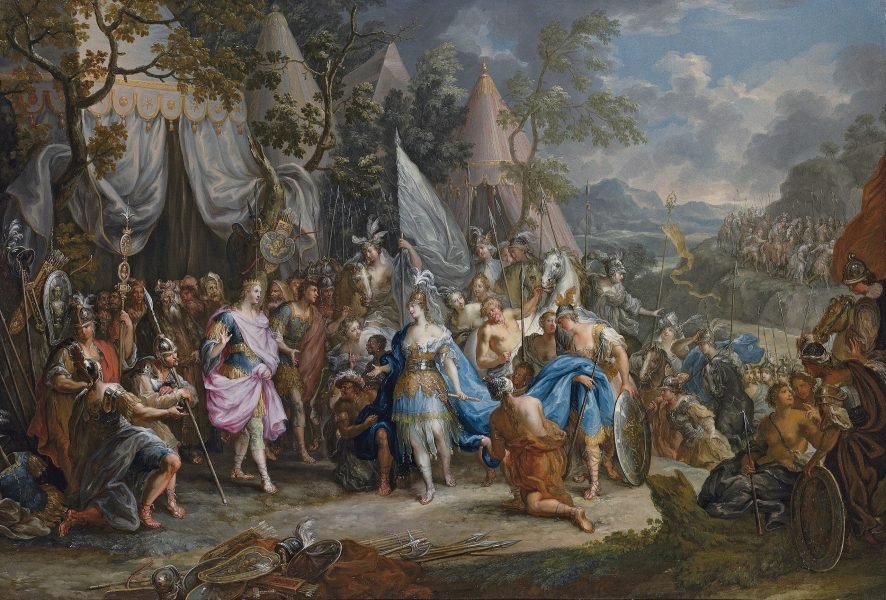
Ballet pantomime in three acts and five scenes premiered on 5th June 1903 at the Royal Opera House, London
Choreography: Richard Hague
Music: Arthur Granville
Premiers Rôles
Alcandre: Jane Wheaton
Plot
Acte 1
Outside the temple to Cupid
The villagers, peasants and townspeople pay homage to Cupid.
Amazons arrive, led by their Queen Alcandre and her second in command Milène. They have come to rest near the city of Thebes on their travels and perform some martial dances to amuse themselves. However Prince Lamédon spies Alcandre and declares his love but she rebuffs him. The other Amazons mock his declarations before they depart.
The King and Queen of Thebes enter and pay homage to Cupid. Alcandre arrives with her delegation and Lamédon asks her to come to the castle. Fearing diplomatic confrontation, she accepts.
The royals enter to pay homage and the peasants perform some dances to entertain them. Lamédon asks Alcandre to a ball and she, for fear of risking confrontation, accepts.
Acte 2
Scène 1
A grand ball is thrown in Alcandre’s honour. The ball opens with a quadrille for the guests. Next, the King of Thebes entreats Alcandre’s help in providing military assistance as he is warring with the neighbouring Sparta. Lamédon again declares his love for her, but she refuses, instead agreeing to help the King of Thebes. The King is delighted and gives her much gold as payment. To entertain the guests, there is a divertissement of the four elements. Finally, there is a Grand Pas d’Action in which Lamédon entreats Alcandre to dance. After the dance he says he will drink from a poisoned chalice if she refuses him. Cupid pierces her heart with an arrow but she still tries to hide her reluctance, knowing that as Queen of the Amazons such love is not her place. Lamédon drinks from the chalice and Alcandre flees the scene.
Scène 2
Alcandre weeps at her love’s death. She is unfamiliar with the feeling of love and how it courses through her body. Cupid arrives and she begs him to take away her feelings. He refuses and says he cannot, but says that he will help her to bring Lamédon back, by going to the underworld.
Acte 3
Scène 1
Cupid leads Alcandre to the underworld where she begs Pluto to release her beloved. Pluto only agrees if another takes his place to die. Alcandre gives Pluto the talisman that was given to her by her father, Zeus, which will grant her immortality and eternal youth. She casts the talisman into a pit of flames as payment. Pluto is unsatisfied but Proserpine takes pity on the lovers and convinces Pluto that the talisman is sufficient payment. Pluto agrees and the pair are united and leave the underworld.
Scène 2
The pair return to the palace to everyone’s delight. They are to marry and Alcandre gives up her Amazonian crown to Milène, having found new contentment as a future Queen of Thebes.
History
Original Production
Alcandra or The Amazons is a ballet pantomime in three acts and five scenes. It was choreographed by Richard Hague and was Arthur Granville’s first full-length ballet score, premiering in 1909.
Due to Hague’s reforms, the post of Official Composer of the Ballet Music had been abolished after Péchard’s retirement in 1903 to diversify music for ballets. Revisions and additions were now to be independently commissioned rather than handed to some resident composer. Granville had been commissioned to revise the score of the 1888 Thompson–Bardet ballet The Fairy of the Forest which was revived in 1908 for Jane Wheaton, for which he contributed a new variation for Élodie in the Pas des Dryades, a new Pas de Dix for the second act and various other minor revisions to the score. He so impressed Hague with his contributions that when Hague came to plan Alcandra for Wheaton the following year he commissioned Granville to compose the score.
During the 1914 season (in which Hague premiered his final ballets The Choice of Hercules and The Red Masque) there were plans to revive the ballet under the shortened title of Alcandra within the next two or three years. However, the First World War quickly put an end to those plans and despite its successful initial run the ballet was ultimately never revived. However, pieces from its score were used to supplement the score for the definitive 1986 revival of The Buccaneers, from which all modern productions of that work derive.
Résumé des Scènes et Danses
Acte 1
1) Introduction
2) Scène Première – Le Temple de Cupidon
3) Entrée et Scène des Votives – Les Offrandes à Cupidon
a) Entrée des Votives
b) Scène des Offrandes
c) Danses et Jeux
d) Départ des Votives
4) Scène Dansante – Les Amazones
a) Entrée des Amazones
b) Intermède
c) Danse Martiale
5) Scène Mimique – Entrée de Lamédon
6) Scène – Entrée du Roi et de la Reine
7) Scène – Rentrée des Amazones
8) Danse des Prêtresses
9) Danse des Thébains
10) Scène Finale
Acte 2
Scène 1
11) Entr’acte
12) Scène – Les Invités
13) Quadrille
14) Scène Mimique
15) Divertissement des Quatre Éléments
a) Entrée
b) L’Air – Scherzo
c) L’Eau – Valse
d) Le Feux – Galop
e) La Terre – Pizzicato
g) Finale
16) Grand Pas d’Action (Pas de Huit)
a) Adage
b) Variation I (used as a Ballabile for the four female coryphées and one male sujet)
c) Variation II (used as a variation for Milène)
d) Variation III – Lamédon
e) Variation IV – Alcandre
f) Coda
17) Scène Finale
Scène 2
18) Entr’acte
19) Scène de Deuil et Entrée de Cupidon
20) Scène Finale
Acte 3
Scène 1
21) Entr’acte
22) Scène – Le Pré de l’Asphodèle
23) Scène – Entrée de Proserpine et Pluton
24) Scène Mimique
25) Pas d’Action (ou Pas des Asphodèles)
a) Adage
b) Valse des Asphodèles
c) Variation de Cupidon
d) Variation d’Alcandre
26) Scène Finale – Le Talisman et La Réunion
Scène 2
27) Entr’acte
28) Scène Mimique – Le Retour et Joie Générale
29) Mazurka
30) Apothéose