François Bardet
The composer who shaped the revival of ballet in London
History
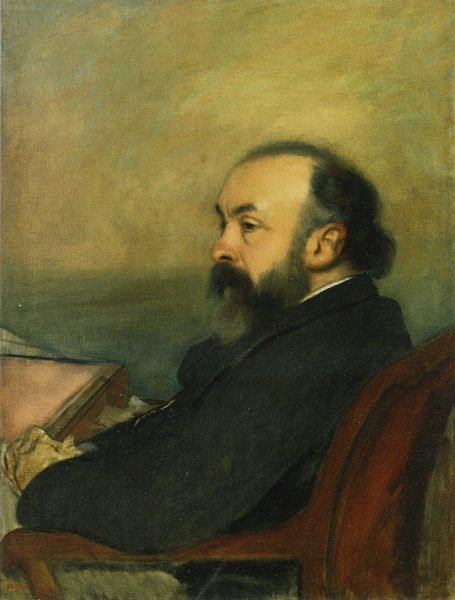
François Bardet was born in Lyon, France in 1824. He trained in composition at the Paris Conservatoire before moving to London in 1856. To make a living, Bardet composed musical hall songs, theatre pieces, incidental music and dances for the London stage. He also composed some short ballet diversions to be performed as part of music hall or variety shows.
Bardet and William Thompson first met in 1874, after Bardet attended a performance of Thompson’s ballet The Pirates’ Victory at The Linden Theatre. The two men were introduced and soon found they had much in common with regard to musical and artistic tastes. At some point after their meeting, Thompson began to request ballet music from Bardet, with their earliest recorded (but likely not their actual earliest) collaboration being for a short diversion in 1875. Despite their friendship, Bardet was not commissioned to provide the score for Thompson’s 1876 ballet The Harvest Festival, though he was in the audience at the ballet’s première.
When Thompson was invited to move his troupe to Her Majesty’s Theatre in 1877, the Linden Theatre’s resident composer did not wish to move with Thompson. Thus, Thompson sought out Bardet, who he knew shared his ambitious dreams of restoring British ballet to the status it had been under the days of Perrot. Their first collaboration was a revival of Perrot and Pugni’s 1843 ballet Ondine, for which Bardet modernised and rearranged the score, as well as adding some supplemental pieces of his own. The revival was a success and began in earnest the fruitful collaboration between Thompson and Bardet, with Bardet receiving the title of Official Composer of the Ballet Music to Her Majesty’s Theatre, a position which had been left vacant since Pugni’s departure in 1850.
Bardet was principally required to revise, rearrange and supplement existing scores by other composers for Thompson, shaping them to be more in line with Thompson’s artistic vision. During his time at Her Majesty’s Theatre he revised numerous ballet scores, and his revisions would become the basis for which later composers (notably Auguste Péchard) would base their revivals. He followed Thompson when he moved the troupe to Covent Garden in 1887 (where the position of Official Composer of the Ballet Music to The Royal Italian Opera at Covent Garden was created for him), and for that season he composed the score for the one-act ballet The Amphitrite. The Amphitrite was composed at breakneck speed, both the music and choreography were finished in just over a fortnight so that the ballet could première as part of the 1887 season.
In 1888 Bardet decided that it was time for him to retire, as he wished to return to his native France. Thompson attempted to persuade him to stay but Bardet was fixed, instead pointing Thompson in the direction of his pupil and assistant, Auguste Péchard. Péchard had come into Bardet’s employ in 1881 and since then had worked closely with him. Thompson commissioned a new score from Bardet for the latter’s farewell benefit, a ballet in two acts and three scenes titled Élodie or The Fairy of the Forest. The ballet was well received and marked a respectable end to Bardet’s theatre career.
Ballets
Works for Her Majesty’s Theatre and Covent Garden
Original Scores
- The Amphitrite (1887)
- Élodie or The Fairy of the Forest (1888)
Revisions to Existing Works
- Ondine (1877, 1887) – original score by Cesare Pugni (1843) in Pungi’s 1851 revision
- The Vivandiere (1877) – original score by Cesare Pugni (1844) in Pungi’s 1848 revision
- Diavolina (1877) – original score by Cesare Pugni (1863)
- Esmeralda (1878) – original score by Cesare Pugni (1844) in Pugni’s 1848 revision
- Giselle (1879, 1888) – original score by Adolphe Adam (1841)
- The Five Senses (1880) – original score by Adolphe Adam (1848)
- The Corsair (1881) – original score by Adolphe Adam (1856) in Léo Delibes’ 1867 revision
- The Fairies’ Goddaughter (1882) – original score by Adolphe Adam (1849)
- Marco Spada (1882) – original score by Daniel Auber (1857)
- The Buccaneers (1883) – original score by Theodore Labarre (1853)
- The Devil to Pay (1883) – original score by Adolphe Adam (1845)
- Coppelia (1885) – original score by Léo Delibes (1870)
- The Wayward Daughter (1886) – original score by Peter Ludwig Hertel (1864)
- Sylvia (1886) – original score by Léo Delibes (1876)
- The Harvest Festival (1887) – original score by John Plummer (1876)
Works for Other Theatres
- Divertissement à Trois (1882)
- For Act 1, Scene 5 of a production of Shakespeare’s Romeo and Juliet at the Lyceum Theatre
- Walpurgisnacht Ballet (Pas de Vénus) (1885)
- For Act 4 of the première of Gorman Wills’ Faust at the Lyceum Theatres