La Fille mal gardée
Or The Wayward Daughter
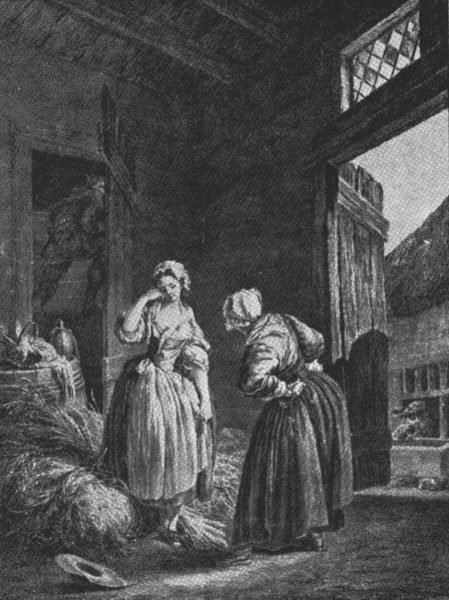
Ballet comique in three acts and four scenes premiered on 7th November 1864 at the Königliche Oper, Berlin
Choreography: Paul Taglioni
Music: Peter Ludwig Hertel
Plot
Summary
Acte 1 – On the Farm
Simone wants to marry her daughter Lise to the wealthy farmer Michaud’s son, Alain. Lise, on the other hand, has chosen Colin, a farmer in her mother’s service, and is trying to circumvent her mother’s wishes. Simone, on the other hand, prevents the two from pursuing their own plans by putting them to work, and also calls Alain to her to put an end to her daughter’s game of hide-and-seek and to make the wedding a reality.
Acte 2 – In the Field
Lise and Colin have fled; Simone finds them, with Alain and his entire entourage in tow, and announces the engagement. A thunderstorm comes up, Colin and Lise are able to flee again for a short time, but are brought back.
Acte 3
Scène 1 – In the house
Simone keeps Lise under lock and key. Colin manages to slip into the house under the cover of the other farmers, who are bringing in the sheaves saved from the rain. Simone goes into the village and returns earlier than expected with a wedding dress, which Lise is now to try on, while Colin hides in the barn. Alain and the notary arrive, and Simone quickly and unconsciously locks Lise, who continues to resist the wedding, in the barn with Colin – where, after the formalities have been completed, she discovers the two of them tightly embraced in the hay. The wedding is off, Alain now refuses to fulfil the agreement, whereupon Simone agrees to the wedding of Lise and Colin.
Scène 2
The engagement of Lise and Colin is celebrated.
History
Original Production
La Fille mal gardée originally premièred as a comic ballet in two acts and three scenes. Inspired by Pierre-Antoine Baudouin’s 1765 painting, La réprimande/Une jeune fille querellée par sa mère, the ballet was originally choreographed by Jean Dauberval to a pastiche score based on fifty-five popular French airs. The ballet was premiered on 1 July 1789 at the Grand Théâtre de Bordeaux in Bordeaux, France under the title Le ballet de la paille, ou Il n’est qu’un pas du mal au bien (The Ballet of Straw, or There is Only One Step from Bad to Good).
The ballet was first presented at the Grand Théâtre de Bordeaux in Bordeaux, France, on 1 July 1789. Dauberval’s wife, Marie-Madeleine Crespé (better known as Mademoiselle Théodore), created the role of Lison (or Lise, as the character is known in modern versions), Eugène Hus created the role of Colin (or Colas), and François Le Riche created the role of the Widow Ragotte (now known as Widow Simone in modern versions). The work met with public success and proved to be Dauberval’s most popular and enduring work.
Dauberval’s original work was restaged several times, beginning with the Ballet of the King’s Pantheon Theatre, London, where Dauberval staged the ballet as La Fille mal gardée. The London production opened on 30 April 1791, with Dauberval’s wife Mme Théodore reprising her role as Lise, while Dauberval’s student, Charles Didelot danced the rôle of Colas.
Eugène Hus, creator of the role of Colas, staged Dauberval’s La Fille mal gardée in 1803 at the old Paris Opéra, the Salle de la rue de Richelieu, predecessor of the Salle Le Peletier. Prior to this production, Hus utilised the ballet’s libretto in 1796 for a comic opera titled Lise et Colin, which was set to the music of Pierre Gaveaux.
1828 Aumer-Hérold Revival
The choreographer Jean-Pierre Aumer, a student of Dauberval, continuously revised Hus’ 1803 production throughout his career as ballet master at the Paris Opéra. He then travelled to Vienna in 1809 to mount the work for the Ballett des kaiserlichen Hoftheater nächst der Burg.
On 17 November 1828, Aumer presented a completely new version of the ballet at the Paris Opéra especially for the ballerina Pauline Montessu. For this revival the composer Ferdinand Hérold created an adaptation of the original score of 1789. Hérold also borrowed many themes from the operas of such composers as Jean-Paul-Égide Martini and Gaetano Donizetti.
In 1837, the great Austrian ballerina Fanny Elssler made her debut at the Paris Opéra in a revival of Aumer’s production of La Fille mal gardée. As was the custom of the time, a ballerina would commission new pas and variations to be interpolated into already existing ballets for their own performances. Making use of the extensive archives in the Paris Opéra’s library, the ballerina selected her favourite airs from Donizetti’s extremely popular score for the opera L’elisir d’amore. The library’s copyist Aimé-Ambroise-Simon Leborne assembled and orchestrated the music for her.
On 23rd February 1853, the Aumer-Hérold version of the ballet was revived by Arthur Saint-Léon for the Théâtre de l’Académie Impériale de Musique for Emma Bessone as Lise and Lucien Petipa as Colin.
For this revival, the score was revised by Adolphe Adam, who as his additions composed a new Pas de Deux for Bessone and Petipa, which presumably functioned as the Grand Pas of the farm scene. The production was not particularly successful, running for 8 performances in 1853-1854 and was subsequently removed from the repertory.
1864 Taglioni-Hertel Production
In 1864, Paul Taglioni created a new version for Berlin under the title of Das Schlecht Bewachte Mädchen. Though the libretto remained the same as the 1789 and 1828 versions, the ballet was set to an entirely new score by Peter Ludwig Hertel.
The ballet was a huge success, and the great Italian Prima Ballerina Virginia Zucchi made her début in the production in 1876 during her tour across Europe. It was her who brought the ballet to Russia, where it was revived in 1885 for her.
In 1886, following the success of the ballet in St Petersburg, Thompson revived the ballet for Emma Ashfield under the title of The Wayward Daughter. The revival required Thompson to pay a high price to obtain the score from Berlin, a concession which did not please Mapleson. However, the ballet was well received and went on to become a popular addition to the troupe’s repertoire.
Selected Revivals
1876
Location: Königliche Oper, Berlin
Staged for Virginia Zucchi.
28 December [O.S. 16 December] 1885
Location: Imperial Mariinsky Theatre, St Petersburg
Staged by Marius Petipa and Lev Ivanov for Virginia Zucchi as La Précaution Inutile (Vain Precaution) with musical revisions by Ludwig Minkus.
1888
Location: Imperial Theatre of Krasnoe Selo, St Petersburg
Staged by Ivanov in an abridged version.
1888
Location: Imperial Mariinsky Theatre, St Petersburg
Staged by Ivanov in an abridged version.
1894
Location: Imperial Mariinsky Theatre, St Petersburg
Full length version staged by Ivanov for Hedwige Hantenbürg.
London Revivals
1886 Revival
In 1886 Thompson revived the ballet in three acts and four scenes for Emma Ashfield as the heroine Lise. Mapleson (the manager of Her Majesty’s Theatre at the time) was sceptical of the choice of ballet, believing that advertising productions “as danced by Grisi, Elssler, Cerrito, Rosati” or some other great name they could attach to the production contributed to ticket sales and positive reception of the ballet. This caused Mapleson to repeatedly oppose the revival of The Wayward Daughter, stating that it had been created by “an unknown danseuse and was sure to fail”. However, The Wayward Daughter proved to be very popular, much to Thompson and Ashfield’s triumph.
As Isabella Velluti had retired at the end of the 1886 season, Sylvia was revived for her benefit. Once Velluti learned of the revival of The Wayward Daughter, she requested some performances as Lise, citing her contract and benefit. Thompson and Mapleson had little choice but to concede and allow Velluti to dance the rôle, permitting her four performances as Lise.
In Berlin the ballet had been presented in four acts, but Thompson presented the ballet in three acts, combining Act 3 and Act 4 into a single act. The score was revised by François Bardet and Thompson also added new dances to Bardet’s music.
Rôles
Lise: Emma Ashfield
Colin: Rafael Caravetti
Musical Revisions
A Valse Provençale was composed for the first act for the friends of Lise.
Thompson considered the second act too short (especially in comparison to the first and third acts) and so sought to lengthen it by the inclusion of new dances. Thus he added three new dances to the Divertissement of the second act.
The first dance added to the Divertissement was a Pas de Quatre danced by four ladies, friends of Lise, following the Valse Comique.
Pas de Quatre, composed by François Bardet (1886)
The second dance added was a Pas de Deux for Lise and Colin, following the Valse Ballabile de Bouquet and set to new music by Bardet. When Thompson received Hertel’s score from Berlin he was disappointed to see that it did not contain pas for Lise and Colin. Upon corresponding with Berlin it seemed that there were several possible pas that could be used for the Lise and Colin in the second act, but Berlin did not wish to part with them ostensibly because the pas were associated with specific dancers. Thompson, by this point, was already irritated with Berlin and so instead requested the music for a new Pas de Deux from Bardet. The Pas de Deux was well received at its première.
The third and final dance added to the Divertissement was the Galop that was originally placed in the second scene of the third act. It was transferred to the second act Divertissement by Thompson, being placed after the Pas de Deux to serva as a final general dance.
The Valse Ballabile de Bouquet, composed by Peter Ludwig Hertel (1864)
The choreography of the video above is by Marius Petipa, likely dating from his 1885 staging and notated in the Stepanov notation c. 1906. The music is likely not in Hertel’s original orchestration, but rather in a reorchestration, possibly created by Ludwig Minkus (who revised the score for the 1885 staging) or Riccardo Drigo (who revised many scores for the Imperial Ballet).
Résumé des Scènes et Danses
Acte 1
1) Introduction
2) Scène Première
3) Scène – Entrée des Fermiers
4) Danse des Fermiers
5) Valse Provençale
6) Scène – Rentrée de Simone
7) Scène – Rentrée de Colin
8) Pas de Ruban
a) Andante
b) Valse
c) Galop
9) Scène – Départ de Colin
10) Scène – Entrée de Michaud et Alain
11) Scène Finale
Acte 2
12) Entr’acte
13) Scène
Divertissement
14) Danse Bohémienne
15) Valse Comique
16) Pas de Quatre
17) Valse Ballabile de Bouquet
18) Pas de Deux
a) Entrée
b) Adage
c) Variation de Colin
d) Variation de Lise
e) Coda
19) Galop (moved here in 1886)
20) Scène Finale – Orage
Acte 3
Scène 1
21) Entr’acte et Scène
22) Scène – Le Filage
23) Thème Varié
a) Thème
b) Variation I
d) Variation II
24) Scène – Entrée des Fermiers
25) Scène Mimique – “Lorsque je serai mariée”
26) Scène Finale – Rentrée de Simone
Scène 2
27) Entr’acte et Scène
Divertissement
28) La Provençale
29) Bourrée
30) La Sabotière
31) Scène Finale
1890 Revival
In 1890 Thompson revived the ballet for Marta Draeger as Lise, partnered by Frederick Hale as Colin. Due to the circumstances of the revival (primarily a longer than usual run being planned due to the ballet’s popularity and Draeger creating the rôle of Alice in Alice’s Adventures in Wonderland the same season) Sarah Nicholson shared the rôle of Lise with her and was partnered by Rafael Caravetti as her Colin. This was a source of contention for the latter, who had decided that Draeger was to be her rival. Nevertheless, both danseuses received praise for their individual portrayals of Lise; whereas Draeger’s Lise was more vivacious, headstrong and mischievous Nicholson’s Lise was a nice contrast who was more coquettish, feminine and flirtatious. Some critics noted that both interpretations must be seen to truly appreciate the rôle.
Rôles
Lise: Marta Draeger / Sarah Nicholson
Colin: Frederick Hale / Rafael Caravetti
Musical Revisions
A brand new Pas de Deux (dubbed the Pas Robert) was added to the second act for Draeger and Hale, replacing the 1886 pas. The Pas Robert was so-called due to its music being arranged from arias from Meyerbeer’s 1832 grand opera Robert le Diable, a revival of which had been presented in Covent Garden (in Italian) in 1889 and in which Draeger and Nicholson (though the rôle initially went to Nicholson alone) had alternated the rôle of Héléna, the abbess.
Nicholson requested to have a new pas arranged for her as well, a request which was denied by Thompson. Thompson stated that Nicholson would dance the 1886 Pas de Deux but if she wished she could interpolate a new variation for Lise. Nicholson initially attempted to counter Thompson’s decision, but eventually relented and interpolated the variation that had been written for her in the Grand Pas de Séduction in the 1889 revival of Faust with minor revisions by Péchard. The variation was retained by Nicholson for her subsequent performances in the rôle.
Thompson revised and shortened the Variation de Colin for Caravetti, owing to Caravetti’s belief that his dancing was past its prime and that he was not quite up to portraying a quick-footed, lovelorn country swain.
The Pas Robert was well received, with critics praising Thompson’s choreography and Draeger’s dancing. One critic noted:
“The new Pas de Deux is a triumph of both choreography and execution. Miss Draeger and Mr Hale, with their exceptional artistry, imbue the movement with a grace and fluidity that is nothing short of captivating. The piece, a delightful union of technique and expression, adds a grandeur and depth to the ballet, elevating it to new heights. It is a dazzling display of skill, which stands as a fitting centrepiece to the evening.”
However (to Nicholson’s delight), some critics noted that the pas was too grand for the rest of the score, nor did it fit particularly well for the playful and flirtatious dynamic between Lise and Colin. One critic noted that:
“Though the newly arranged Pas de Deux was executed with admirable precision and grace by Miss Draeger and Mr Hale, the composition itself struck a note of grandeur that seemed ill-suited to the lighter, more playful character of the score and the ballet as a whole.”
And another that:
“The Pas de Deux of the second act, though executed with consummate skill and artistry by Miss Draeger and Mr Hale, possessed a formality and grandeur that appeared at odds with the playful flirtations and rustic charm of Lise and Colin. While undeniably impressive, it seemed a departure from the characters’ light-hearted vivacity, rendering the piece somewhat detached from the spirit of the ballet.”
The Pas Robert was eventually removed from the ballet, but did resurface on occasion, being interpolated by Nicholson into the third act of Coppelia when it was given for the State Performance for the Visit of the French President in 1903. The pas also resurfaced in the 1912 revival of The Fairy Doll, where it was interpolated for the Fairy Doll and her partner, the Tin Soldier.
Extract from the Adage from the Pas Robert, composed by Auguste Péchard (1890)
A new pas, the Valse Dansée was added to the third act for Lise and Colin. This pas was added at Draeger’s request, who was dissatisfied with the fact that the Divertissement of the second scene of the third act contained no dance for Lise and Colin. This was initially resisted by Thompson, who did not wish to lengthen the third act. However, Nicholson was also in favour of the idea, welcoming the opportunity for more dancing. Thus, Thompson relented, originally planning to add a Pas de Quatre for Lise, Colin and two female coryphées set to new music by Péchard. However, at Caravetti’s suggestion, the music for the new pas was changed to waltz taken from Auber’s score for Marco Spada, leading to the coryphées being taken out of the pas.
Marco Spada had been revived by Thompson in 1882 with musical revisions by Bardet (a production in which Caravetti himself had portrayed the rôle of Pepinelli during his first season with the troupe) but the ballet received no further revivals. Thompson updated the choreography but there was no need for Péchard to adapt the waltz (as the waltz had already been rearranged and adapted in 1882 by Bardet). This addition (unlike the Pas Robert) was retained in the ballet by danseuses who followed in the rôle.
Résumé des Scènes et Danses
Acte 1
1) Introduction
2) Scène Première
3) Scène – Entrée des Fermiers
4) Danse des Fermiers
5) Valse Provençale (1886)
6) Scène – Rentrée de Simone
7) Scène – Rentrée de Colin
8) Pas de Ruban
a) Andante
b) Valse
c) Galop
9) Scène – Départ de Colin
10) Scène – Entrée de Michaud et Alain
11) Scène Finale
Acte 2
12) Entr’acte
13) Scène
Divertissement
14) Danse Bohémienne
15) Valse Comique
16) Pas de Quatre (1886)
17) Valse Ballabile de Bouquet
18 a) Pas de Deux (1886) – Danced by Miss Nicholson and Mr Caravetti
a) Entrée
b) Adage
c) Variation de Colin
d) Variation de Lise
e) Variation de Mlle Nicholson (supplemental variation written for Nicholson in the Grand Pas de Séduction in the 1889 revival of Faust)
f) Coda
18 b) Pas de Deux (ou Pas Robert) – Danced by Miss Draeger and Mr Hale
a) Adage
b) Variation de M Hale
c) Variation de Mlle Draeger
d) Coda
19) Galop
20) Scène Finale – Orage
Acte 3
Scène 1
21) Entr’acte et Scène
22) Scène – Le Filage
23) Thème Varié
a) Thème
b) Variation I
d) Variation II
24) Scène – Entrée des Fermiers
25) Scène Mimique – “Lorsque je serai mariée”
26) Scène Finale – Rentrée de Simone
Scène 2
27) Entr’acte et Scène
Divertissement
28) La Provençale
29) Bourrée
30) Valse Dansée (interpolation from Auber’s 1857 ballet Marco Spada)
31) La Sabotière
32) Scène Finale
1899 Revival
In 1899 the ballet was revived for Nicholson as Lise.
Rôles
Lise: Sarah Nicholson
Musical Revisions
For this revival, the lighter and more playful 1886 Pas de Deux was retained as the second act grand pas in favour of the grander and more technically demanding Pas Robert added for Draeger in 1890. Though Nicholson retained her interpolated Faust variation for her performances, she did not permit other danseuses to dance it. As a result, other danseuses who performed the rôle instead danced the original 1886 variation, hence why there are two accepted variations for this pas (though the original 1886 variation is the better known of the two).
The Valse Dansée that was interpolated into the second scene of third act was retained.
1907 Revival
The 1907 revival marked the third and final guest appearance of Adeline Genée on the Covent Garden stage, as she departed for America in November of the same year. In 1902 she had made her first guest appearance at the theatre as the titular rôle in the revival of Alice’s Adventures in Wonderland and her second as Médora in the 1904 revival of The Corsair. In 1906 she was invited to dance the rôle of Jovita in the revival of The Buccaneers but she declined as she was working on staging her version of Coppelia at the Empire Theatre of Varieties at the time. However, she accepted the invitation to dance the rôle of Lise in the 1907 revival and was praised for her interpretation of the rôle.