Le Corsaire
Or The Corsair
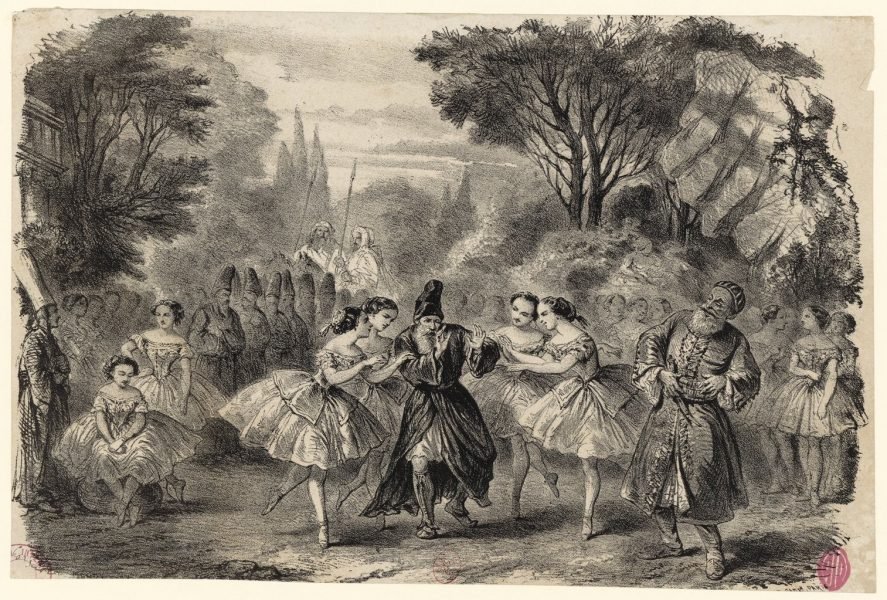
Ballet pantomime in three acts and five scenes premiered on 23rd January 1856 at the Théâtre Impérial de l’Opéra, Paris
Choreography: Joseph Mazilier
Music: Adolphe Adam
Premiers Rôles
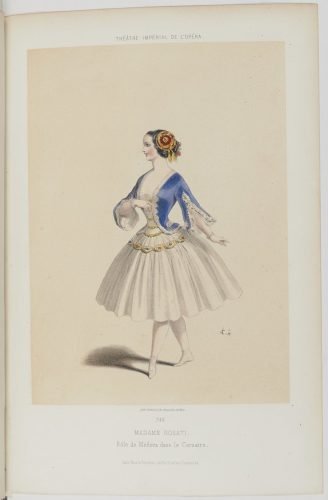
Médora: Carolina Rosati
Conrad: Domenico Segarelli
Gulnare: Claudina Couqui (also rendered “Cucchi”)
Plot
Summary
Acte 1
Scène 1 – A Bazaar in a Seaport Square
Slave girls are among the goods for sale. Corsairs (pirates) arrive with their leader, Conrad. Watching the scene from a balcony is a young woman, Médora, the ward of the bazaar owner, Lanquedem. She fashions a coded message into a bouquet of flowers, which she throws to Conrad. Later, when Médora and Lanquedem go to the square, she and Conrad exchange loving glances.
At this point, Seyd Pasha, a rich buyer of slave girls, arrives in the square. Seeing Médora, he is smitten and asks to buy her. Lanquedem initially refuses, but as Seyd Pasha raises his price Lanquedem eventually relents. Seyd Pasha orders that Médora be delivered to his palace and leaves. Conrad promises Médora that he and his corsairs will rescue her. The corsairs begin to dance with the slave girls. At a signal from Conrad the corsairs all run off with the girls. For good measure, they also kidnap Lanquedem.
Scène 2 – The Corsair’s Den
Médora asks Conrad to release the women slaves. To this he agrees. However, one of his men – Birbanto – objects and begins a fight. Conrad subdues him. Meanwhile, Lanquedem tries to escape. The corsairs who are opposed to Conrad’s release of the women convince Lanquedem to stay long enough to give Conrad a flower sprayed with a sleeping potion.
Later, at dinner, Médora dances for Conrad. Lanquedem gives her the flower with the sleeping potion, asking that she give it to Conrad. She does this, and when he smells the flower he falls asleep. Corsairs surround Médora, threatening her. Defensively, she stabs Birbanto in the arm and faints into the arms of the corsairs, who take her away. Conrad awakens and sets out to recapture Médora.
Acte 2 – Harem at the Palace of Seyd Pasha
The Sultana Zulméa demands that the Odalisques (female concubines of the harem) respect her. For this, she is mocked by harem slave, Gulnare and her friends. Seyd Pasha enters. Gulnare teases him flirtatiously in dance, and he gives her a handkerchief. She makes fun of him by passing the handkerchief around the group of women. Seyd Pasha is furious. His Keeper of the Harem attempts to distract and calm him with dancing performances by the girls. Lanquedem arrives, leading Médora in delivery of her sale to Seyd Pasha. She begs Seyd Pasha for her freedom and also complains of mistreatment by Lanquedem. Gulnare comforts her. Seyd Pasha offers Médora jewels, which she refuses. The Corsairs enter, disguised as robed members of a religious order. They act embarrassed at the sight of the concubines of the harem. Seyd Pasha orders the women of the harem to dance for the entertainment of his guests.
Conrad, in his disguise, recognizes Médora. The corsairs throw off their disguises and threaten Seyd Pasha with daggers. The Corsairs begin pillaging the palace. Gulnare rushes in, pursued by Birbanto. Médora recognizes Birbanto as her kidnapper and informs Conrad. She demonstrates the identification by pointing out the wound she inflicted on Birbanto’s arm. Médora prevents Conrad from killing Birbanto, who then runs away. Seyd Pasha’s guards enter and attack the corsairs, capturing them including Conrad. Seyd Pasha sentences Conrad to death.
Act 3
Scène 1 – Seyd Pasha’s Private Room at the Palace
Seyd Pasha proposes to Médora, who refuses him. As Conrad is led to his execution, Médora begs Seyd Pasha to pardon him. He agrees on the condition that she freely submit to him. He leaves the room as she considers the offer. Conrad is able to run to her; she informs him of the deal she must make to have him freed. Conrad objects and talks her out of the offer. They resolve to die together. At this point Gulnare, who is in love with Seyd Pasha, approaches the two and proposes a plan to secretly switch places with Médora in the wedding.
Seyd Pasha returns to the room where, after assurances from Médora he orders Conrad to be freed and the marriage ceremony to commence. Later, as the wedding procession approaches, the bride enters covered in a veil. Seyd Pasha places a ring on the bride’s finger in marriage, and the odalisques dance.
After the wedding, Seyd Pasha is alone with Médora. As she dances for him, she tells him that the pistol on his belt scares her and asks that he give it to her. He complies. She then asks for his dagger, and he hands that over also. She continues to dance to evade him. As he kneels before her and begs for her love, he hands her his handkerchief. Acting as if playfully joking, she ties his hands with the handkerchief.
At this point Conrad enters the room. He and Médora threaten Seyd Pasha, warning him not to raise a cry of alarm. They escape. Gulnare rushes into the room and unties Seyd Pasha. She shows him the ring on her finger and reveals it was she whom he had married.
Scène 2 – Corsair Ship at Sea
At first the sea is calm. Birbanto is in chains. On Médora’s pleas, Conrad releases him. As a storm arises, Birbanto tries to sow dissatisfaction among the crew. Conrad throws him overboard. The ship runs aground. The sea calms. Conrad and Médora are seen climbing safely onto land together.
History
Original Production
Le Corsaire was created primarily for the talents of the famous Italian ballerina Carolina Rosati, who was then the Paris Opéra’s reigning prima ballerina. The rôle of Conrad, which contained no dancing in Mazilier’s original staging, was created by the Italian Domenico Segarelli. Although he was an accomplished dancer, it was Segarelli’s abilities as a mime artist that won him the many roles he created on the stage of the Opéra. It would not be until the ballet left Paris that the rôle of Conrad began to include dancing.
The ballet was a great success, with the Pas des Éventails and the shipwreck scene receiving the most praise. The première was honoured by the presence of Emperor Napoleon III and Empress Eugénie, both of whom highly praised the production. The director of the Opéra was summoned to the Imperial box where the Empress was alleged to have said:
“I have never seen in all my life and probably shall never see again anything at once so beautiful and so moving.”
In 1881 Thompson decided to revive the ballet for Isabella Velluti under the title of The Corsair (the same title would be used for subsequent London revivals of the ballet). The Duchess of Connaught (wife of the third son of Queen Victoria) attended two performances of the ballet with her entourage, further lending credence to the continuation of the ballet and increasing the prestige of ballet among the English public. Quick to capitalise on the royal attendance, Thompson was given permission to mount two revivals a season starting from 1882. This convention was followed until 1887 when Thompson moved his troupe to Covent Garden. The Corsair proved to be one of the favourite ballets in London and performances (including subsequent revivals) were always sure to bring in ticket sales.
Selected Revivals
24th January [O.S. 12th January] 1858
Location: Imperial Bolshoi Kamenny Theatre, St Petersburg
Staged by Perrot for Ekaterina Friedbürg with Marius Petipa as her partner. Cesare Pugni revised the score.
5th February [O.S. 24th January] 1863
Location: Imperial Bolshoi Kamenny Theatre, St Petersburg
Staged by Petipa for his wife Maria Surovshchikova-Petipa with Pugni again revising the score. For this revival Petipa added a Pas de Six to the second scene of the first act to the music of Pugni, replacing Adam’s Pas des Éventails.
21 October 1867
Location: Théâtre Impérial de l’Opéra, Paris
Staged by Mazilier for Adèle Grantzow in honour of the 1867 Exposition Universelle given that year in Paris. Adam’s former pupil Léo Delibes composed a new Variation for Grantzow in the Pas des Éventails and a new pas known as the Pas des Fleurs to replace the Pas de Mme Rosati of the second act.
6th February [O.S. 25th January] 1868
Location: Imperial Bolshoi Kamenny Theatre, St Petersburg
Staged by Petipa for Adèle Grantzow with the inclusion of the 1867 Pas des Fleurs expanded into the scene known as Le Jardin Animé.
12th December [O.S. 30th November] 1880
Location: Imperial Bolshoi Kamenny Theatre, St Petersburg
Staged by Petipa for Eugenia Sokolova.
25th January [O.S. 13th January] 1899
Location: Imperial Mariinsky Theatre, St Petersburg
Staged by Petipa for the celebrated Pierina Legnani with Pavel Gerdt as Conrad. Olga Preobrazhenskaya danced the rôle of Gulnare.
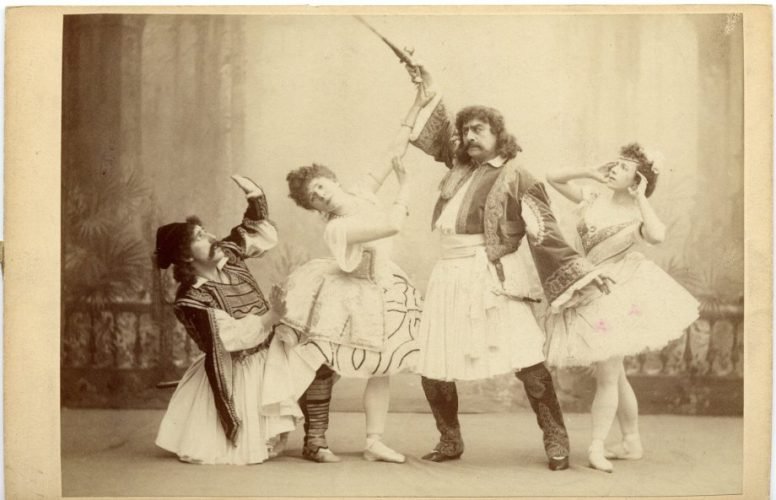
London Revivals
1881 Revival
In 1881 Thompson revived the ballet for Velluti as the heroine Médora. The score was revised by François Bardet and following Thompson’s direction, the 1867 score was used as a starting point, along with Delibes’ additions. As usual, Thompson remained faithful to the original libretto but re-choreographed several of the dances. The ballet was well received and thanks to the Duchess of Connaught’s attendance and Velluti’s celebrated portrayal of Médora, the revival proved to be the theatre production to attend of the 1881 London season.
Rôles
Médora: Isabella Velluti
Conrad: Samuel Penrose
Gulnare: Marguerite Lemoine
Musical Revisions
A waltz for Médora and the Seyd Pasha titled La Coquetterie de Médora was added to the first scene of the first act. In this pas Médora, compelled to do so by Lanquedem, danced around the Seyd Pasha to entertain and entice him. However, she never quite let him embrace her, instead embracing Conrad when Lanquedem and the Seyd Pasha were not looking.
A new variation was composed for Médora in the Pas des Éventails of the second scene of the first act. The variation received great applause at its premiere and became a signature part of the rôle of Médora in London, so much so that subsequent danseuses were reluctant to substitute other variations into this pas, preferring to dance the well-known 1881 variation (known as the Velluti Variation after the danseuse who originated the pas).
At the 1856 première, the central pas in the second act was the Pas de Mme Rosati, danced by Rosati and eight ladies of the corps de ballet. When the ballet was revived for Grantzow in 1867, the Pas de Mme Rosati was replaced by the Pas des Fleurs, which was retained in later revivals and endures until today as Le Jardin Animé. Thompson decided to retain both Rosati’s and Grantzow’s pas, leaving the Pas de Fleurs in its intended place in the second act and moving the Pas de Rosati (or Pas de Six as it was alternately called by him) to the first scene of the third act.
A new variation was composed for Gulnare in the Pas des Fleurs.
Variation for Miss Lemoine as Gulnare in the Pas des Fleurs, composed by François Bardet (1881)
Résumé des Scènes et Danses
Acte 1
Scène 1 – Le Bazar d’Adrinople
1) Introduction
2) Grand Scène du Bazar
3) Entrée des Corsaires
4) Entrée du Seyd Pasha
5) Pas de Cinq
a) Introduction
b) Variation I – L’Italienne (Tarentelle)
c) Variation II – La Moldave (Mazuetta)
d) Variation III – La Française
e) Variation IV – L’Espagnole (Boléro)
f) Variation V – L’Écossaise
g) Coda
6) Scène
a) Après le Pas
b) Valse – La Coquetterie de Médora
c) Scène
7) Bacchanale des Corsaires
8) Scène Finale
Scène 2 – Le Palais Souterrain
9) Entracte
10) Scène
11) Pas des Éventails
a) Andante Sostenuto
b) Valse d’Ensemble
c) Danse des Coryphées
d) Variation de Médora
e) Coda
12) Scène Mimique
13) Scène de Séduction
14) Scène du Bouquet
15) Scène Finale
Acte 2 – Le Palais du Seyd Pasha
16) Entracte et Scène
17) Entrée des Odalisques
18) Pas des Odalisques
19) Scène Dansante
a) Entrée de Gulnare
b) Entrée du Seyd Pasha
c) Variation Espiègle de Gulnare
d) Galop
20) Scène
a) La Plainte de Zulmée
b) Entrée de Médora et Lanquedem
c) Danse des Almées
d) Rentrée de Gulnare
21) Entrée des Pèlerins et Derviches
22) Pas des Fleurs
a) Valse
b) Adage
c) Petite reprise de la valse
d) Variation de Gulnare
e) Andante
f) Variation de Médora
g) Coda
23) Petite Scène – La Retraite des Fleurs
24) Scène Finale
Acte 3
Scène 1 – L’appartement du Seyd Pasha
25) Entracte et Scène
26) Petite Marche
27) Scène du Mariage
28) Pas de Rosati (ou Pas de Six)
a) Entrée
b) Allegretto
c) Variation de Gulnare
d) Variation de Médora
e) Coda
29) Scène Dansante de Caractère – Médora et Seyd Pasha
30) Scène Finale
Scène 2 – La Mer
31) Entracte et Scène
a) La Mer
b) Les Corsaires
32) Danse à Bord du Vaisseau
33) La Naufrage
34) Apothéose
1889 Revival
In 1889 Thompson again revived the ballet, this time for the celebrated German danseuse Marta Draeger. The score was revised by Bardet’s pupil, Auguste Péchard, following Bardet’s retirement in 1888.
Rôles
Médora: Marta Draeger
Conrad: Rafael Caravetti
Gulnare: Sarah Nicholson
Birbanto: Charles Jennings
Odalisques: Ivy Gregson and Mary Butler
Seyd Pasha: Edward Lamb
Lanquendem: Jean Rousset
Head Eunuch: George Cox
Musical Revisions
A new variation was composed for Conrad in the Pas des Éventails of the second scene of the first act. In the 1881 revival Thompson had followed the Parisian staging of the pas, where Médora danced the pas alone with 16 ladies of the corps de ballet. However, in 1889 Conrad was added to the pas in earnest: the Andante Sostenuto was re-choreographed to include him as a partner, a Variation was composed for him and he also danced in the Coda. No new variation was composed for Médora as Draeger elected to dance the popular Velluti Variation.
In order to add more opportunities for sujets to dance, the Pas des Odalisques of the second act was expanded into a full pas. Adam’s original waltz was retained for the corps de ballet as the Entrée. Two new variations were added for two female sujets, the first was a newly composed variation and the second was by Adam, transferred from the discarded Pas de Rosati (the variation of Gulnare from this pas). A Coda was also added to conclude the pas.
The Pas de Rosati in the first scene of the third act was replaced by a brand new pas, the Pas de Distraction. This pas was danced by Médora, Gulnare, an unnamed cavalier and eight female coryphées. The argument was that as part of the plan to allow the Médora and Conrad to escape, Gulnare would entreat some of her friends in the harem to help to distract the Seyd Pasha with dances as they waited for the execution of the escape plan come nightfall. The pas included variations for both Médora and Gulnare as well as one for the unnamed male cavalier and was closed by a waltz-coda.
Résumé des Scènes et Danses
Acte 1
Scène 1 – Le Bazar d’Adrinople
1) Introduction
2) Grand Scène du Bazar
3) Entrée des Corsaires
4) Entrée du Seyd Pasha
5) Pas de Cinq
a) Introduction
b) Variation I – L’Italienne (Tarentelle)
c) Variation II – La Moldave (Mazuetta)
d) Variation III – La Française
e) Variation IV – L’Espagnole (Boléro)
f) Variation V – L’Écossaise
g) Coda
6) Scène
a) Après le Pas
b) Valse – La Coquetterie de Médora (1881)
c) Scène
7) Bacchanale des Corsaires
8) Scène Finale
Scène 2 – Le Palais Souterrain
9) Entracte
10) Scène
11) Pas des Éventails
a) Andante Sostenuto
b) Valse d’Ensemble
c) Danse des Coryphées
d) Variation de Conrad
e) Variation de Médora (1881)
f) Coda
12) Scène Mimique
13) Scène de Séduction
14) Scène du Bouquet
15) Scène Finale
Acte 2 – Le Palais du Seyd Pasha
16) Entracte et Scène
17) Entrée des Odalisques
18) Pas des Odalisques
a) Valse des Odalisques
b) Variation I
c) Variation II (Adam, transferred from the Pas de Rosati)
d) Coda
19) Scène Dansante
a) Entrée de Gulnare
b) Entrée du Seyd Pasha
c) Variation Espiègle de Gulnare
d) Galop
20) Scène
a) La Plainte de Zulmée
b) Entrée de Médora et Lanquedem
c) Danse des Almées
d) Rentrée de Gulnare
21) Entrée des Pèlerins et Derviches
22) Pas des Fleurs
a) Valse
b) Adage
c) Petite reprise de la valse
d) Variation de Gulnare (1881)
e) Andante
f) Variation de Médora
g) Coda
23) Petite Scène – La Retraite des Fleurs
24) Scène Finale
Acte 3
Scène 1 – L’appartement du Seyd Pasha
25) Entracte et Scène
26) Petite Marche
27) Scène du Mariage
28) Pas de Distraction
a) Entrée
b) Adage
c) Valse des Coryphées
d) Variation du Cavalier
e) Variation de Gulnare
f) Variation de Médora
g) Coda
29) Scène Dansante de Caractère – Médora et Seyd Pasha
30) Scène Finale
Scène 2 – La Mer
31) Entracte et Scène
a) La Mer
b) Les Corsaires
32) Danse à Bord du Vaisseau
33) La Naufrage
34) Apothéose
1889 State Performance
In 1889, the second act of the ballet was given as part of the State Performance for the Visit of the Shah of Persia.
Rôles
Médora: Marta Draeger
Conrad: Rafael Caravetti
Gulnare: Sarah Nicholson
Birbanto: Charles Jennings
Odalisques: Ivy Gregson, Mary Butler and Joséphine Decoin
Seyd Pasha: Edward Lamb
Lanquendem: Jean Rousset
Head Eunuch: George Cox
Musical Revisions
A variation was interpolated into the Pas des Odalisques for Joséphine Decoin, to allow her to take part in the state performance. The variation was taken from the Pas de Deux that had been interpolated into the 1889 revival of Diavolina for her, originally composed by Bardet for the 1878 revival of Esmeralda.
Résumé des Scènes et Danses
Acte 2 – Le Palais du Seyd Pasha
1) Entr’acte et Scène
2) Entrée des Odalisques
3) Pas des Odalisques
a) Valse des Odalisques
b) Variation I (1889)
c) Variation II (supplemental variation from a Pas de Deux written for the 1878 revival of Esmeralda)
d) Variation III (Adam, transferred here in 1889)
e) Coda (1889)
4) Scène Dansante
a) Entrée de Gulnare
b) Entrée du Seyd Pasha
c) Variation Espiègle de Gulnare
d) Galop
5) Scène
a) La Plainte de Zulmée
b) Entrée de Médora et Lanquedem
c) Danse des Almées
d) Rentrée de Gulnare
6) Entrée des Pèlerins et Derviches
7) Pas des Fleurs
a) Valse
b) Adage
c) Petite reprise de la valse
d) Variation de Gulnare (1881)
e) Andante
f) Variation de Médora
g) Coda
8) Petite Scène – La Retraite des Fleurs
9) Scène Finale
1897 Revival
In 1897, the ballet was revived for the Queen’s Diamond Jubilee year.
Following Draeger’s departure in 1894, Nicholson had become the reigning première of the Covent Garden troupe. Thompson had considered a few of the sujets for promotion to première, but did not get around to doing so before his 1896 retirement.
His successor as balletmaster, Richard Hague, sought to remedy this issue by inviting Maria Nardella to perform a season at Covent Garden, with the aim of her accepting a more permanent contract. To entice her, he decided to revive The Corsair, well loved by dancers, critics and the public alike.
Nardella, who had trained at La Scala in Milan, was already known on the London stage, primarily in the Variety Theatre space, having danced at The Alhambra and The Empire. The theatre management were enthusiastically receptive to Hague’s suggestion to engage her for the 1897 season, and thankfully she accepted. She requested new additions to the ballet, which were duly composed for her by Péchard. The rôle of Conrad was given to a young premier danseur of the troupe, James Elton.
Nicholson was not pleased by this development, as she had very much wished to add Médora to her repertory of rôles. Hague attempted to placate her by reviving The Beauty of Ghent (a ballet which Nicholson was fond of), a strategy which was not quite successful.
Rôles
Médora: Maria Nardella
Conrad: James Elton
Musical Revisions
A new Pas de Deux was composed for Médora and Conrad to replace the Pas des Éventails of the second scene of the first act. This decision was not looked on favourably by the English danseuses, as they were quite attached to the original pas. However, Nardella requested a new pas to be added and due to the theatre management’s wish to engage her the balletmaster was obliged to comply with this demand. The pas originally had an Entrée set to a lilting waltz, but it was cut during rehearsals.
Variation for Mr Elton as Conrad in the Pas de Deux, composed by Auguste Péchard (1897)
A new variation was added for Médora in the Pas des Fleurs, again at the request of Nardella.
Though Nardella’s performances as Médora were highly praised by both the public and the critics, her new additions did not become part of the London performance tradition of the ballet. This was in no small part due to Nardella herself, as she did not take well to the Covent Garden Thompsonesque school of dancing nor to Hague’s resistance of her more involved demands (e.g. her request to redesign all four of her costumes which was denied by Hague). As a result, she declined the request to stay in Covent Garden on a permanent basis, preferring to continue her travels to Brussels. Before she left, she refused to give her consent for anyone else to dance the pas that had been composed for her, so to avoid a public scandal, the traditional pas were reinstated upon her departure. Nardella went on to interpolate both the Pas de Deux and additional Variation into other ballets that she danced at other theatres.
Résumé des Scènes et Danses
Acte 1
Scène 1 – Le Bazar d’Adrinople
1) Introduction
2) Grand Scène du Bazar
3) Entrée des Corsaires
4) Entrée du Seyd Pasha
5) Pas de Cinq
a) Introduction
b) Variation I – L’Italienne (Tarentelle)
c) Variation II – La Moldave (Mazuetta)
d) Variation III – La Française
e) Variation IV – L’Espagnole (Boléro)
f) Variation V – L’Écossaise
g) Coda
6) Scène
a) Après le Pas
b) Valse – La Coquetterie de Médora (1881)
c) Scène
7) Bacchanale des Corsaires
8) Scène Finale
Scène 2 – Le Palais Souterrain
9) Entracte
10) Scène
11) Pas de Deux
a) Entrée
b) Adage
c) Variation de M Hale
d) Variation de Mlle Nardella
e) Coda
12) Scène Mimique
13) Scène de Séduction
14) Scène du Bouquet
15) Scène Finale
Acte 2 – Le Palais du Seyd Pasha
16) Entracte et Scène
17) Entrée des Odalisques
18) Pas des Odalisques
a) Valse des Odalisques
b) Variation I (1889)
c) Variation II (Adam, transferred here in 1889)
d) Coda (1889)
19) Scène Dansante
a) Entrée de Gulnare
b) Entrée du Seyd Pasha
c) Variation Espiègle de Gulnare
d) Galop
20) Scène
a) La Plainte de Zulmée
b) Entrée de Médora et Lanquedem
c) Danse des Almées
d) Rentrée de Gulnare
21) Entrée des Pèlerins et Derviches
22) Pas des Fleurs
a) Valse
b) Adage
c) Petite reprise de la valse
d) Variation de Gulnare (1881)
e) Andante
f) Variation de Mlle Nardella
g) Coda
23) Petite Scène – La Retraite des Fleurs
24) Scène Finale
Acte 3
Scène 1 – L’appartement du Seyd Pasha
25) Entracte et Scène
26) Petite Marche
27) Scène du Mariage
28) Pas de Distraction (1889)
a) Entrée
b) Adage
c) Valse des Coryphées
d) Variation du Cavalier
e) Variation de Gulnare
f) Variation de Médora
g) Coda
29) Scène Dansante de Caractère – Médora et Seyd Pasha
30) Scène Finale
Scène 2 – La Mer
31) Entracte et Scène
a) La Mer
b) Les Corsaires
32) Danse à Bord du Vaisseau
33) La Naufrage
34) Apothéose
1904 Revival
In 1904 the ballet was revived for Giulia Moretti. Her performances as Médora marked a return to the traditional and well-loved pas and variations (as Nardella refused to give permission for her additions to be danced by anyone else).
This revival also marked the second guest appearance of Adeline Genée at Covent Garden (who had made her first guest appearance at Covent Garden as the titular rôle in the 1902 revival of Alice’s Adventures in Wonderland), as she was invited to dance the rôle of Médora in the run.
Rôles
Médora: Giulia Moretti
Musical Revisions
All of Nardella’s additions (the Pas de Deux and Variation for the Pas des Fleurs) were removed and the ballet was presented much the same as it had been in 1889.
The only notable departure from the 1889 version was the inclusion of a new interpolated variation for Gulnare in the Pas des Fleurs, taken from the Pas des Fées from The Fairies’ Goddaughter. As the Meisenburg notations of the ballet were made in 1904, it is the interpolated variation from The Fairies’ Goddaughter that is included in the notations.