The Harvest Festival
Or La Fête de la Récolte
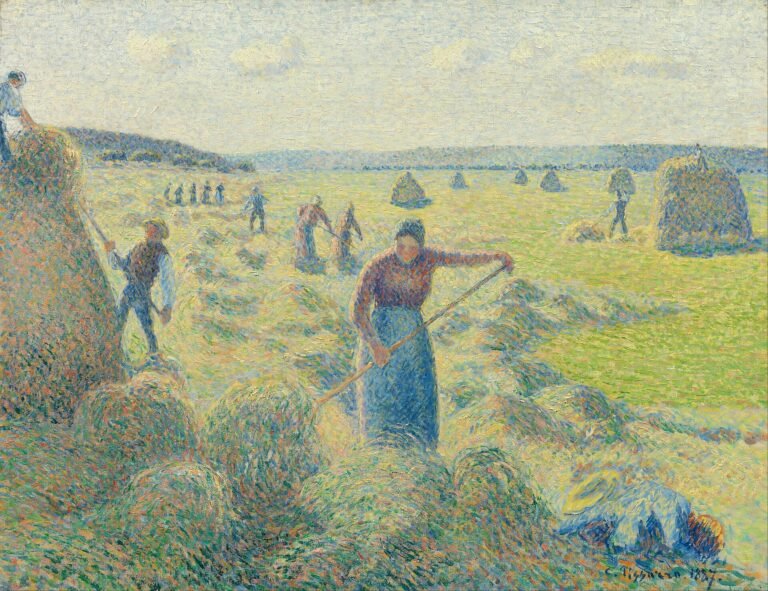
Ballet comique in one act premiered on 7th March 1876 at the Linden Theatre, London
Choreography: William Thompson
Music: John Plummer
Plot
The stage represents a village square decorated for a harvest festival.
It is morning. Young girls arrive to collect flowers with which they shall decorate themselves and their baskets. Peggy, most beautiful among them, is somewhat downcast because of her lover Thomas paying court to another, Eliza, the daughter of a wealthy farmer. Her friends bid her not to worry as she shall win the Cotillion and thus regain his affections.
Thomas enters in pursuit of Eliza. She has learned of her rival and wishes the young man to cease paying court to her. Thomas is undeterred and pines for Eliza, even as Peggy repeatedly tries to regain his attention.
They are soon interrupted by the signal for the festival to begin. Villagers and villagesses form a procession of dancing and pulling wagons of harvest.
The parson declares the Cotillion must begin, with money provided for by the lady of the manor as a prize. When it comes time to select the conductor of the Cotillion, Peggy aside convinces the parson to choose Thomas. The Cotillion commences in which Peggy is crowned the winner. She bestows to Thomas her prize as a dowry, and the lovers are reconciled.
General dance.
History
Original Production
The Harvest Festival is a ballet comique in one act, choreographed by William Thompson to a score by John Plummer. The ballet premiered in March of 1876 at the Linden Theatre and had a successful run.
In 1870, at the age of 41, William Thompson founded his own troupe of dancers. His troupe performed at venues across London and soon became one of the foremost ballet troupes in London. The troupe most frequently performed at the Linden Theatre where Thompson was able to present his first original one act ballets.
Choreographed for the Linden Theatre, The Harvest Festival was Thompson’s most successful work from what later historians would term his “early period.” Unlike his earlier ballets of The Elements (1871) and The Pirates’ Victory (1874), The Harvest Festival was his first work that aimed to present a complete narrative, albeit a short one, as his earlier works were closer to extended divertissements than self-contained plots.
Though the plot was not particularly original, the ballet seemed to have a good reception from the audiences. It ran for a more than respectable twenty-nine shows in eight months at the Linden before being dropped from the list of acts, and was revived again in 1878 for ten performances over a three-month period. Thompson was also invited to stage the ballet at the Alhambra Theatre in 1877, but declined on account of his time being occupied by his work at Her Majesty’s Theatre. He did, however, give his permission for Thomas Colton (who had created the mimed rôle of the parson at the 1876 première) to stage the ballet for the Alhambra. Colton took the liberty of rechoreographing some of the dances in a more contemporary music hall style (as opposed to the strict classicism Thompson had stuck to) to please the audiences of the Alhambra, a decision which allegedly irritated Thompson.
It was in no small part the success of the ballet that brought Thompson to the notice of James Henry Mapleson, impresario and Director of Her Majesty’s Theatre. Mapleson, in his search for an appropriate choreographer to support his vision for a new theatre, had attended two performances of the initial 1876 run. He soon sought to be introduced to Thompson, and the acquaintance led to Mapleson’s official 1877 invitation for Thompson to move his troupe to Her Majesty’s Theatre.
Résumé des Scènes et Danses
1) Introduction
2) Scene 1 – Entrance of the Village Girls
3) Scene 2 – Peggy and the Village Girls
4) Scene 3 – Entrance of Thomas and Eliza
5) Pas de la Volatilité (Pas de Trois)
6) Ballabile de la Récolte
7) Scene 4
8) Pas du Cotillon (Pas de Huit)
a) Valse
b) Andante
c) Allegretto
d) Coda
9) Scene 5
10) Danse Finale
London Revivals
1887 Revival
For the 1887 season, Thompson had originally planned to revive the familiar Ondine and mount a brand new creation set to music by François Bardet, with whom he had been collaborating since 1877. However, the management of Her Majesty’s Theatre refused Thompson his new creation, preferring he revive an existing work they could market as having danced by some revered danseuse of times past. The quarrel continued for weeks, until the theatre management presented a compromise: Thompson would be allowed to present an original work of his own, but not a new creation. Thompson had created three ballets at the Linden Theatre: The Elements in 1871, The Pirates’ Victory in 1874 The Harvest Festival in 1876. The management instructed him to revive one of his older works, as they could at least call to its past glories in their advertisements instead of gambling on a brand new work. Thompson was far from pleased but was obliged to accept the compromise, deciding to revive The Harvest Festival (which had been the most popular and most ambitious of the three).
Thompson set about revising the choreography and Bardet Plummer’s score, but the quarrels with management continued. Therefore, when Thompson received an invitation to move his troupe to Covent Garden that year, he greatly considered it. On the one hand, Her Majesty’s Theatre had been associated with London ballet since the days of Perrot and Pugni, and so to move theatres was a risk that ought to be considered. However, Covent Garden decided to sweeten the persuasion by promising Thompson what he had been denied at Her Majesty’s Theatre: the creation of a brand new ballet of his own. It was this that finally convinced Thompson, and he accepted the offer to move his troupe. Thus, the programme was changed, and the two ballets that were now to be staged were the familiar Ondine and a brand new creation set to music by Bardet: The Amphitrite.
The Amphitrite was created at breakneck speed, with the music and choreography being completed in just over a fortnight to ensure that the ballet could premiere as part of the 1887 season. The set was hastily built (consisting mostly of a backdrop and some scarce props) and costumes were borrowed from other productions. However, the dancers who had been cast in the revival of The Harvest Festival, particularly Ivy Gregson who had been cast in the rôle of Peggy, were not pleased to learn that their rôles were to be cast aside in favour of Thompson’s new creation. They petitioned the management of Covent Garden to allow the revival to go ahead, despite Thompson devoting his attention entirely to his new creation. Management eventually agreed, and it was decided that The Harvest Festival and The Amphitrite would both première as part of the 1887 season.
Though Bardet had tried to enliven the score with expansions and new dances and Thompson had updated its choreography, The Harvest Festival was not at all well received with one critic stating:
“[There was] not a single pleasing air throughout, save for Miss Gregson’s newly introduced variation, which, though an improvement, could scarcely rise above mediocrity.”
The Amphitrite fared better, particularly the central Pas de Deux of Emma Ashfield and Samuel Penrose as Sarah and Martin. This was also to be Penrose’s last season on the stage, as he retired at the end of the 1887 season.
Rôles
Peggy: Ivy Gregson
Eliza: Marie Saunier
Musical Revisions
François Bardet was commissioned to revise and supplement the score, leading to the expansion of several scenes across the ballet.
A new scene was added between the Pas de la Volatilité and the Ballabile de la Récolte.
A new Pas de Trois for three ladies was added to precede the Pas du Cotillon.
The Pas du Cotillon, though still a Pas de Huit, was reworked. Three variations were composed for the pas: one for the three men, one for Thomas and one for Peggy. The variation of the three ladies was fashioned from the Allegretto of the original pas.
Résumé des Scènes et Danses
1) Introduction
2) Scène 1re – Entrée des Filles du Village
3) Scène 2e – Entrée de Peggy
4) Scène 3e – Entrée de Thomas et Eliza
5) Pas de la Volatilité
6) Scène 4e
7) Ballabile de la Récolte
8) Scène 5e
9) Pas de Trois
a) Entrée
b) Variation I
c) Variation II
d) Variation III
e) Coda
10) Pas du Cotillon
a) Valse
b) Andante
c) Variation des Hommes
d) Variation des Femmes (Allegretto)
e) Variation de Thomas
f) Variation de Peggy [Mlle Gregson]
g) Coda
11) Scène 6e
12) Danse Finale
1895 Revival
In 1895 the ballet was revived for a visiting Spanish danseuse, Anita Ramos.
With this revival, Thompson aimed to address some of the criticisms of the 1887 revival, further revising the ballet to hopefully better please the public. To this end, Péchard revised and supplemented the score.
Despite Thompson’s best efforts, the revival had a lukewarm reception. The critics were not won over by Ramos’ portrayal, nor did they believe revisions had made the ballet anything more than mediocre. Following its 1895 run, the ballet was officially retired from the repertory and was not revived again. Ramos departed London at the end of the season, partially due to the poor reception of the revival.
Rôles
Peggy: Anita Ramos
Musical Revisions
In an effort to improve the reception of the ballet, the score was again revised by Auguste Péchard.
A new pas was composed to replace the original Pas de la Volatilité. The new pas retained the function of the original pas, namely Peggy and Eliza’s fighting over Thomas.
A new Andante was composed for the Pas du Cotillon.
The Variation des Hommes was cut from the Pas du Cotillon, and the Allegretto was expanded to be danced by the three ladies and the three men.
A new Variation was composed for Ramos in the Pas du Cotillon.
Résumé des Scènes et Danses
1) Introduction
2) Scène 1re – Entrée des Filles du Village
3) Scène 2e – Entrée de Peggy
4) Scène 3e – Entrée de Thomas et Eliza
5) Pas de la Volatilité
a) Andante
b) Valse
c) Galop
6) Scène 4e (1887)
7) Ballabile de la Récolte
8) Scène 5e
9) Pas de Trois (1887)
a) Entrée
b) Variation I
c) Variation II
d) Variation III
e) Coda
10) Pas du Cotillon
a) Valse
b) Andante
c) Allegretto
d) Variation de Thomas (1887)
e) Variation de Mlle Ramos
f) Coda
11) Scène 6e
12) Danse Finale