Pygmalion
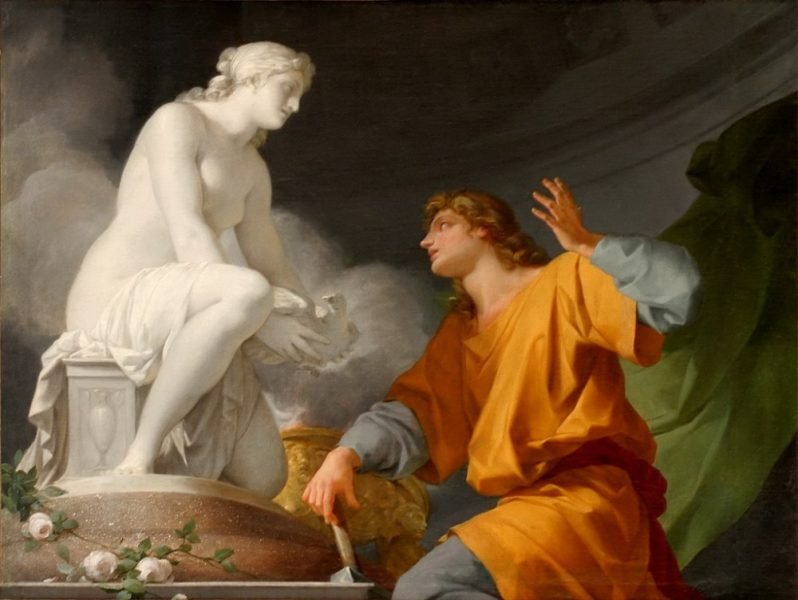
Ballet pantomime in three acts premiered on 5th June 1893 at the Royal Opera House, London
Choreography: William Thompson
Music: Auguste Péchard
Premiers Rôles
Galatée: Marta Draeger
Pygmalion: Frederick Hale
Minos: Jean Rousset
La Rose: Sarah Nicholson
Plot
Acte 1
Pygmalion’s atelier. There are easels, sculptures and paintings around the room, some finished, some unfinished. There are all manner of objects to be drawn ranging from fruits to musical instruments to live models. Six young men and women stand around the room, some drawing or being drawn, some sculpting or being sculpted and others simply talking and laughing. Downstage left is a raised alcove covered with a red curtain.
Pygmalion’s students are in his workshop for another day. Eventually they grow bored of painting and one suggests that they dance to amuse themselves. Pygmalion then enters and chides his students for being too lazy to work; they try to get him to dance and when that fails some of the women ask him to draw or sculpt them. Pygmalion refuses, having a notorious dislike for live models and sends all of them away. Pygmalion then unveils the alcove to reveal a beautiful statue of a young woman. He had sculpted this statue for himself and had named her Galatée. Pygmalion serenades the statue, telling her how much he loves her and wishing she could reciprocate his love. He covers the statue in the curtain again and prays to Venus, that she may grant his statue life. Venus enters and decides that she will grant Pygmalion’s wish. She first animates some of Pygmalion’s other statues who perform a waltz. Then she throws the curtain off and reveals Galatée, then animates her. Galatée steps down from her alcove and is immediately entranced by her surroundings. When she finally meets eyes with Pygmalion, she falls in love. They dance together and Pygmalion, overjoyed, thanks Venus and runs to go show Galatée some of his paintings of her. Meanwhile, King Minos enters and sees Galatée by herself in the atelier. He is immediately smitten by her beauty and decides to kidnap her. She resists but he is too strong for her and carries her off. Pygmalion re-enters and upon seeing Galatée gone, becomes saddened. Venus enters and tells Pygmalion that Galatée has been kidnapped and they both leave to find her.
Acte 2
The Palace of King Minos. A ballroom is ornately decorated with candles on the walls and golden flourishes. There are guards standing on the sides talking instead of paying attention. There is a bard reciting poetry to an audience with a musician accompanying him.
Minos enters dragging Galatée and again declares his love for her. Galatée, on the other hand, is more interested in the palace itself, marvelling at the golden walls and grandeur. Minos sees this and immediately calls his servants to bring her luxurious goods: silver jewellery, precious stones, fine fabrics, beautiful laces and the crowning glory, a large gilded mirror. Galatée, on seeing her reflection for the first time, is both entranced and intrigued by her own reflection. Minos then tries to gain her affections, but she still rejects Minos’ advances as she is more intrigued by his finery. Minos then resorts to giving her a goblet in which he has placed a love potion. She drinks from the goblet and falls in love with Minos. He asks her to dance and finally she agrees. A Grand Pas is performed featuring people from the Greek empire: Minoans, Spartans, Macedonians, Lydians and Arcadians. Suddenly, Pygmalion runs in and tries to rescue Galatée. When she doesn’t leave, he asks her why. She replies she loves Minos and Minos agrees with contempt. Pygmalion is saddened but Venus appears to him in a vision telling him to kiss her. He kisses Galatée and the spell is broken. Minos goes to kill Galatée, but Venus appears and intercedes. Minos relents as he knows not to challenge the power of a goddess. Venus then blesses their union.
Acte 3
Interior of the temple of Venus. The walls are richly decorated with flowers, pearls and paintings depicting beautiful things. In the centre on a raised platform is Venus enthroned and triumphant. People hurry about, trying to finish the preparation before the Veneralia.
Just as the decorations are being finished, a trumpet sounds, signalling the start of the Veneralia. There is a grand procession in which everyone enters the temple and hails the statue of Venus. Last to enter are Pygmalion and Galatée, finely dressed. After the march there is a Grand Divertissement in honour of Venus with dances for the roses, pearls, cupids, swans, priestesses of Venus and a dance for the three graces. Next is the Grand Pas de Deux for Pygmalion and Galatée. All the parties dance a waltz, and everyone comes together in a grand apotheosis of Venus and Hymen enthroned.
History
Original Production
Pygmalion was considered to be one of Thompson’s finest works (though many considered his 1896 ballet The Swords of Toledo to be finer). Created for the celebrated danseuse Marta Draeger to a score by Auguste Péchard, the lavish production was a success at its première.
Pygmalion followed in the footsteps of Thompson and Péchard’s ballet Alice’s Adventures in Wonderland, which premièred in 1890 with Draeger as Alice. The libretto developed by Thompson and Albert Finch (with whom Thompson would later collaborate for the libretto for The Swords of Toledo in 1896) was based on the Classical myth of Pygmalion and Galatea, as recounted in Ovid’s Metamorphoses. Finch moved the story from Cyprus to Crete to allow for King Minos of Crete to become the story’s antagonist, also creating the conflict of the abduction and rescue of Galatea. Finch was sure to include many opportunities for dance, as Thompson allegedly aimed to rival the successes of St Petersburg with its presentation of spectacle, scale and a parade of pretty dances.
Draeger was cast in the rôle of Galatée, following her successful debuts as Alice in Alice’s Adventures in Wonderland (1890), Béatrix in The Beauty of Ghent (1891) and the titular heroine in Sylvia (1892). Sarah Nicholson was allegedly not pleased with this development, as she believed that since Thompson had created Alice’s Adventures in Wonderland for Draeger, it was Nicholson’s “turn” to have a ballet created for her. Nicholson was instead cast as the Rose in the Grand Divertissement of the third act (where she led a Pas de Six) and would later create the rôle of Léonor in The Swords of Toledo in 1896, a work which was considered by most to be finer than Pygmalion.
Thompson, building on the success of the Polka des Huîtres in Alice’s Adventures in Wonderland, choreographed another dance for the students of the Covent Garden School for Ballet (later known as the Royal Ballet School from 1892): the Danse des Petits Amours in the Grand Divertissement of the third act.
The lavish première was well received and was broadly considered to be a success, with some critics stating that Thompson succeeded in his aim of recreating the extravagance of the Russian stage. There were numerous opportunities for dance in each act, and Draeger as Galatée danced no less than four (if the Valse du Miroir Doré is to be counted) variations and three Grand Pas throughout the ballet.
However, the ballet was not completely without criticism. Many noted the thinness of the plot, that Galatée herself was little more than an accessory to the action and that the action occupied only two of the three acts. The third act, being almost entirely an extended Grand Divertissement that added little to the already completed plot, received criticism for being overly long and self-indulgent though lavish and mostly well arranged. The sets and costumes also received praise, but the principal accolades went to Thompson’s choreography and Draeger’s dancing. Hale’s Pygmalion was thought to be a bit stern for a Romantically minded sculptor, but not so much that it detracted from the overall effect.
Résumé des Scènes et Danses
Acte 1
1) Introduction
2) Grande Scène – L’atelier de Pygmalion
3) Danse des Élèves
4) Scène – Entrée et Récit de Pygmalion
5) Scène d’Amour
6) Scène – Entrée et Récit de Vénus
7) Valse des Statues Animées
8) Scène – Métamorphose de Galatée
9) Grand Pas d’Action
a) Adage
b) Ballabile
c) Variation I
d) Variation II
e) Variation III – Galatée
f) Coda
10) Scène – Départ de Vénus
11) Scène – Entrée de Minos et l’Enlèvement de Galatée
12) Scène Finale
Acte 2
13) Introduction et Scène – Le Palais de Minos
14) Divertissement – Les Produits de Luxe
a) Les Bijoux en Argent
b) Les Pierres Précieuses
c) Les Tissus Fins
d) Les Belles Dentelles
e) Coda-Valse
15) Scène dansante – Le Miroir Doré
16) Scène – Le Gobelet
17) Grand Pas Grecque
a) Entrée
b) Adage Ensemble
c) Danse des Minoens
d) Danse des Spartiates
e) Danse des Macédoniens
f) Danse des Lydiens
g) Danse Arcadienne – Variation [de Galatée]
h) Coda Générale
18) Scène Mimique et Finale – Entrée de Pygmalion
Acte 3
19) Entr’acte
20) Grand Cortège
Grand Divertissement
21) Pas de la Rose (Pas de Six)
a) Andante
b) Danse des Boutons de Rose (Pas de Quatre)
c) Pizzicato pour la Rose
d) Coda
22) Valse des Colombes
23) Danse de Prêtresses de Vénus
24) Pas de Trois – Les Grâces
a) Entrée
b) Variation I – Aglaé (Beauté)
c) Variation II – Euphrosyne (Joie)
d) Variation III – Thalie (Abondance)
e) Coda
25) Danse des Petits Amours (Les élèves d’école de danse)
26) Valse des Perles
27) Grand Pas de Deux
a) Adage
b) Variation de Pygmalion
c) Variation de Galatée
d) Coda
28) Grande Valse Ensemble
29) Apothéose
Selected Revivals
1903
Location: Königliche Oper, Berlin
After Draeger left London in 1894, she returned to her native Berlin, where she soon joined the faculty of the Königliche Oper as a répétitrice, coaching dancers of the troupe in matters of style and artistry. Though she did not care much for character rôles, she was on occasion persuaded to do them, notably appearing onstage in character rôles in the 1900 revival of Paul Taglioni’s Satanella and the 1905 revival of Taglioni’s Ballanda.
In 1903, the director of the Königliche Oper in Berlin expressed a desire to revive Pygmalion for the ten year anniversary of its creation. Draeger seemed receptive to the idea, and wrote to Richard Hague (Thompson’s successor) at Covent Garden for permission to do so. Hague obliged, and a balletmaster was dispached with the orchestral score to stage the ballet.
Draeger danced the character rôle of Vénus and also assisted with the staging of the ballet, at times clashing with the Covent Garden balletmaster where the “modern version” differed from what she remembered from 1893.
One example of this disconnect was in the Variation de Galatée in the Grand Pas d’Action of the first act. Nicholson had replaced the variation in 1899, leading to Draeger’s original variation being forgotten in London. Draeger restored her original variation, setting the choreography herself from what she could remember. She also reversed some of the revisions that had been made to Galatée’s dances when Nicholson took over the rôle, preferring, where memory served, to use what had been created for her.
Much to Draeger’s satisfaction, Die Marmorstatue (the title under which the ballet was staged in Berlin) was well received, though some Berlin critics shared the London criticisms of the length of the third act. Die Marmorstatue was retained in the repertory until the post-war era, being performed for the final time in 1921.
London Revivals
1899 Revival
In 1899 the ballet was revived by Richard Hague for Sarah Nicholson with Harriet Linwood as second cast. Péchard contributed minor revisions to his score. The ballet was technically revived for the benefit of Frederick Hale, who was to retire at the end of the season.
Musical Revisions
A new variation was added for Nicholson as Galatée in the Grand Pas d’Action.
A Variation de l’Orgeuil was interpolated into the Divertissement of the second act as the Variation Saphir. The variation was originally a supplemental variation written for Draeger as the Spirit of Pride in the Pas des Sept Péchés Capitaux from the 1889 revival of Faust.
A new Valse des Perles was interpolated into the third act. Originally, Hague had wished to interpolate the Valse des Fées from Adam’s score for The Fairies’ Goddaughter, which had most recently been revived in 1893 with Nicholson as Ysaure. Though Nicholson seemed receptive, Péchard abjectly refused to have the music of another composer interpolated into his ballet. It was eventually decided to interpolate Péchard’s Valse des Rêves, written for the short-lived 1896 revival of Paolo Redolfi’s 1876 ballet La Rosa d’Argento, revived as The Silver Rose at Drury Lane by John D’Auban. Though the interpolated waltz replaced the original 1893 waltz, it retained the same title, still being known as the Valse des Perles.
A new Grand Pas Classique was written for the third act to replace the original Grand Pas de Deux, composed at Nicholson’s request. Hague was opposed to this suggestion, as to make room for the new pas several dances would need to be cut from the Grand Divertissement to prevent the third act from becoming unwieldy long. Nicholson proposed that the Danse des Prêtresses de Vénus, the Valse des Colombes and the Pas de Trois des Grâces could be cut, along with, of course, the Grand Pas de Deux. This suggestion was, of course, strategic, as the third act had been criticised for its length at the 1893 première, and the dances that Nicholson proposed to be cut were the dances that received the least amount of praise at the première, at least in comparison to the likes of the Pas de la Rose and Danse des Petits Amours. Additionally, she was able to convince Neil Forsyth, the General Manager of the Royal Opera House, towards her side, as he had expressed to Hague his concern about the previous criticisms of the length of third act.
As such, Hague was obliged to commission Péchard for the music for a new Grand Pas Classique. However, once Péchard had completed the music, Hague did not yet begin choreographing, instead focusing his attention on continuing his rehearsals for the first and second acts. Nicholson accused him of stalling, which he very much was, but the arrangement of the rehearsal schedule lay with Hague so there was little Nicholson could do about it. Hague was eventually able to convince Forsyth to refuse Nicholson her new pas, stating that the public and critics would expect to see the Grand Pas de Deux as Draeger and Hale had been praised for its execution at the première. As for concerns of length, Hague agreed to cut the Danse des Prêtresses de Vénus and the Valse des Colombes but would reinstate the Pas de Trois des Grâces to increase opportunities for sujets to dance.
Nicholson, predictably, was furious at her pas being cut and completely walked out of the ballet, refusing to attend rehearsals. Hague, who incidentally was not much fond of Nicholson’s tantrums, was undeterred, moving Linwood up to the new first cast and bringing in one of the leading sujets, Giulia Moretti, stepped in to learn the rôle as the new second cast. Nicholson’s Grand Pas Classique (the music of which had been completed Péchard, though not yet orchestrated) was shelved and the Grand Pas de Deux was restored. This stalemate continued until Michael Anson, one of the balletmasters under Hague, was able to persuade Nicholson to return to rehearsals and dance the Grand Pas de Deux. As such, Moretti was again demoted to her original sujet rôles, and the initial plan was resumed with Nicholson as first cast and Linwood as second cast.
The Grand Pas Classique was later revived for the 1912 revival of The Pearl of Iberia, orchestrated by Lawrence Selwood.
Rôles
Galatée: Sarah Nicholson
Pygmalion: Frederick Hale
Résumé des Scènes et Danses
Acte 1
1) Introduction
2) Grande Scène – L’atelier de Pygmalion
3) Danse des Élèves
4) Scène – Entrée et Récit de Pygmalion
5) Scène d’Amour
6) Scène – Entrée et Récit de Vénus
7) Valse des Statues Animées
8) Scène – Métamorphose de Galatée
9) Grand Pas d’Action
a) Adage
b) Ballabile
c) Variation I
d) Variation II
e) Variation III – Galatée (for Mlle Nicholson)
f) Coda
10) Scène – Départ de Vénus
11) Scène – Entrée de Minos et l’Enlèvement de Galatée
12) Scène Finale
Acte 2
13) Introduction et Scène – Le Palais de Minos
14) Divertissement – Les Produits de Luxe
a) Les Bijoux en Argent
b) Les Pierres Précieuses
c) Les Tissus Fins
d) Les Belles Dentelles
e) Variation Saphir (supplemental variation for The Spirit of Pride in the Pas des Sept Péchés Capitaux in the 1889 revival of Faust)
f) Coda-Valse
15) Scène dansante – Le Miroir Doré
16) Scène – Le Gobelet
17) Grand Pas Grecque
a) Entrée
b) Adage Ensemble
c) Danse des Minoens
d) Danse des Spartiates
e) Danse des Macédoniens
f) Danse des Lydiens
g) Variation Arcadienne
h) Coda Générale
18) Scène Mimique et Finale – Entrée de Pygmalion
Acte 3
19) Entr’acte
20) Grand Cortège
Grand Divertissement
21) Pas de la Rose (Pas de Six)
a) Andante
b) Danse des Boutons de Rose (Pas de Quatre)
c) Pizzicato pour la Rose
d) Coda
22) Valse des Colombes
23) Danse de Prêtresses de Vénus
24) Pas de Trois – Les Grâces
a) Entrée
b) Variation I – Aglaé (Beauté)
c) Variation II – Euphrosyne (Joie)
d) Variation III – Thalie (Abondance)
e) Coda
25) Danse des Petits Amours
26) Valse des Perles (supplemental waltz, the Valse des Rêves, for the 1896 revival of The Silver Rose)
27) Grand Pas de Deux
a) Adage
b) Variation de Pygmalion
c) Variation de Galatée
d) Coda
28) Grande Valse Ensemble
29) Apothéose
1910 Revival
In 1910 the ballet was revived for the benefit of Giulia Moretti, who was to retire at the end of the season. Jane Wheaton was second cast.