La Péri
Or The Peri
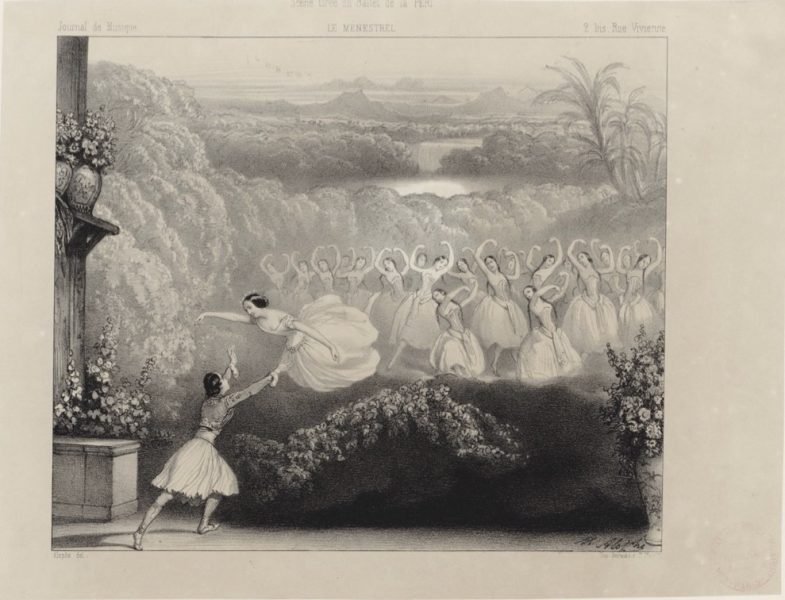
Ballet fantastique in two acts and three scenes premiered on 17th April 1843 at the Théâtre de l’Académie Royale de Musique, Paris
Choreography: Jean Coralli
Music: Friedrich Burgmüller
Premiers Rôles
La Péri/Léïla: Carlotta Grisi
Achmet: Lucien Petipa
Nourmahal: Delphine Marquet
Plot
Summary
Acte 1
The interior of a harem, with marble columns, mosaic pavements, and fretted walls like lace. Here and there are tapestry hangings, and flowers placed in tall vases. In the background is a fountain with high-flung crystal thread. In the left foreground is a divan covered with a lionskin.
At the rise of the curtain the women of the harem are seen busily engaged, under the direction of the chief eunuch, Roucem, in adding artificial beauties to their natural charms, the better to please their master.
A slave-dealer arrives and tells Roucem that he has for sale four European women of great beauty. “What do you ask?” asks Roucem.
“A high price,” replies the dealer. The transaction is concluded after an amusing scene in which the eunuch decries the merchandise as much as the dealer extols it.
Achmet enters with an air of boredom, leaning on a slave.
Roucem, hoping to afford his lord a pleasant surprise, contrives a tent formed of flowing scarves borne by slaves, which parts to reveal the four new women: a Spaniard, a German, a Scotswoman, and a Frenchwoman. The first dances a bolero, the second a waltz, the third a jig, the fourth a menuet. Achmet, momentarily interested, soon resumes his air of boredom.
The truth is Achmet is something of a poet. He is weary of earthly pleasures and dreams of celestial amours. He seeks happiness in an artificial paradise. Dismissing the women, he calls for his opium-pipe. Then, reclining on the divan, he fills his lungs with the smoke and falls into a stupor.
As the drug affects his brain, the harem dissolves in mist to give place to an immense, fairy-like oasis.
Peris, oriental fairies, are grouped about their Queen, who stands amid the prostrate court. A starry crown gleams on her forehead; wings, shot with gold, azure, and purple, quiver on her shoulders; a light muslin skirt envelopes her in a silvery mist.
The peris cross the boundary that divides the ideal from the real world. They gather about Achmet who dreams on, oblivious of their presence. But when the Queen kisses his forehead, he wakes, rises, and perceives the ideal beauty of his dreams. He pursues her, but always she eludes his grasp.
She strives to induce Achmet to follow her into her domain, but, since he cannot fly, she resolves to give him a talisman by which he can summon her at will.
At her bidding the flowers in the vases fall into her hand to form a bouquet, to which she adds a star taken from her crown. “You have but to kiss the star,” she says, “and I will appear.”
Since Achmet is incredulous, the Peri hides; he presses the star to his lips and in a flash she stands before him. Then she takes a tender farewell of the astonished and delighted young man.
With the departure of the Peri, Achmet falls to sleep again.
Later, Roucem enters and awakes his master, who tells him of his wonderful experience. But the eunuch tells him that he has been dreaming. Achmet, half-convinced by Roucem, gives way to doubt. He summons his women and Nourmahal uses all her wiles to arouse her master’s former love for her. He is about to throw the handkerchief to her when the Peri, an invisible witness of this scene, seizes the handkerchief, and places the mystic bouquet in Achmet’s hands.
He remembers and places the star to his lips. At the same moment the Peri appears. She reproaches him, saying: “You are not worthy of an immortal’s love. Farewell!” Then she disappears, taking the bouquet with her.
Nourmahal, astonished at this scene and at the coldness which succeeds Achmet’s ardour, gives way to tears and reproaches.
Achmet, weary of her complaints, repulses his slave and sells her to the dealer.
The Peri re-appears, delighting in her triumph, and restores the bouquet to Achmet. Nourmahal, threatening vengeance, leaves with the merchant.
Acte 2
Scène 1
The terrace of Achmet’s palace, which offers a bird’s-eye view of Cairo, with its myriad domes, turrets, and tall minarets, while in the far distance loom the three giant pyramids of Gizeh. It is night and the moon shines strongly on one of the palace windows.
The Peri’s companions flutter about Achmet’s palace, reviving the flowers with dew poured from golden urns. The Peri herself peers through the gleaming window in search of Achmet, as if to spy upon his actions. One of the peris urges her to renounce this foolish love for a mortal and return to her proper sphere. She hints that Achmet is only in love with her power. The Peri is troubled at the thought of such a possibility.
There is a sudden clamour and it is possible to see a running figure in white, hotly pursued by armed men. The Peri and her companions watch the scene with interest. The woman, as the figure is now seen to be, makes a desperate bound and reaches the terrace, only to be shot by one of the soldiers. She is a fugitive slave from the Pasha’s harem.
The Peri resolves to enter the body of the dead slave and in this humble guise test Achmet’s love. The transformation is accomplished and the Peri becomes the slave, Leila.
Achmet and Roucem enter and find Leila. They restore her to consciousness and she tells them that she has fled the Pasha’s harem, because she cannot return his love. She asks for Achmet’s protection and swears eternal fidelity to him.
The women of the harem, filled with curiosity, run in to see the stranger. Some consider her charming, others find fault with her.
Achmet, fearful of the Peri’s jealousy, treats Leila with reserve, which gradually softens as he becomes aware of her resemblance to that being. He asks her what talents she possesses. She replies that she can play on the gusla, and dance. Achmet tests her abilities and, charmed by her artistry, commands a festival in her honour.
The odalisques seek to rival the newcomer in the graces of the dance. Measure succeeds measure, but Leila triumphs by her interpretation of the famous Pas de l’Abeille, which victory her master acknowledges by covering her forehead and bosom with gold pieces. He bids Leila sit with him and dismisses the other women.
The more Achmet studies Leila, the closer he finds her resemblance to the Peri, but to all his inquiries she replies that she is only a humble slave.
Nourmahal, filled with a burning desire for revenge, makes her way into the palace. She draws a dagger from her girdle and attempts to stab Achmet, but Leila seizes her wrist and turns the weapon aside. Then Nourmahal turns upon Leila, who is saved by Achmet. The former favourite is threatened with death, but Leila intercedes for Nourmahal and secures her pardon.
Suddenly a negro enters in a great fright and declares that the Pasha claims Leila in order to put her to death. Achmet confides her to Roucem who makes her descend into a subterranean passage. There is a tense atmosphere of confusion and alarm.
Scène 2
A prison in a fortress. In the background is a solitary barred window.
Achmet, now a prisoner of the Pasha, attempts in vain to bribe his jailer. Dismayed by his failure he muses sadly on his unhappy lot. All at once the prison wall opens and the Peri appears. She urges him to give up Leila, of whom she pretends to be jealous, and share eternal happiness and power with her. Achmet refuses and the Peri departs in feigned anger.
Now the Pasha summons Achmet for the last time to surrender Leila, and, when he declines, orders the executioners to throw him out of the window, where his body will be torn to death in its descent by the sharp hooks fixed in the wall. Hardly has Achmet disappeared from view when the prison-walls vanish to give place to banks of clouds peopled with peris. The clouds part to reveal a wonderful paradise to which Achmet climbs, holding the hand of his beloved.
History
Original Production
La Péri is a ballet fantastique in two acts and three scenes with a Romantic plot dealing with a mortal’s love for a supernatural being. Gautier’s scenario was inspired by his attraction to the Orient and was devised for his favourite ballerina, Carlotta Grisi, in the guise of a Persian fairy.
Coralli’s choreography provided Grisi with two striking dances: a Pas du Songe that culminated in her daring leap from a six-foot-high platform into her partner’s arms, and a Pas d’Abeille, a decorous striptease prompted by the invasion of an imaginary bee. The ballet’s immediate success did much to revive Grisi’s flagging reputation. It was soon produced on ballet stages in theatres all over Europe.
Beginning in March 1846, the second act was omitted and only the first act was given. However, this did not seem to much matter, as the majority of the interest was generated by the first act, namely by the Pas de Songe. Additionally, there were those who objected to the depiction of Léïla being shot and killed in the first scene of the second act, so its omission was not met with much grievance. The ballet would be retained in the repertory until 1853 and would have a total of 76 performances at the Paris Opéra. Following Grisi’s 1850 departure for St Petersburg, the rôle would be inherited by Marie-Adeline Plunkett and later by Regina Forli.
Selected Revivals
30 September 1843
Location: Theatre Royal, Drury Lane
Staged by Alfred Bunn for Carlotta Grisi and Lucien Petipa, who reprised their rôles.
The production was a huge success, with the Times critic reporting:
“We never saw an audience so completely turned round from an ill-humour to a state of perfect delight as Saturday’s audience were by the dancing of Carlotta Grisi. There is a great deal of tedious pantomime in this piece which should at once be curtailed, but all that is done by Carlotta Grisi is worthy of the highest praise. Her grand achievement is the Pas de deux with Petipa, in the first act. She introduces several evolutions, totally unlike anything that has been seen before; such are a flying movement from one side of the stage to the other, in which she is supported by Petipa, but seems as if supported by air alone; such is a terrific spring she takes from an eminence at the back of the stage, which she continues by a brilliant advance to the lamps. The applause of the audience at these feats was a perfect storm that has rarely been equalled.”
1844
Location: Imperial Bolshoi Kamenny Theatre, St Petersburg
Staged for Elena Andreyanova.
1847
Location: Imperial Bolshoi Kamenny Theatre, St Petersburg
Staged for Tatyana Smirnova with Marius Petipa as Achmet.
1850
Location: Hof-Theater, Weimar
Staged for Lucile Grahn with Hr Ambroglio as Achmet.
17 January 1851
Location: Königliches Hoftheater, Stuttgart
Staged in one act as Die Peri oder Ein orientalischer Traum. It is very likely that the one-act form in which the ballet was staged consisted of only the first act, with the second act completely omitted as had become the practice at the Paris Opéra. The ballet would receive its final performance on 16 November 1895.
11 September [O.S. 30 August] 1856
Location: Imperial Bolshoi Theatre, Moscow
The first act was staged for Marfa Muravieva as part of the gala for the coronation of Tsar Alexander II.
1883/1884
Location: Imperial Bolshoi Kamenny Theatre, St Petersburg
Staged in a one-act production. The ballet was so poorly received it was only given a single performance. A fragment would later be given as part of the 1893 summer season at Krasnoe Selo.
1898
Location: Imperial Bolshoi Theatre, Moscow
The first act was staged for Adelina Giuri.
London Revivals
1892 Revival
In the early 1890s, Covent Garden had two première danseuses: Marta Draeger and Sarah Nicholson. To please them both, in 1892 Thompson decided to revive The Peri for Nicholson and Sylvia for Draeger.
These revivals were a reflection of Thompson’s broader approach to what he considered to be the strengths of the two danseuses: whereas Draeger received most of Thompson’s new creations (Alice’s Adventures in Wonderland in 1890 and later Pygmalion in 1893), Nicholson received his expansions and revisions of Romanic works (which he would continue with revivals of The Fairies’ Goddaughter in 1893 and The Sylph in 1895). The Peri in 1892 marked the first of these Romantic revivals, as he revived the ballet for Nicholson with musical revisions by Péchard.
The ballet was technically produced for the benefit of Rafael Caravetti, a long serving premier danseur of the troupe. Caravetti would portray the rôle of Achmet while Nicholson was to portray the rôle of the Peri. This partnership was a longstanding one, which had begun in 1885 when Nicholson and Caravetti first danced together in the Pas des Paysans in Giselle. The revival also earned Nicholson her promotion to première danseuse, which she received partway through the season.
Rôles
Péri/Léïla: Sarah Nicholson
Achmet: Rafael Caravetti
Nourmahal: Ivy Gregson
Musical Revisions
The second Allegro of the Pas des Femmes of the first act was cut.
A new Variation was added to the first act Pas du Songe for Nicholson’s Peri. Nicholson received good reviews for the new variation, with some critics considering it the high point of the evening.
Owing to the lack of dancing for the corps de ballet, a Ballabile was added to the Pas de la Sultane of the first act for the attendants of Nourmahal, the remainder of which was arranged from Burgmüller’s score.
The Pas Arabe was added to the second act Divertissement for the corps de ballet to provide more dancing for the corps de ballet.
The Andante of the second act Pas de Trois was cut.
A new Variation was written for the Pas de Quatre. The pas was originally Pas de Quatre for four ladies, and Thompson planned to retain the pas as such while inserting a new variation for one of the almées, Lucia Rinaldi. Péchard provided Thompson a variation, but as Thompson began to choreograph the ballet he changed his mind and removed the variation, choosing to revert to the original scheme of the pas. The variation later found a home in the 1901 revival of Esmeralda, where it was interpolated into the Grand Pas des Corbeilles as a variation for Diane.
Thompson had initially wanted to replace the Pas de l’Abeille with a Pas de Deux for Nicholson and Caravetti. The Pas de l’Abeille had been created by Carlotta Grisi at its première, and had been danced by Grisi alone in the guise of Léïla, where the invasion of a bee causes Léïla to cast off pieces of her clothing before hiding under Achmet’s cloak.
Though Nicholson welcomed the idea of a new Pas de Deux, it soon became apparent that it would be too trying for Caravetti to dance two variations during the evening, as Caravetti was 38 years old at the time and he would have already danced a variation in the Pas du Songe of the first act. It was initially suggested that his variation in the Pas du Songe be cut to allow for his variation in the Pas de Deux, but Caravetti preferred to dance his variation earlier in the ballet when he was fresher.
Thus, it was instead decided to add a Pas de Cinq for Nicholson’s Léïla and four female coryphées, with Caravetti’s Achmet watching from the side and not taking part in the pas. The Pas de Cinq had a much more lukewarm reception than Nicholson’s new variation in the Pas du Songe, partially because the variation in the first act was more technically brilliant and partially because Nicholson did not quite succeed in portraying the seductive and sensual quality that the Pas de Cinq seemed to have demanded.
However, during the rehearsal process it seemed that even Caravetti’s one variation in the first act would prove a challenge. Caravetti expressed that he wished to completely remove his variation in the Pas du Songe, but Thompson tried to appease him by shortening his variation as much as possible and simplifying the steps. Rather than appear in such a diminished fashion, Caravetti chose to cut the variation outright and Thompson reluctantly did so.
Résumé des Scènes et Danses
Acte 1
1) Ouverture
2) Scène 1re
3) Scène 2e
4) Scène 3e
5) Pas des Femmes
a) Introduction
b) Andante Sostenuto
c) Allegro
d) Variation I – Ecossaise
e) Variation II – Espagnole
f) Variation III – Française
g) Variation IV – Allemande
h) Coda
6) Scène 4e – Après le Pas
7) Scène 5e – Le Rêve
8) Pas du Songe
a) Entrée
b) Adage
c) Ballabile
d) Variation à deux
e) Variation d’Achmet
f) Variation de Mlle Nicholson
g) Coda
9) Scène 6e – Après le Pas
10) Scène 7e
11) Pas de la Sultane
a) Ballabile
b) Mazurka de Nourmahal
c) Coda
12) Scène Finale – Après le Pas
Acte 2
Scène 1
13) Entr’acte et Scène 1re
14) Scène 2e
15) Scène 3e
16) Scène 4e
17) Scène 5e
18) Scène 6e
Divertissement
19) Pas Arabe
20) Pas de Trois
a) Entrée
b) Allegro
c) Variation I
d) Variation II
e) Variation III
f) Coda
21) Pas de Quatre
a) Entrée
b) Andante Sostenuto
c) Variation
d) Polka
22) Pas de Cinq
a) Andante
b) Valse
c) Variation de Mlle Nicholson
d) Coda
23) Scène 7e – Après le Divertissement
24) Scène 8e
Scène 2
25) Entr’acte et Scène 9e
26) Scène Finale
1903 Revival
In 1903, Nicholson decided that it was time for her retirement. Thus, as per her contract, she was permitted to request a ballet to be revived for her benefit.
She initially selected Yedda to be revived, being attracted to its Japonaiserie scenario. However, she eventually changed her mind, deciding instead that The Peri would be revived for her benefit, fondly recalling the revival of 1892 with Caravetti. Richard Hague, Thompson’s successor, was convinced that she did so to spite him. The two had not seen eye to eye since Hague’s 1897 instatement as balletmaster in chief, as she regarded him as inferior to Thompson and he regarded her as difficult and self important.
However, the reason for Nicholson’s change of mind was likely not as clear cut as Hague had imagined. According to Hague (or at least what can be taken from contemporary accounts of others in the theatre), quite a lot of of the pre-work had been completed by the time of Nicholson’s change of mind: the costumes were being sketched, music revisions had begun, sets were being designed and the casting was being finalised. Hague was thus furious at Nicholson’s request to change the ballet, but as it was for her retirement benefit, there was little he could do about it. He was, however, very vocal about his irritation, at least going by the accounts of the stage manager and others in the theatre.
Hague was convinced that Nicholson changed her mind to spite him, in a final act of malice right before she left. In her memoirs, however, Nicholson gives a completely different account of what happened. She claimed that while she initially wanted Yedda, she was eventually convinced by Hague’s vocal distaste for the ballet. Indeed, Hague made no secret of the fact that he did not like the ballet. Why he was vocally snide about Yedda cannot be known, but it could have been anything from wanting to taunt Nicholson to simply sharing his professional opinion or even to possibly washing his hands of it. What this resulted in was Nicholson doing something that Hague was not used to, nor had she much done before: she began to doubt herself. As such, she abandoned her request to revive Yedda and instead requested to have her benefit ballet be The Peri.
In her memoirs, Nicholson speaks fondly of The Peri. Though it was not loved by many people at the theatre, it was by her, especially so since it held sentimental value for her. It was the ballet in which she danced for the final time with Rafael Caravetti, a danseur with whom she had had her “break” in the Pas des Paysans of the 1885 revival in Giselle. Nicholson, in her memoires, writes that Caravetti was instrumental in easing her nerves, and also said that Caravetti always spoke kindly of her to Thompson, who held Caravetti in high regard. She even referred to him as “her dearest partner,” and though the relationship does not appear to have been romantic (some claimed it was but Nicholson firmly protests this in her memoirs), the pair continued to correspond even after they had both left the stage and Caravetti had returned to Italy.
Curiously, in her memoirs Nicholson states that she went to apologise to Auguste Péchard that his revisions would go to waste because of her change of mind. Even more curiously, she writes that Péchard apparently replied that it would not matter because he was also soon leaving. Judging by the timelines of the change in ballet, and assuming Nicholson did not wait weeks after the change to issue her apology, Péchard’s retirement, while rumoured, had not yet been announced, and in fact was only announced sometime after the conversation. How much later cannot be stated exactly, as Nicholson was not prescriptive in the timeline of events. Péchard himself would naturally have already thought through his retiring and had likely been planning for Tristan and Yseult (which was also to première in the 1903 season) to be his final ballet.
What Nicholson’s surprise does indicate is that not everyone knew he was retiring. Some cited the fact that even though he and Hague did not get on with each other, which everyone knew, Hague had recently commissioned Péchard to provide the score for the 1902 ballet, Fairest Isle, which had been given as part of the coronation gala. To some this had been seen as a gesture of peace, indicating that the two men were willing to set aside their quarrel and work with one another. This hypothesis was likely then grafted onto Hague commissioning Péchard for the score of the the three-act, four-scene Tristan and Yseult for the 1903 season, framing it as signalling the beginning of this new partnership.
However, this gesture did not signal the beginning but the end of their partnership, though many in the theatre were not aware of that until Péchard’s retirement was officially announced. There were some who, of course, had suspected that this would happen, and they instead speculated that Tristan and Yseult was to be Péchard’s retirement ballet, but rumour is always rumour until confirmed.
Hague would later clearly change his mind about Yedda as he would go on to reuse much of the 1903 pre-work for his 1904 revival of the ballet for Harriet Linwood. Why he changed his mind cannot be known, but it is not unreasonable to assume that he was primed to be opposed to whatever Nicholson chose and only with a fresh pair of eyes did he see Yedda’s merits. In any case, he did make tweaks to Péchard’s completed revisions (as though The Peri was to revived in 1903 it needed few revisions, so Péchard continued to work on the planned revisions for Yedda) and changed his conception of the characters.
Musical Revisions
Achmet’s variation in the Pas du Songe of the first act was restored. It had been cut during the 1892 rehearsal process due to Caravetti’s age, but now a younger danseur, Lucien Rigaud, was cast to portray the rôle of Achmet, the variation could be restored, with new choreography by Hague (as Thompson’s choreography for Caravetti had been long forgotten).
There were some discussions about replacing the Pas de Cinq, possibly with a Pas de Deux as Thompson had originally intended in 1892, but it was eventually decided to retain the pas. Nicholson fared better in the pas than she had done in 1892, her experience informing a more nuanced portrayal of her seduction of Achmet.