Giselle
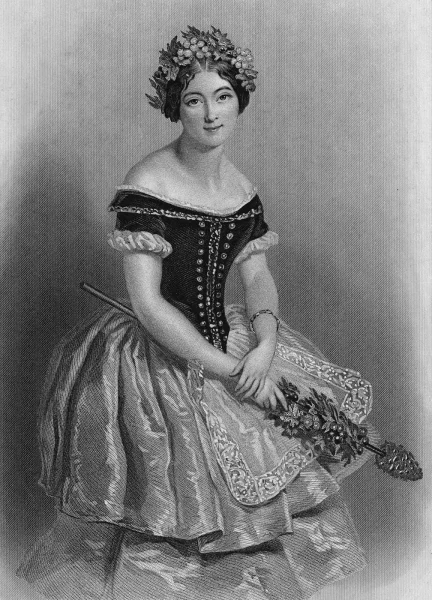
Ballet pantomime in two acts premiered on 28th June 1841 at the Théâtre de l’Académie Royale de Musique, Paris
Choreography: Jules Perrot and Jean Coralli
Music: Adolphe Adam
Premiers Rôles
Giselle: Carlotta Grisi
Albrecht: Lucien Petipa
Hilarion: Jean Coralli
Myrtha: Adèle Dumilâtre
Plot
Summary
Acte 1
In a medieval Rhineland village during the grape harvest, Duke Albrecht, disguised as the villager Loys, courts Giselle, a beautiful peasant girl. Unbeknownst to her he is secretly engaged to a noblewoman, Bathilde. Hilarion, a jealous gamekeeper who is also in love with Giselle, uncovers Albrecht’s true identity and exposes him during the harvest festivities. Heartbroken by Albrecht’s betrayal, Giselle succumbs to madness and dances until her weak heart gives out, dying in Albrecht’s arms.
Acte 2
At night Hilarion comes to mourn at Giselle’s grave but flees as the vengeful Wilis, ghostly spirits of betrayed maidens, appear. Led by their Queen, Myrtha, the Wilis compel any man whom they happen upon to dance to their deaths. Myrtha rouses Giselle’s spirit as a Wili, who is now under Myrtha’s rule. Albrecht also comes to her grave to mourn, but Giselle forgives him. The Wilis happen upon Hilarion and dance him to exhaustion before throwing him into a lake. They then begin to do the same to Albrecht, but Giselle’s love protects him until sunrise. As day breaks, the Wilis are forced to retreat, and Giselle bids Albrecht a tender farewell before returning to her grave to rest in peace.
History
Original Production
It would not be a understatement to state that Giselle ou Les Wilis is one of the most, if not the most popular and enduring works from the era of Romantic Ballet. It was the rôle that launched Grisi to stardom, bringing favourable comparisons to Marie Taglioni (for whom the ballet La Sylphide was created and whom many believed to be the greatest ballerina of her period). It was in many ways a successor to Taglioni’s La Sylphide, as both included hallmarks of the Romantic Ballet era such as a human man in love with a supernatural woman and a “white act” populated by otherworldly maidens dressed in white.
A point of interest is the Pas des Paysans. The music was not by Adam but by Friedrich Burgmüller, who would later compose the score for the ballet La Péri in 1843, which featured Grisi in the title rôle of the Péri/Léïla. The pas was inserted into Giselle at the behest of Nathalie Fitzjames, at the time a ballerina at the Paris Opéra. Though she managed to use her connections to secure a pas for herself, Adam was not available to compose the music. As such, Coralli turned to Burgmüller, and arranged the pas from Burgmüller’s suite Souvenirs de Ratisbonne. Fitzjames was partnered by the danseur Auguste Mabille and the pas would remain a celebrated part of the ballet.
Another point of interest is the Marche des Vignerons. The Marche originated as the Marche Diabolique and was originally composed by Adam for the first act of Faust, a grand ballet in three acts choreographed by André-Jean-Jacques Deshayes that premièred on 16 February 1833 at His Majesty’s Theatre, London. The principal D major flute and violin melody of the Scène de la Réconciliation from the second act of Giselle also originated in Faust, where it was composed as the Andantino of the Grand Pas de Quatre of the second act. It is worth noting that it is only the sole melody that bears a resemblance between the two ballets, as the passage was reorchestrated for Giselle and proceeded differently following the melody’s initial statement.
Selected Revivals
12 March 1842
Location: Her Majesty’s Theatre, London
Staged by Deshayes and Perrot for Carlotta Grisi. The Pas des Paysans was cut from the first act of this staging. The ballet ran for thirteen performances, two of which were attended by Queen Victoria. For a ball held at Buckingham Palace in April of that year, the composer Jullien was commissioned to arrange a quadrille, a galop and a waltz based on Adam’s score for the ballet.
30 December [O.S. 18 December] 1842
Location: Imperial Bolshoi Kamenny Theatre, St Petersburg
Staged by Antoine Titus for Elena Andreyanova
1842
Location: Teatro Regio, Turin
Staged for Nathalie Fitz-James with Arthur Saint-Léon as her Albrecht. The rôle of Myrtha was danced by a young Amalia Ferraris.
30 March 1843
Location: Her Majesty’s Theatre, London
Staged by Benjamin Lumley for Fanny Elssler for a run of eight performances.
1843
Location: Imperial Bolshoi Theatre, Moscow
Staged by M Didier.
1 January 1846
Location: Howard Athenæum, Boston
Staged by Mary Ann Lee, the first staging of the ballet in the United States. Lee danced the titular rôle with George Washington Smith as her Albrecht.
13 April 1846
Location: The Park Theatre, New York
Staged by Mary Ann Lee. Lee danced the titular rôle with George Washington Smith as her Albrecht.
22 October [O.S. 10 October] 1848
Location: Imperial Bolshoi Kamenny Theatre, St Petersburg
Staged by Antoine Titus for Fanny Elssler with Marius Petipa as her Albrecht. A Pas de Trois was inserted into the first act by Elssler, presumably to replace the Pas des Vendanges.
16 October [O.S. 4 October] 1850
Location: Théâtre à l’Orangerie, Warsaw
Staged by Roman Turczynowicz for his wife Konstancja Turczynowicz with Aleksander Tarnowski as her Albrecht. The score was revised by Joseph Stefani.
The surviving programme seems to indicate that the Pas des Paysans was cut from the first act.
20 October [O.S. 8 October] 1850
Location: Imperial Bolshoi Kamenny Theatre, St Petersburg
Staged by Jules Perrot for Carlotta Grisi with Christian Johansson as her Albrecht. A Pas de Cinq to the music of Cesare Pugni was added to the first act for Grisi, presumably to replace the Pas des Vendanges. The pas was danced by Grisi’s Giselle, Johansson’s Albrecht and three female sujets: Anna Prikhunova, Anastasia Amosova and Maria Sokolova.
23 February 1851
Location: Königliches Hoftheater, Stuttgart
Staged under the title of Gisella oder Die Willys.
11 August 1852
Location: Théâtre de l’Académie Nationale de Musique, Paris
Staged for Regina Forli with Lucien Petipa as her Albrecht. They were joined by M Adice as Hilarion, Mme Émarot (the mother of the famous Emma Livry) as Myrtha and Nadezhda Bogdanova and Louis Mérante in the Pas des Paysans.
8 May 1863
Location: Théâtre Impérial de l’Opéra, Paris
Staged for Marfa Muravieva with Louis Mérante as her Albrecht. They were joined by Eugène Coralli as Hilarion, Laure Fonta as Myrtha and Zina Mérante and M Chaupy in the Pas des Paysans.
Zina Mérante would debut in the rôle on 30 September 1863 following Muravieva’s departure from Paris for Russia, and would be “very cordially greeted” in the rôle.
Nadezhda Bogdanova would make a single guest appearance on 13 November 1865, dancing only the first act. She had requested to dance the entire ballet, but Émile Perrin, the director of the Paris Opéra at the time, would only permit her to dance the first act. Her appearance passed almost unnoticed and, likely due to the poor reception of her appearance, Bogdanova would not again return to Paris.
11 May 1866
Location: Théâtre Impérial de l’Opéra, Paris
Staged for Adèle Grantzow with Louis Mérante as her Albrecht. They were joined by Eugène Coralli as Hilarion, Laure Fonta as Myrtha and Mlle Fiorelli and M Chaupy in the Pas des Paysans.
25 December [O.S. 13 December] 1866
Location: Imperial Bolshoi Kamenny Theatre, St Petersburg
Staged for Adèle Grantzow. It was for Grantzow that the now famous Variation of Giselle was added to the Pas de Deux of the second act, the music of which was composed by Pugni.
7 May 1870
Location: Wiener Hofoper, Vienna
Staged by Karl Telle for Guglielma Salvioni partnered by Alfred Franz Eugen Charon as Albrecht.
The Pas des Paysans of the first act seems to have been replaced with a Pas de Trois danced by two danseuses and one danseur. The composer of the Pas de Trois is not indicated, so it is unclear if the music for the pas was an arrangement of the Pas des Paysans or was a new interpolation.
The ballet would be restaged in 1876 for Adèle Grantzow, 1880 for Lugia Cerale and in 1894 for Irene Sironi.
17 February [O.S. 5 February] 1884
Location: Imperial Mariinsky Theatre, St Petersburg
Staged by Marius Petipa for Maria Gorshenkova with Pavel Gerdt as her Albrecht.
Petipa added a new Pas de Deux for Gorshenkova to the first act, presumably to replace the Pas des Vendanges. The music for this pas was supplied by Ludwig Minkus, and was assembled from re-orchestrated and rearranged numbers from Adam’s 1852 ballet Orfa.
24 December 1884
Location: The Empire Theatre, London
Staged by A. Bertrand for Alice Holt as Giselle and Mlle Sismondi en travesti as Albrecht/Loys.
1886
Location: Königliche Oper, Berlin
Staged for Antonietta Dell’Era.
1887
Location: Imperial Mariinsky Theatre, St Petersburg
Staged by Petipa for Emma Bessone with Pavel Gerdt as her Albrecht. Anna Johansson danced the rôle of Myrtha and Enrico Cecchètti also appears to have danced Albrecht at some point opposite Bessone’s Giselle.
The production was “refreshed” with new costumes designed by Evgeny Ponomarev.
Aleksey Pleshcheyev reviewed Bessone’s début performance as follows:
“She made her debut on 12 April in “Giselle”, dancing this role for the first time in her life. Mme. [Emma] Bessone is a terre à terre dancer with steel pointe, which gives her the ability to perform bewildering pas. The ethereal Giselle did not quite harmonize with the nature of the debutante’s talent, but nevertheless she had a success, and won great approval in pas de deux with M. [Pavel] Gerdt, and in the variation of her own composition and in other plug-in devilry. Although critics praised this dancer, Mme. Bessone did not possess enough grace. Her dances, in comparison to the dances of [Antonietta] Del-Era [sic], looked rather as a rough work, revealing abundant, but not much developed abilities. Mme. Bessone, no doubt, could surprise and amaze, but she did not fascinate the audience.As a mime actress, Mme. Bessone showed a lot of life, fervor, temperament, and the scene, when Giselle went crazy out of love and jealousy and died, she performed very well.”
Location: Imperial Mariinsky Theatre, St Petersburg
Staged by Petipa for Elena Cornalba. It was Cornalba that interpolated the now famous Pas Seul into the first act. It was composed by Riccardo Drigo for Cornalba’s performances in Fiametta in 1887 and she likely transferred it into the first act of Giselle when Petipa revived the ballet for her.
17 September [O.S. 5 September] 1899
Location: Imperial Mariinsky Theatre, St Petersburg
Staged by Petipa for Henrietta Grimaldi. Olga Preobrazhenskaya danced the rôle of Myrtha in this production. Lyubov Petipa would replace Preobrazhenskaya as Myrtha from the third performance onwards.
The production was given five times during the 1899/1900 season, with Grimaldi dancing the first three, possibly four performances. The final performance of Giselle (O.S. 28 December 1899) was danced by Preobrazhenskaya with Lyubov Petipa as Myrtha.
17 September [O.S. 10 October] 1901
Location: Imperial Mariinsky Theatre, St Petersburg
Staged by Petipa for Carlotta Zambelli. Julia Sedova danced the rôle of Myrtha in this production.
The production was given three times during the 1901/2 season, on 28 October, 4 November and 7 November (all dates O.S.).
On O.S. 26 November 1901, the ballet critic Konstantin Skalkovsky reviewed Zambelli as follows:
“I did not see Mme. [Carlotta] Zambelli in Coppelia, but in Giselle, during the second act, this pearl of choreography, there was such a darkness on the stage, that even from the first row you could hardly make anything out, as if the action took place in the “cellar of foreign wines”. However, people who understand things could not but admire the performance of Mme. Zambelli in it. The famous pas de deux in the second act is the pinnacle of the poetry; she fluttered across the stage like a real Willi, and everyone subconsciously felt sorry for such a treasure to be buried back into the grave.
There cannot be seriously two opinions about Mme. Zambelli. She maybe not like one artist or another, tastes are different – but, of course, she is the first dancer now in Europe. Otherwise, the Paris Opera, in view of its centuries-old glorious traditions, would not have engaged her as a prima ballerina; yet Mme. Zambelli has been dancing there for the sixth year, and for the first three years after graduation she danced along with the aged Mme. [Rosita] Mori [sic], with whom she contrasted in lightness.
Mme. Zambelli represents a very rare combination of all the qualities required of a first class classical dancer. She has beautiful appearance, a delicate build, strong legs with good turnout, taste, and elevation. She mimes as mush expressively, as she easily, brilliantly and gracefully dances. Such combinations, I repeat, are very rare.
…
Mme. Zambelli has significant “ballon”, that is when she rises in a dance from the ground, it seems as if she is floating in the air. This optical illusion depends on the invisibility of the effort. Her performance generally has such an ease, that it seems that she does everything as a playful joke. This is the top notch of choreographic art, the highest stage of an excellence. With ease and freedom of movement, the artist must show that she overcomes all the difficulties without effort and exertion – in a word, she must hide her art.”
13 May [O.S. 30 April] 1903
Location: Imperial Mariinsky Theatre, St Petersburg
Staged by Petipa for Anna Pavlova with Nikolai Legat as her Albrecht. Sedova again danced the rôle of Myrtha.
London Revivals
1879 Revival
In 1879 William Thompson revived the ballet for Isabella Velluti. This was the third full length ballet he revived, and Velluti herself had a hand in the choice of ballet. The ballet proved to be quite popular with the London audiences, who were charmed with Adam’s music and the story as Parisian audiences had been decades prior. The score received relatively minor revisions by François Bardet and he also composed some new music as per Thompson’s request.
This third revival for Velluti had the effect of further sidelining Marguerite Lemoine to the point of resentment. Lemoine had been a danseuse with Thompson’s troupe before Her Majesty’s, and had been displaced when Thompson engaged Velluti. For the past two years, Velluti had been given the titular rôles in the revivals of Ondine in 1877 and Esmeralda in 1878, while Lemoine was relegated to the secondary rôles of Giannina in Ondine and Fleur de Lys in Esmeralda in addition to a one-act ballet Diavolina.
Lemoine was so offended by being sidelined for the third time that she left for France shortly after the announcement of Giselle. She would not dance in the 1879 season. She would eventually return to London in 1880, when Thompson would revive Griseldis with Lemoine as the titular heroine, a move which only temporarily soothed her annoyance.
A point of note is the positioning of the Pas des Paysans (a.k.a the Peasant Pas de Deux). Modern productions differ on whether the pas is danced to entertain the nobles as they rest from their hunt or whether the pas is danced as part of the harvest celebrations. In the original production the pas occurred during the harvest celebrations (before the Pas des Vendanges) and when Petipa staged the ballet the pas also occurred during the harvest celebrations (after the Pas Seul and before the Galop Général).
When Thompson staged the ballet in 1879 he followed the Parisian convention. Subsequent London revivals followed the traditional positioning of the pas.
Rôles
Giselle: Isabella Velluti
Albrecht: Samuel Penrose
Zulmé: Adèle Vernay
Musical Revisions
A variation was composed for Giselle in the Pas des Vendanges of the first act. This pas (which does not appear in the vast majority of revivals today) was originally placed before the Galop Général of the first act and after Giselle is crowned Queen of the Vintage. A classically structured four-part Pas de Deux, the pas was danced by Albrecht (under the disguise of Loys) and Giselle.
The only part of this pas that is included in productions today is the Coda, which is the music that occurs after the Valse of the first act where Giselle and Albrecht dance together. The complete pas was retained by Thompson and continued to be part of the London performance tradition of the ballet for many years.
A variation was composed for Giselle in the Grand Pas de Deux of the second act and was danced between Albrecht’s variation and the Coda.
Résumé des Scènes et Danses
Acte 1
1) Introduction
2) Scène Première – Les Vendangeurs
3) Scène – Entrée du Prince
4) Scène – Entrée de Giselle
5) Scène – Entrée d’Hilarion
6) Scène – Le Retour de la Vendange
7) Valse
8) Scène – Récit de Berthe
9) Scène – Entrée des Chasseurs
10) Scène d’Hilarion
11) Marche des Vignerons
Divertissement
12) Pas des Paysans
a) Entrée
b) Adage
c) Variation du danseur
d) Variation de la danseuse
e) Deuxième variation du danseur
f) Deuxième variation de la danseuse et Coda
13) Pas des Vendanges
a) Andante
b) Variation de Loys
c) Variation de Giselle
d) Coda
14) Galop Général
15) Scène Finale
Acte 2
16) Entracte et la Halte des Chasseurs
17) Scène – Apparition de Myrtha
18) Scène – Apparition des Wilis
a) l’Evocation Magique
b) Andante
c) Valse des Wilis
d) Variation de Myrtha
e) Coda
19) Scène – l’Apparition de Giselle
20) Scène – Entrée des Paysans
21) Scène – Entrée d’Albrecht
22) Scène – La Réconciliation
23) Bacchanale des Wilis
24) Scène – La Sortie des Wilis
a) Entrée d’Albrecht
b) Fugue des Wilis
25) Grand Pas de Deux
a) Andante
b) Allegretto
c) Variation d’Albrecht
d) Variation de Giselle
e) Coda
26) Scène Finale
1885 Revival
In 1885 Thompson revived the ballet for Emma Ashfield who had that year been promoted to the rank of première danseuse. It was to be her first leading rôle, as prior to then (due to her rank) she was confined to supporting rôles (though she notably danced the Marchesa opposite Lemoine’s Angela in the 1882 revival of Marco Spada). Few changes were made to the score for Ashfield and she danced both of Velluti’s additional variations.
Sarah Nicholson (who would later rise to the rank of première danseuse and would be remembered as the rival of the celebrated Marta Draeger) was selected to dance the Pas des Paysans following her successful performances as Dawn in the third act of Coppelia a few weeks before Giselle‘s run was scheduled to begin. Thompson recognised her talent and so cast her in this rôle in Giselle, which she alternated with another female sujet. Nicholson was partnered by Rafael Caravetti and her success in the rôle led to her promotion to coryphée later that year.
Rôles
Giselle: Emma Ashfield
Myrtha: Mary Butler
Pas des Paysans: Sarah Nicholson and Rafael Caravetti
1888 Revival
In 1888 Thompson revived the ballet for Marta Draeger with Bardet again composing additions to the score. This was to be the last ballet that Bardet would revise for London as he retired from London and moved back to France at the end of the 1888 season. Butler (rumoured to be dissatisfied with not having yet received a promotion to première danseuse and being eclipsed by Nicholson) would also retire from the London stage that year, joining the troupe of the Théâtre Royal de la Monnaie in Brussels.
Despite Draeger’s enthusiasm to portray the titular heroine, her performances as Giselle received mixed reviews from the critics. Her performance in the first act was better received, with critics praising the new Pas de Deux that she danced with Giuseppe Mainero. However, the critics were less enthusiastic about her performance in the second act, with several stating that Draeger did not quite succeed in portraying the ghostly quality that the act demanded, drawing unfavourable comparisons to Ashfield’s portrayal three years prior. A rather sharp critic even suggested that Nicholson seemed better suited to the rôle than Draeger, stating:
“Miss Draeger, having delivered a commendable first act, fails thereafter to convey the true poetry of the second. She dances with no small grace, yet one cannot wish to see Giselle hurl herself across the stage, a manner entirely contrary to the demands of the rôle. Miss Nicholson, in the rôle of Myrtha, embodies all that a wili ought to be: cold, ethereal, and gliding lightly across the scene. Perhaps the unfortunate Giselle might do well to study her queen, and so learn what she ought truly to be.”
Rôles
Giselle: Marta Draeger
Albrecht: Giuseppe Mainero
Myrtha: Sarah Nicholson
Hilarion: Jean Rousset
Pas des Paysans: Ivy Gregson and Frederick Hale
Zulma: Marie Saunier
Moyna: Harriet Linwood
Musical Revisions
A new Pas de Deux was composed for Draeger to replace the Pas des Vendanges of the first act. This relatively simple charming pas unexpectedly became one of Draeger’s favourite creations, to the surprise of Thompson and several others. She interpolated the pas into other works, and she notably performed the pas near the end of the fifth act of the 1890 revival of Shakespeare’s As You Like It at the Lyceum Theatre. She also interpolated the pas into the third act of the 1894 revival of The Devil to Pay to replace Adam’s original Grand Pas de Deux Noble, but the pas would eventually be replaced by Nicholson when she danced in The Devil to Pay in 1900.
Résumé des Scènes et Danses
Acte 1
1) Introduction
2) Scène Première – Les Vendangeurs
3) Scène – Entrée du Prince
4) Scène – Entrée de Giselle
5) Scène – Entrée d’Hilarion
6) Scène – Le Retour de la Vendange
7) Valse
8) Scène – Récit de Berthe
9) Scène – Entrée des Chasseurs
10) Scène d’Hilarion
11) Marche des Vignerons
Divertissement
12) Pas des Paysans
a) Entrée
b) Adage
c) Variation du danseur
d) Variation de la danseuse
e) Deuxième variation du danseur
f) Deuxième variation de la danseuse et Coda
13) Pas de Deux
a) Adage
b) Variation I
c) Variation II
d) Coda
14) Galop Général
15) Scène Finale
Acte 2
16) Entracte et la Halte des Chasseurs
17) Scène – Apparition de Myrtha
18) Scène – Apparition des Wilis
a) l’Evocation Magique
b) Andante
c) Valse des Wilis
d) Variation de Myrtha
e) Coda
19) Scène – l’Apparition de Giselle
20) Scène – Entrée des Paysans
21) Scène – Entrée d’Albrecht
22) Scène – La Réconciliation
23) Bacchanale des Wilis
24) Scène – La Sortie des Wilis
a) Entrée d’Albrecht
b) Fugue des Wilis
25) Grand Pas de Deux
a) Andante
b) Allegretto
c) Variation d’Albrecht
d) Variation de Giselle (1879)
e) Coda
26) Scène Finale
1898 Revival
In 1898 the ballet was revived for Sarah Nicholson. She requested to dance the Pas de Deux that had been added for Draeger in 1888 but was not allowed to do so, and so instead danced the Pas des Vendanges with Velluti’s 1879 variation, with new choreography supplied by Richard Hague.
This revival also marked a significant change in the way ballets were cast. Generally (with certain exceptions) a ballet would be revived or choreographed for a particular danseuse and only she would dance it. The exception to this rule was diversions following operas, in which the première danseuse rôle would generally alternate more freely. As part of Hague’s modernisations, he wished to break the monopoly that danseuses had on their rôles and to introduce multiple casts of the same rôle during the same run, to give more opportunities to the dancers of the troupe. Hague had allegedly shared this idea with Thompson prior to his 1896 retirement, but Thompson did not approve of the destruction of the traditional model. However, Thompson did make concessions for the 1895 and 1896 seasons, as the ballets Coppelia (1895), The Sylph (1895) and The Buccaneers (1896) were all revived for Nicholson, alternate danseuses were cast in the lead rôles (Giulia Moretti for Coppelia, Marie Saunier for The Sylph and Harriet Linwood for The Buccaneers) in order to not overload Nicholson and allow her to rest between performances. Though Nicholson at first protested she eventually accepted the arrangement as the other danseuses were explicitly considered to be alternates and not considered to be sharing the rôle in earnest.
In 1898, Hague explicitly broke this tradition by casting both Nicholson and Harriet Linwood in the rôle of Giselle. Linwood had been promoted to première danseuse by Hague at the end of the 1897 season, ending Nicholson’s reign as the sole première danseuse at Covent Garden following Draeger’s 1894 retirement. Nicholson was furious about sharing the rôle and complained to management that her contract was being breached by being expected to share a rôle without her express permission. Unfortunately for Nicholson, nowhere in her contract was this stated, as it was more an understood convention than a contractual obligation and thus Hague had not technically erred in changing it.
Although Hague was initially relieved that management had sided with him, his relief soon gave way to disappointment with the reviews for Linwood’s Giselle. The critics were not pleased with her portrayal, with some even going so far as to state that she was entirely unsuited to such rôles. Nicholson fared much better in the rôle and received good reviews for her performances. Nevertheless, the revival started the new convention that would continue at Covent Garden, and following the revival the vast majority of rôles, even those of premières and premiers, would have more than one cast.
Rôles
Giselle: Sarah Nicholson
1905 Revival
In 1905 the ballet was revived for Giulia Moretti with Carolina Ferreira as second cast. Moretti’s portrayal, though less ethereal than Nicholson’s had been, was nonetheless appreciated for its depth of feeling and nuance of emotion across the ballet. However, there were still some critics who considered her unsuited to the rôle, and instead praised Ferreira’s interpretation as the more “poetic” one.
Linwood was extremely displeased to learn that she would not dance Giselle. Hague cited her poor performance in 1898, but she was determined to redeem herself and so set about securing some performances for herself. She eventually managed to wrench performances from Moretti and Ferreira, dancing the rôle twice and faring better than she had done six years prior.
1913 Revival
In 1913 the ballet was revived for Sofia Zacchini with Susan Harmon as second cast.