Music and Musicians
The foundation of ballet and those who created it
History
It would not be an overstatement to claim that music is one of the most important and influential, if not the most important and influential part of a ballet.
The orchestras at Her Majesty’s Theatre and Covent Garden, though smaller than the orchestras of today, seemed to have been more than adequate to support the opera and ballet. The musicians are, unfortunately, scarcely mentioned in the surviving documentation, save for account books that show what was paid and to whom.
A notable exception to the oft unreferenced orchestra is Friedrich Mandl, a virtuoso Prussian harpist engaged at Covent Garden from 1894. Several pieces were specially composed for his talents, including the Variation de Mazourka in the Pas de Leçon of The Devil to Pay (1894), the Variation de Mlle Nicholson in the Grand Pas des Syphides of The Sylph (1895) (later interpolated into the 1901 revival of Ondine) and the Pas de la Guitare of The Swords of Toledo (1896).
Composers, such as François Bardet and Auguste Péchard (who both in sequence held the position of Official Composer of the Ballet Music), would work directly with the balletmaster, either supplying music for them to choreograph to or composing music to support a preconceived piece of choreography, as was the style of the balletmaster in question.
Music for Rehearsal: Violin or Piano?
The instrument most associated with ballet instruction, since its inception was the violin. The pochette (also called the violon de poche or pocket violin) was used by dance masters at royal courts and aristocratic settings from the 15th through to the 19th centuries.
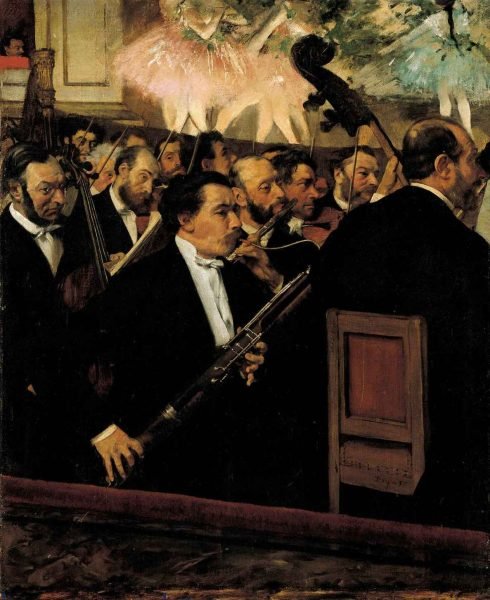
The violin continued to be associated with ballet instruction in Paris (an oft featured musician in the works of Edgar Degas), both in the daily class and in rehearsals. The daily ballet class was usually conducted with a solo violin that supported the exercises set by the balletmaster, responding to the steps and dynamic by playing improvisations or extracts from operas, ballets, symphonies or other extracts of music. Some balletmasters used a violinist for this purpose, while others still retained the older tradition of accompanying their exercises themselves on the violin. For rehearsals of ballets, where the music was composed rather than improvised, a two-violin répétiteur (a reduction of the orchestral score for two violins) was used, with the first violin generally playing the melody and the second the accompaniment. However, there is evidence of rehearsals also being conducted with a single violin instead of two, where the solo violin would play the melody alone.
Towards the end of the 19th century, the piano began to appear in classrooms and rehearsal rooms, supplementing or in some cases replacing the violin. It is often claimed, as far as records indicate, that André Messager’s Les Deux Pigeons (1886) was the first ballet at the Paris Opéra to be rehearsed with piano as opposed to violin, but the change, both in Paris and in other cities, was gradual.
In London, the shift from violin to piano was not an abrupt one, nor was it by any means universal. The first reference to piano accompaniment in relation to ballet that we can find is in 1892, in relation to the revival of The Peri. Nicholson, in her memoirs, states rather dismissively that:
“I remember myself particularly irritated on that occasion, for the unfortunate musician at the pianoforte never once succeeded in following my tempo, a matter which tried my already worn patience.”
What this tells us is by 1892, rehearsals were being conducted to piano in some capacity. However, we do not know if this anecdote refers to a stage rehearsal or a studio rehearsal, nor do we know whether rehearsals to piano were a usual or an unusual thing, but what we do know is that the piano was present in the rehearsal room.
The next reference we can find is in 1895 for rehearsals of Coppelia. In the stage manager’s book, we find the notice in relation to a stage rehearsal of the ballet:
“Mr Ford is ill, Mr Myers obliged instead on violin”
Upon examination of the payment accounts for the year of 1895, we find Mr Ford’s name as listed as répétiteur de pianoforte (one of two listed as such). Since we know that violin scores were called violin répétiteurs, it is not unreasonable to assume that répétiteur de pianoforte would refer a rehearsal pianist. The “instead”, however, is unclear, as it does not tell us whether the “instead” is being used to indicate the substitution of musician (that Mr Ford was the usual rehearsal musician and Mr Myers was the substitute) or the substitution of instrument (that the piano was the usual instrument in this situation and the violin was the substitute).
Various other such references keep cropping up through the 1890s and 1900s, leading us to the conclusion that the piano was used as time went on. Unsurprisingly, there is no record of a troupe-wide mandate on which instrument was to be used in rehearsals or classes, suggesting that it was a more a matter of what worked for the task and people at hand.
Another point of note is the question of rehearsals of full ballets versus the daily ballet class. In the daily ballet class, the balletmaster would either, according to his style, set new exercises to challenge the dancers or set known exercises to address specific technical demands. In both cases, it would be the musician’s job to supply an ex tempore accompaniment that fit the steps and the dynamic of the exercise. This accompaniment could, as mentioned, be completely his own invention, or it could be extracts from operas, ballets, salon works, symphonies or whatever other music he had in his head that would work for the exercise. It would then be reasonable to assume that the matter of music was dictated by the balletmaster’s personal preference. An older or more traditionally-minded balletmaster may have preferred to use a violinist or even to accompany himself on the violin, whereas a younger or more modern-minded balletmaster may have preferred to use a pianist.
As for rehearsals of full ballets, where the music was composed and thus the same every rehearsal, it would have been much easier to bring in a pianist, as once given the correct tempi he would be able to read and play the sheet music.
Finally, it would be reasonable to assume that violin hung on much longer in the daily ballet class than in rehearsals of full ballets, for the primary reason that the violinists were already trained in the skill of responding to the balletmaster, while pianists, at least initially were not. Whereas for a rehearsal you could supply the pianist with a reduction to play, for a ballet class you could not, as most balletmasters would not be obliged to stick to some pre-agreed plan, preferring instead to tailor their class to the needs of the day, season, dancers and other such things. However, such as skill would eventually start to be learnt by pianists, leading to pianos being heard in ballet class as frequently as violins, eventually supplanting them completely, as is the case today.