Le Diable à Quatre
Or The Devil to Pay
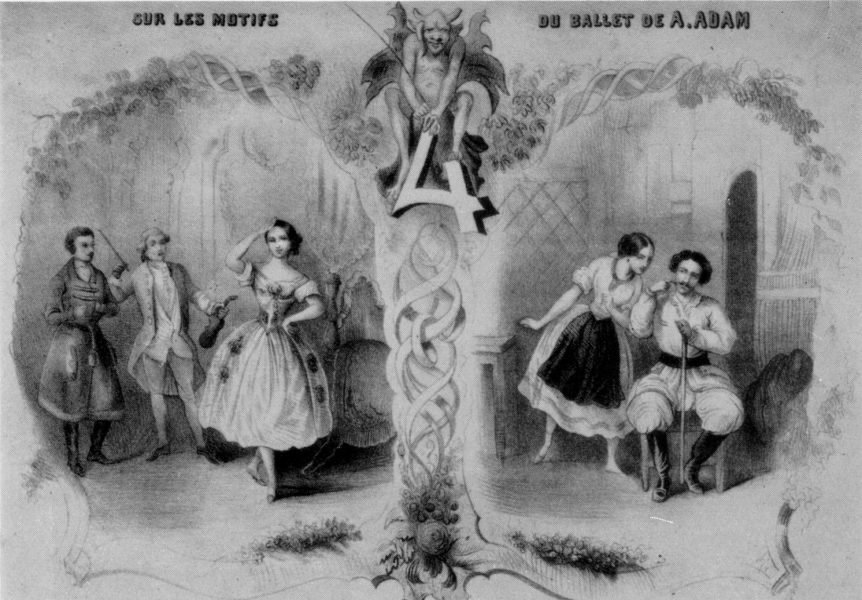
Ballet pantomime in three acts and four scenes premiered on 11th August 1845 at the Théâtre de l’Académie Royale de Musique, Paris
Choreography: Joseph Mazilier
Music: Adolphe Adam
Premiers Rôles
Mazourka: Carlotta Grisi
Comte Polinski: Lucien Petipa
Comtesse: Maria Jacob (known as Mlle Maria)
Mazourki: Joseph Mazilier
Plot
The plot is based on an English farce of the same title and contrasts the lives of two Polish women, a spoilt Countess and Mazourka, a sweet-tempered woman who is married to a brutal basket-maker called Mazourki. The two women encounter a magician disguised as a blind fiddler. The Countess behaves offensively but Mazourka is kind and in return he causes them to change places for a day. Mazourka astonishes everybody at the Countess’s castle with her unexpected kindness while the Countess has to suffer Mazourki’s rough treatment. Chastened, she promises to behave more humanely when returned to her real life, while Mazourki promises never to beat his wife again.
Summary
Acte 1
The scene represents a lawn before the castle of Count Polinski. On the left hand side is the entrance to the castle. On the same side is a pavilion belonging to the castle, with a window in front of the stage. On the right hand side there is a small cabin, where dwells a basket maker; a window is opened also in front. The background is a luxuriating landscape.
Gamekeepers celebrate the Count’s generosity, and Yvan, the castle doorkeeper, joyfully announces his engagement to Yelva, the Countess’s chambermaid. The Count warmly blesses the match, even providing a dowry, and permits a wedding dance to take place during the hunt.
Festivities are abruptly disrupted when the Countess, furious at being neglected for hunting and social pleasures, storms in before the guests. In a public and humiliating scene, she accuses the Count and his friends of abandoning her. To everyone’s surprise, Polinski asserts his authority, insisting the hunt proceed and announcing a ball for the following day, forcing the Countess to retreat in shock and anger.
Meanwhile, attention shifts to Mazourka, a lively basket-maker’s wife, and her husband Mazourki, whose passions clash: she loves dancing, he loves drink. After a comic attempt at mutual restraint, both abandon self-control and indulge freely.
The village gathers for Yvan and Yelva’s wedding celebration. Mazourka dances joyfully to the music of a blind fiddler, delighting the Count and his guests. Suddenly, the Countess reappears, enraged that festivities continue without her consent. In a violent outburst, she smashes the blind man’s violin, scattering the villagers and guests and bringing the fête to ruin.
Once the Countess departs, Mazourka consoles the blind fiddler, who reveals himself to be a magician. He foretells that Mazourka may become a great lady for one day, while the Countess will take her place in the hut. Though skeptical, Mazourka ultimately agrees.
As night falls, the magician summons spirits, and a magical exchange occurs: Mazourka is transformed into the Countess and carried into the castle whereas the Countess is dressed as a peasant and taken to Mazourka’s hut.
Acte 2
Scène 1
The scene represents the inside of the basketmaker’s hut. On the background a window opened, through which the country is seen. On the right hand side a rustic be surrounded by curtains of green serge. On the left hand side a table covered with baskets not yet finished, and bottles, benches and chairs.
At dawn, Mazourki awakens to find his “wife” behaving very strangely. The Countess, now trapped in Mazourka’s life, is horrified by her surroundings and outraged by Mazourki’s rough familiarity. He, believing her mad, treats her with increasing authority and violence.
When Yvan and Yelva arrive to invite the couple to their wedding, the Countess tries desperately to assert her true identity, but the servants dismiss her as insane. Her behavior only confirms Mazourki’s suspicions, and he subjects her to humiliation, forced reconciliation, and even compels her to dance for his amusement.
Seizing an opportunity while Mazourki attires himself for the wedding, the Countess escapes the hut, with Mazourki chasing after her.
Scène 2
The scene represents the inside of an elegant boudoir in the castle; with a divan, toilette, chairs, etc.
In the castle, Mazourka awakens as the Countess, surrounded by luxury. The magician reminds her that she must fully assume the role. Though initially awkward, Mazourka’s natural kindness astonishes the servants, especially Yelva, whom she treats with warmth rather than cruelty.
When the Count arrives, he is amazed by his wife’s gentleness and generosity. He attempts to court her affection, but Mazourka firmly refuses intimacy, remaining faithful to Mazourki. Instead of angering the Count, this sincerity puzzles and softens him.
Preparations begin for the grand ball. Mazourka struggles with the aristocratic dancing as instructed by the dancing master, revealing her peasant origins until the magician discreetly intervenes. Instantly transformed, she dances with elegance and brilliance, enchanting the Count and domestics alike.
Acte 3
The scene represents a rich gallery forming a hothouse, profusely adorned with various rare plants.
The Count receives the guests with Mazourka as the Countess. There are dances for the amusement of the guests.
During the ball, the true Countess bursts in, still dressed as a peasant and furious at seeing another woman in her place. Chaos ensues as Mazourki arrives, insisting the peasant woman is his wife, while the Countess claims to be mistress of the château. Guests laugh, believing her mad.
Mazourka intervenes with compassion. She forces Mazourki to swear an oath to abandon drink and treat his wife kindly, then consoles the Countess, urging her to repent her former cruelty.
The Countess, broken and remorseful, accepts her fall as divine punishment and begs forgiveness. At the climactic moment, Mazourka appeals to the magician, who restores everyone to their rightful place: the Countess regains her rank and Mazourka returns to her humble life, content and loved.
The Countess, transformed by the ordeal, embraces Mazourka and promises to live with humility and kindness. There is universal reconciliation and a joyful final dance.
History
Original Production
Le Diable à Quatre was originally choreographed in two acts and four scenes for the great Carlotta Grisi. The ballet’s simple comic realism, rare during the Romantic era, was warmly praised, and gave Grisi the opportunity to display a sparkling wit, rather than her usual poetic lyricism.
The ballet was a great success, and Grisi was showered with praise, both for her dancing and for her acting. Mazilier and Adam received praise for their choreography and score respectively. The ballet’s run was paused on 2 February 1846, when Grisi sustained an injury during a performance, but thankfully she soon recovered and was back on the stage as Mazourka within a few weeks.
Allegedly, Mazilier had planned to feature the Danseuses Viennoises in the ballet (as had been done in the revival of The Beauty of Ghent in January of 1845) but eventually it was decided that they would not be included in the ballet.
Marie-Adeline Plunkett débuted as Mazourka on 26 May 1847, though her performances initially did not receive good reviews. However, the ballet was still appreciated, as evidenced by the ballet remaining in the repertory and Plunkett’s continued performances in the ballet. The full ballet in its original version was last given on 23 February 1855 with Caterina Beretta as Mazourka, Lucien Petipa as the Comte, Mme Quéniaux as the Comtesse, M Berthier as Mazourki, Célestine Emarot as Yelva and Louis Mérante as Yvan. Following this, the ballet would continue to be given in various shortened forms until 6 August 1856, when the ballet would be performed for the final time (in a shortened version consisting of only Act 1 and Act 2, Scene 1) with Beretta as Mazourka, Petipa as the Comte, Emarot as the Comtesse and Berthier as Mazourki, following which it would be retired from the repertory.
Selected Revivals
24 November 1845
Location: Theatre Royal, Drury Lane, London
Staged by Mr Barrez.
26 December 1845
Location: Théâtre Royale de la Monnaie, Brussels
Staged for Mlle Rousset.
27 December [O.S. 15 December] 1846
Location: Imperial Bolshoi Theatre, Moscow
Staged by Ekaterina Sankovskaya.
28 October 1846
Location: Grand Theatre, Warsaw
Staged by Roman Turczynowicz for Konstancja Turczynowicz under the title of Hrabina i wieśniaczka (The Countess and the Peasant) with Józef Stefani revising the score. Mazourki in this production (called Maturyn) was danced by Felix Kschessinsky who would go on to dance with the Imperial Ballet under Petipa and was the father of the Prima Ballerina Assoluta Matilda Kschessinskaya.
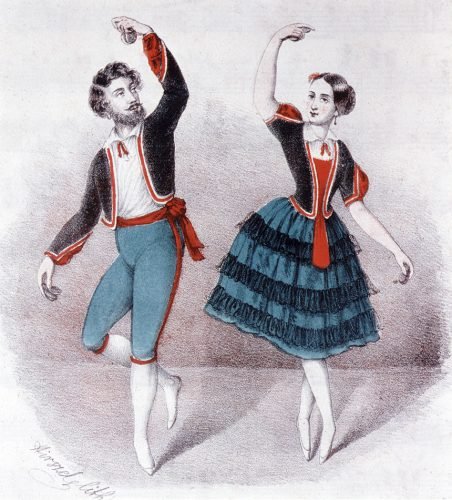
18 July 1848
Location: The Broadway Theatre, New York
Staged by M Bartholomin and M Montplaisir for Mme Montplaisir.
8 January 1849
Location: Königliche Oper, Berlin
Staged by Paul Taglioni as Die Weiberkur (The women’s cure).
The first act appears to have contained three dances: a Pas de Deux (presumably a replacement for or a version of the Pas de Trois), a Solotanz (presumably the Pas Seul avec huit coryphées) and a Mazurka. The second act appears to have contained two dances: the Ensemble-Tanz (presumably a version of the Pas de Vingt) and a Pas de Deux (presumably a version of the Pas de Carlotta au 2me acte). The Pas de Deux of the two sujets (also known as La Polka) appears to have been omitted.
1850
Location: Gran Teatro del Liceo, Barcelona
Staged by Señor Barrez for Marie Guy-Stéphan as El Diablo á Cuatro in three acts and four scenes.
26 November [O.S. 14 November] 1850
Location: Imperial Bolshoi Kamenny Theatre, St Petersburg
Staged by Jules Perrot for Carlotta Grisi under the title of La Femme Capricieuse (The Wilful Wife) with extensive musical revisions by Pugni that expanded the ballet from a ballet pantomime in two acts and four scenes to a grand ballet in four acts. Perrot appears to have portrayed the rôle of the dancing master.
Some of Perrot’s additions and revisions included a new version of the dancing lesson scene in Act 3, a new version of the Pas de Deux in Act 4 (danced by Perrot and Grisi, potentially either a new version of Adam’s original Pas de Deux or a new Pas de Deux with music by Pugni), the Pas des Nymphes (either a new version of the Pas de Vingt or a new pas composed by Pugni) and a new final Galop-Krakoviak (danced by Perrot and Grisi, presumably for the ball scene and presumably with music by Pugni).
Summer 1851
Location: Teatro di San Carlo, Naples
Staged by Salvatore Taglioni for Adelaide Merant in four acts as La Baronessa Polinski.
Some of the changes included the Pas Seul avec huit coryphées being replaced by a Pas de Deux for Mazourka and an unnamed cavalier, and the Mazourka being moved the ballroom scene.
Autumn 1856
Location: Teatro degli Intrepidi, Florence
Staged for Sofia Fuoco with Dario Fissi as the Comte.
1857
Location: Nationaltheater, Munich
Staged in four acts as Die Weiber-Kur.
24 March 1862
Location: Théâtre Impérial de l’Opéra, Paris
The revival was staged by Marius Petipa for his first wife, Maria Surovshchikova-Petipa. Also sharing the stage were Lucien Petipa as the Comte and Zina Mérante (wife of the famous dancer and choreographer Louis Mérante) as the Comtesse.
The score was revised by Cesare Pugni, who composed two new pas for Mme Petipa. The first of these pas was dubbed the Pas Nouveau and replaced Adam’s original Pas Seul avec huit coryphées in the first act. The Pas Nouveau was danced by Mme Petipa and four female coryphées and was choreographed by Marius Petipa.
The second of these pas was the celebrated Polski Mazur, composed to replace the Pas de Deux of the second act. The Polski Mazur was danced by Mme Petipa’s Mazourka partnered by a male dancer specially engaged from St. Petersburg (at what was noted as a large salary for a male dancer), Felix Ivanovitch Kschessinsky. The Polski Mazur was well received at its première, so much so that it was encored.
Kschessinsky had also danced the rôle of Mazourki (called Maturyn) in the 1846 Warsaw staging of the ballet.
The ballet was revived the following year in Paris for Marie Vernon, with both of Mme Petipa’s additions being retained.
27 April 1875
Location: Wiener Hofoper, Vienna
Staged by Karl Telle for Rosita Mauri as Die verwandelten Weiber (The transformed women) partnered by Joseph Beau. The records indicate that the first act Mazourka danced a Pas de Deux with an unnamed cavalier (presumably in place of the Pas Seul avec huit coryphées) and danced a Sequidilla in the second act with the dancing master and the corps de ballet (presumably in place of the original Pas de Deux).
The ballet would be staged the following year in 1876 with Adèle Grantzow as Mazourka, being last given in its entirety on 30 May 1876. In 1879 the first scene of the second act was revived for Henriette Mauthner and Louis Frappart. On 6 January 1894 the ballet would be revived for its final one-off performance. On this occasion, the ballet was staged in an abridged form with only the first act and the first scene of the second act given. The rôle of Mazourka was portrayed by Irene Sironi.
4th February [O.S. 23rd January] 1885
Location: Imperial Bolshoi Kamenny Theatre, St Petersburg
Staged by Petipa for Eugenia Sokolova as the Comtesse (renamed to Countess Berta) and Maria Gorshenkova as the now nameless Basket Maker’s Wife. Pavel Gerdt danced the rôle of Count Polinski and Ludwig Minkus revised the score in Pugni’s four-act revision.
For this revival, the focus seems to have shifted to the Comtesse as the principal rôle as it was she who the sorcerer wished to punish and correct by turning her into the wife of the basket maker. This differed from previous versions, in which Mazourka’s reward for her patience and life as a Comtesse was the primary focus of the story, with the Comtesse being considered the second rôle. As one review recorded:
“The ballet’s story takes place in Poland and based on a tale about a sorcerer, who wants to punish a capricious countess, who mistreats her kind husband. The sorcerer temporarily turns her into a simple wife of a basket-maker, and makes a good-natured real basket-maker’s wife a countess. The countess’s new husband, a man of strict character, corrects her behaviour in the way that used to take an important place in the archaic Russian “Domostroy” [an old Russian set of household rules and instructions], that is, by beating her with a stick. In the end, everyone returns to their places and the sorcerer is satisfied with the success he has achieved.”
It also seems that the revival dispensed with the actual switching places of the dancers, as had been done previously. In the ballet’s original conception, the ballerina playing the Comtesse would appear in Mazourka’s dress during the first scene of the second act, and the ballerina playing Mazourka would appear in the Comtesse’s dresses during the second and third scenes of the second act. However, the 1885 revival appears to differ in this respect, as it is Gorshenkova who is listed as performing in the second scene and Sokolova in the third. This would seem to indicate that the ballerinas did not switch parts, but merely imitated the manner of the other in order to maintain the illusion that they had been transformed to look like the other.
This revival appears to have been produced for the farewell benefit of Alexandra Shaposhnikova, who had served twenty years on the Imperial stages and so was entitled to a benefit performance. Shaposhnikova appears to have portrayed the rôle of Yelva. Also sharing the stage were Felix Kschessinsky as Mazourki and Timofei Stukolkin as the dancing master.
A selection of dances (mentioned in a contemporary newspaper review) from this revival include:
- A Pas de Deux in the first act danced by Varvara Nikitina and Sergei Litavkin (possibly with music by Minkus, potentially even an arrangement of Adam’s Pas de Deux – La Polka from the fourth act)
- A Pas des Villageois in the first act danced by Shaposhnikova and Anna Johansson (presumably new version of Adam’s original Pas de Trois, potentially still staged as such even if the male dancer was not mentioned)
- A Krakowiak led by either Alexandra Zhukova or Vera Zhukova (the source is unclear) and Alfred Bekefi (potentially a revision of the Galop-Krakoviak added by Perrot for the 1850 revival)
- A Mazurka led by Marie Petipa and Felix Kschessinsky (presumably Adam’s original Mazourka)
- A scene in the second act in which the basket-maker “educates” his substitute wife executed by Gorshenkova and Kschessinsky
- The dancing lesson scene in the third act executed by Sokolova and Stukolkin
- A Harlequinade in the fourth act executed by pupils of the Imperial Ballet School (possibly with music by Minkus, and among the pupils were a young Matilda Kschessinskaya and a young Georgy Kyaksht) dressed as characters from Commedia dell’Arte
- A Pas des Fleurs danced by “all the best dancers of the troupe” supported by sixty members of the corps de ballet (potentially either a new version of the Pas de Vingt or a new pas with music by Minkus)
28 March 1889
Location: Nationaltheater, Munich
Staged by Franz Fenzl as Die Weiberkur.
2 October [O.S. 20 September] 1895
Location: Imperial Mariinsky Theatre, St Petersburg
Staged in an abridged form, with only the second and the third scenes given. The ballet was performed four times in the 1895 season, on 20 September, 24 September, 12 November and 19 November.
London Revivals
1883 Revival
In 1883 William Thompson revived the ballet in two acts and four scenes under the title of The Devil to Pay for Marguerite Lemoine as the heroine Mazourka. The score was revised by François Bardet and as usual Thompson remained faithful to the original libretto but re-choreographed several of the dances.
Grisi’s first act pas was referred to as the Pas Seul avec huit coryphées in the programmes, owing to the fact that Grisi danced the pas with eight coryphées ladies and no partner. Thompson wished to rename the pas for clarity, as due to the presence of the coryphées it was not, strictly speaking, a Pas Seul. He first considered renaming the pas as the Pas de Neuf, before settling on the Pas de Grisi in Grisi’s honour.
The third scene of the second act, the ballroom scene, originally contained three pas: a Pas de Deux for two sujets (also referred to as Polka or La Polka and was danced by M Hoguet and Sophie Dumilâtre at the première), a Pas de Deux for Mazourka and the Comte (also referred to as the Pas de Carlotta au 2me acte) and a Pas de Vingt (also referred to as the Pas d’Ensemble).
The first Pas de Deux was retitled by Thompson to La Varsovienne and was now to be danced by two newly created characters: the Ambassador and the Ambassadress. The Pas de Deux for Mazourka and the Comte was retitled as the Grand Pas de Deux Noble and the Pas de Vingt was retitled as the Pas de Fantaisie.
Rôles
Mazourka: Marguerite Lemoine
Comte: Johann Faber
Comtesse: Emma Ashfield
Yelva: Adèle Vernay
Ambassadress in La Varsovienne: Mary Butler
Ambassador in La Varsovienne: Rafael Caravetti
Musical Revisions
A new variation was written for Mary Butler as the Ambassadress in the Pas de Deux titled La Varsovienne of the third scene of the second act, replacing Adam’s original variation. Butler had joined the troupe at the beginning of the 1883 season as a sujet.
Both the Comte and Mazourka received brand new variations for the Grand Pas de Deux Noble of the third scene of the second act, replacing Adam’s original variations.
As the corps de ballet did not have much dancing to do in the second act, a Cracovienne Générale was added for the troupe, in which the corps de ballet, sujets and main characters participated.
Extract from the Cracovienne Générale, composed by François Bardet (1883)
Résumé des Scènes et Danses
Acte 1
1) Introduction
2) Scène Première – Les Veneurs et Gardes de Chasse
3) Scène – Entrée d’Yvan et Yelva
4) Scène – Entrée du Comte
5) Scène – Le Partie de Chasse
6) Scène – Entrée d’Yelva
7) Scène – Entrée de la Comtesse
8) Scène – Entrée de Mazourka
9) Scène – Les Paysans
10) Scène – Les Nobles
Divertissement
11) Pas de Trois
a) Entrée
b) Variation I
c) Variation II – Yvan
d) Variation III – Yelva
e) Coda
12) Pas de Grisi
a) Andante
b) Allegretto non troppo
c) Variation de Mazourka
d) Coda
13) Mazourka
14) Scène – La Colère de la Comtesse
15) Scène – Mazourka et l’Aveugle
16) Scène Finale – La Transformation
Acte 2
Scène 1
17) Entr’acte et Scène Première – La Cabane du Vannier
18) Scène – Entrée d’Yvan et Yelva
19) Scène de La Dispute
20) Polka à Coup de Bâton
21) La Toilette de Mazourki
Scène 2
22) Entr’acte et Scène – Mazourka et Le Magicien
23) Scène – Le Toilette de Mazourka
24) Scène – Entrée du Comte
25) Scène – La Leçon de Danse
26) Scène Finale
Scène 3
27) Entr’acte et Scène du Bal
28) Scène – Les Invités
Divertissement
29) La Varsovienne – Pas de Deux
a) Entrée
b) Adage
c) Variation I
d) Variation II (for Miss Butler)
e) Coda
30) Grand Pas de Deux Noble
a) Adage
b) Allegretto
c) Variation du Comte
d) Variation de Mazourka
e) Coda
31) Pas de Fantaisie
a) Andante
b) Allegretto
c) Variation à Deux
d) Coda-Valse
32) Scène – Entrée de la Comtesse
33) Scène Dramatique
34) Cracovienne Générale
35) Scène Finale
1884 Revival
In 1884 Lemoine requested to dance the ballet for her benefit as she was to retire at the end of the 1884 season. She was granted this request and so the ballet was restaged for her. Thompson did not make significant changes to the ballet, save the shortening of a couple of scenes to improve the pacing of the narrative.
Lemoine did not end up dancing all the performances in the rôle, but decided to leave London a month earlier than scheduled to return to France on urgent business. Before she left, Lemoine proposed Emma Ashfield, rather than Velluti take on the remainder of her performances (numbering three), citing Ashfield’s success as the Marchesa in the 1882 revival of Marco Spada. Thompson decided to go ahead and cast Ashfield in the rôle with Faber as her partner, and she received good reviews for her portrayal of Mazourka.
Rôles
Mazourka: Marguerite Lemoine / Emma Ashfield
Comte: Johann Faber
Comtesse: Emma Ashfield
Yelva: Mary Butler
Yvan: Rafael Caravetti
Ambassadress: Adèle Vernay
1894 Revival
In 1894 Thompson revived the ballet for the benefit of Marta Draeger with musical revisions by Auguste Péchard.
In late 1893 Draeger decided that she wished to retire from the stage. She considered her 1893 role as Galatée in Pygmalion to be her crowning glory and so wished to end her career on a high note. However, neither the theatre managers nor Thompson wished her to retire as she was far too popular. A compromise was to be made, Draeger would dance one final season on the London stage in 1894. The theatre director offered to have a new ballet created for her but she refused, choosing instead to dance in Esmeralda for her benefit, a ballet which had not been staged in London since 1878. Thompson also decided to revive The Devil to Pay for her in the same season, a ballet that had not been staged in London since 1884.
Despite the success of Draeger’s stay in London, it was not without its contentions. Draeger was particularly disliked by Sarah Nicholson, an English ballerina who was a rising star in the troupe. Though Draeger’s supporters claimed that this rivalry was one-sided and due to Nicholson’s jealousy (a narrative sensationalised by the press), there was arguably precedent for Nicholson’s irritation. There had been the issue of the 1889 revival of Roberto il Diavolo but there was also Thompson’s continued favouritism that he displayed towards Draeger, a fact which was both known and acknowledged backstage at Covent Garden. Additionally, Nicholson was often cast by Thompson as the seconde danseuse to Draeger’s première, even after Nicholson’s 1892 promotion to première danseuse.
This tension reached a head in the 1894 revival of The Devil to Pay where Nicholson had been cast as the Comtesse. Though it was the second danseuse rôle, it did not contain a great amount of dancing. In fact, the rôle’s only real pas was the Polka à Coup de Bâton, which Thompson expanded with additional music by Péchard into the Pas Villageois, danced by Nicholson’s Comtesse and Mazourki. For Draeger’s Mazourka, on the other hand, there were revisions galore: a new variation for the Pas de Grisi of the first act, a brand new pas, the Pas de Leçon for the second act and a newly interpolated Grand Pas de Deux for the third act. Though Nicholson begrudgingly accepted this (as it was, after all, the understood custom that the revival of a ballet be furnished with new pas for the new danseuse), a heavy blow came when Harriet Linwood, the danseuse who had been cast as Yelva succeeded in having a Pas de Deux inserted into the first act for her in place of the original Pas de Trois. Nicholson was so insulted that a lesser sujet should receive a new pas while she, a première danseuse, did not that she walked out of the ballet, refusing to attend rehearsals for two weeks. To entice her to return, August Harris, the manager of the theatre promised her a pas of her own. Nicholson accepted the condition and Thompson was obliged to arrange a Pas Seul for her in the third act, newly composed by Péchard.
The rôle of the Dancing Master was danced by James Elton, who had joined the troupe that year as a sujet. He would later be promoted to premier danseur in 1897, following his successful performances as Conrad in the revival of The Corsair.
Despite all the backstage drama the revival would turn out to be a great success with Draeger receiving great praise in the rôle of Mazourka. Draeger’s performances as Mazourka would lead to the rôle becoming one of the most coveted amongst the danseuses of Covent Garden.
Rôles
Mazourka: Marta Draeger
Comte: Frederick Hale
Comtesse: Sarah Nicholson
Mazourki: Antoine Férat
Yelva: Harriet Linwood
Yvan: Charles Jennings
Dancing Master: James Elton
Ambassadress: Vittoria Riccardi
Musical Revisions
The ballet was expanded from two acts and four scenes to three acts and four scenes. Act 2, Scene 3 became the third act, while Act 2, Scene 1 and Act 2, Scene 2 retained their original numberings.
The original Pas de Trois which was danced by Yelva, Yvan and an additional unnamed danseuse was replaced by a Pas de Deux for Yelva and Yvan. This was in no small part due to Harriet Linwood, the danseuse who had been cast in the rôle of Yelva. She pressed for a new Pas de Deux to be arranged for her but Thompson did not wish to do so, preferring to retain Adam’s original Pas de Trois. However, Linwood was the mistress of The Earl of Banstead, a wealthy aristocrat whose father, the Marquess of Athelington, was one of Covent Garden’s patrons. She used her influence to get her way and so Thompson was obliged to arrange a new Pas de Deux for her. Péchard arranged the music for the new pas, and at Thompson’s request several of the numbers were taken from Adam’s original Pas de Trois. The Entrée, Variation d’Yvan and Coda were taken from Adam’s original Pas de Trois while the Adage and Variation d’Yelva were newly composed.
Variation for Miss Linwood as Yelva in the Pas de Deux, composed by Auguste Péchard (1894)
A new variation was added for Mazourka in the Pas de Grisi. This was a supplemental variation originally written for Fleur de Lys in the Grand Pas des Corbeilles in the 1878 revival of Esmeralda.
The Polka à Coup de Bâton of the first scene of the second act was expanded into the Pas Villageois. This expansion was a result of the relatively small amount of dancing that the rôle of the Comtesse was originally given. The pas followed the story at that point, where Mazourki ordered the Comtesse (who through magic had been transformed to look like his wife Mazourka) to dance. She began by dancing a noble Menuet which he quickly grew bored of. He then showed her (with the help of a stick he beat on the ground) how to dance in a more ‘rustic’ and entertaining style. The pas concluded with a rousing finale, including big lifts and a difficult diagonal for the Comtesse that consisted of several repeated quick relevés sur la pointe.
As the second act was split into two a new grand pas was needed for the act. This resulted in the celebrated Pas de Leçon being added to the second scene of the second act. The pas builds on the action of the scene where Mazourka is being taught how to dance in the ‘noble’ style. The pas was arranged as a Pas de Six danced by Mazourka, the dancing master and four female coryphées as chambermaids. The Comte, though present, did not dance but observed the proceedings from his seat to the side of the stage. The pas, true to its name, served as a rehearsal and educational exercise for Mazourka. It featured passages of academic and almost pedagogical choreography, repeated as the dancing master assessed his pupil’s progress and technique. In this way, Draeger was also able to display her technical precision and exactness as well as her command of technique and pointework. Her variation, in particular, was technically challenging, including double pirouettes en attitude and a diagonal of temps levés sur la pointe. Another notable feature of this pas was the prominent use of the harp. A harp cadenza preceded the Adage and Mazourka’s variation was also set to harp music. This musical choice was specifically requested by the theatre director, who wished to show off the talents of Friedrich Mandl, a talented Prussian harpist that had been engaged earlier that year as harpist in the Covent Garden orchestra. Mazourka’s variation in particular became a highlight of the ballet, with the variation even being encored at its premiere.
The fact that Draeger gave an encore of her variation in the Pas de Leçon is notable, as Thompson famously discouraged encores being given by the dancers. In the 1889 revival of Faust, for example, Joséphine Decoin had given an encore of her variation in the Grand Pas de Séduction, prompting a backstage shouting match between her and Thompson which would result in the souring of their until then cordial working relationship. However, when Draeger came to give her encore at the première, she received no such public reprimand. She was instead firmly, but privately, informed by Thompson not to repeat the action. Thompson’s favouritism was on full display here, but as the 1894 summer seaon was to be Draeger’s last on the Covent Garden stage, she may well have seen her opportunity and taken it. Nicholson, in her memoirs, notes how odd it was that an encore should be given, as such things were so unusual at Covent Garden. She also hints (but crucially does not confirm) that a bisseur was paid to ensure an encore of Draeger’s variation. It is similarly implied that she believes Draeger herself did this (though it would have more plausibly been Draeger’s supporters than Draeger herself), but as stated, Nicholson did not confirm it.
The Entr’acte at the top of the new third act was expanded.
A new polonaise rhythm variation was composed for the Ambassadress in La Varsovienne. This variation was composed for Vittoria Riccardi, a visiting Italian danseuse and replaced the supplemental variation added in 1883. Though polonaise variations had by then largely fallen out of fashion, Riccardi specifically requested it. Thompson and Péchard were compelled to comply as the management wanted to feature her on the Covent Garden stage while she was in London. The variation was not retained for subsequent revivals of the ballet, and the variation that was written for the 1883 revival (a more conventional waltz variation) was restored soon after Riccardi’s departure.
Variation for Miss Riccardi as the Ambassadress in La Varsovienne, composed by Auguste Péchard (1894)
A new variation was also composed for Draeger in the Grand Pas de Deux Noble of the third act. Originally, this was to be the only change to the pas, with her partner dancing the 1883 variation instead of Adam’s original variation. However, Draeger requested to substitute the pas for the Pas de Deux that had been written for her 1888 performances as the titular character in Giselle, a request which was granted by Thompson. The new variation that Péchard had composed for Draeger was retained and interpolated into the Giselle pas to replace the original variation.
A Pas Seul was arranged for Nicholson as the Comtesse in to placate her. The pas was danced before the Cracovienne Générale of the third act. Thompson expressed that he did not like the positioning of the pas as he felt that it greatly detracted from the flow of the story. However, subsequent danseuses who performed the rôle greatly appreciated this pas (being the rôle’s only real piece of solo dancing) and refused to let it be removed from the ballet.
Résumé des Scènes et Danses
Acte 1
1) Introduction
2) Scène Première – Les Veneurs et Gardes de Chasse
3) Scène – Entrée d’Yvan et Yelva
4) Scène – Entrée du Comte
5) Scène – Le Partie de Chasse
6) Scène – Entrée d’Yelva
7) Scène – Entrée de la Comtesse
8) Scène – Entrée de Mazourka
9) Scène – Les Paysans
10) Scène – Les Nobles
Divertissement
11) Pas de Deux
a) Entrée (original Adam, arranged)
b) Adage (newly written)
c) Variation d’Yvan (original Adam, arranged)
d) Variation d’Yelva (newly written for Miss Linwood)
e) Coda (original Adam, arranged)
12) Pas de Grisi
a) Andante
b) Allegro non troppo
c) Variation de Mazourka (supplemental variation for Fleur de Lys in the Grand Pas des Corbeilles in the 1878 revival of Esmeralda)
d) Coda
13) Mazourka
14) Scène – La Colère de la Comtesse
15) Scène – Mazourka et l’Aveugle
16) Scène Finale – La Transformation
Acte 2
Scène 1
17) Entr’acte et Scène Première – La Cabane du Vannier
18) Scène – Entrée d’Yvan et Yelva
19) Scène de La Dispute
20) Pas Villageois
a) Menuet
b) Polka à Coup de Bâton (expansion of Adam’s original music)
c) Coda – Louré (expansion of Adam’s original music)
21) La Toilette de Mazourki
Scène 2
22) Entr’acte et Scène – Mazourka et Le Magicien
23) Scène – Le Toilette de Mazourka
24) Scène – Entrée du Comte
25) Scène – La Leçon de Danse
26) Pas de Leçon
a) Adage
b) Allegretto
c) Variation du Maître à Danser
d) Variation de Mazourka
e) Coda
27) Scène Finale
Acte 3
28) Entr’acte et Scène du Bal (expanded)
29) Scène – Les Invités
Divertissement
30) La Varsovienne
a) Entrée
b) Adage
c) Variation I
d) Variation II (for Miss Riccardi)
e) Coda
31) Grand Pas de Deux (supplement for Giselle, 1888)
a) Adage
b) Variation du Comte
c) Variation de Mazourka (newly written for Miss Draeger)
d) Coda
32) Pas de Fantaisie
a) Andante
b) Allegretto
c) Variation à Deux
d) Coda-Valse
33) Scène – Entrée de la Comtesse
34) Scène Dramatique
35) Pas Seul de la Comtesse (for Miss Nicholson)
36) Cracovienne Générale (1883)
37) Scène Finale
1900 Revival
In 1900 ballet was revived for Sarah Nicholson, who had held the position of the most senior première danseuse since Draeger’s 1894 departure. Giulia Moretti was second cast. The ballet was technically revived for the benefit of Antoine Férat, Nicholson’s most frequent partner, who was to retire at the end of the season.
Rôles
Mazourka: Sarah Nicholson
Comte: Antoine Férat
Comtesse: Louise Grignon
Yelva: Lily Clifford
Ambassadress: Teresa Montoro
Musical Revisions
Nicholson considered restoring the original Adam variation in the Pas de Grisi, as she believed that it better suited her talents than the variation that Draeger had interpolated in 1894. However, she was advised by Richard Hague (Thompson’s successor) to dance it, believing the challenge would be beneficial for her. Nicholson eventually relented and decided that she would dance Draeger’s variation.
The variation written for Riccardi’s 1894 performances as the Ambassadress in La Varsovienne was cut. In its place, a variation from Adam’s original Pas de Trois in the first act (the Variation III from this pas that was originally danced by Yelva) was interpolated, to which Péchard added a short introduction.
Both Hague and Nicholson were in agreement that she should not dance Draeger’s interpolated Pas de Deux, and so a new pas would need to be arranged for her in the third act. Nicholson initially requested for a new pas to be composed by Péchard, a suggestion which was refused by Hague. As a result, Nicholson looked back on her oeuvre as to what she wished to interpolate. She eventually decided on a Pas de Deux that Péchard had composed for her to be inserted into the 1895 revival of Coppelia, but it had eventually been decided that she would dance the original pas and Péchard’s supplement would be shelved. She now expressed a wish to finally dance the pas, and as no new music would need to be commissioned Hague did not object and permitted the interpolation. Hague arranged the choreography for the new pas, and Péchard performed small adjustments to the music, as per Hague’s conception. Péchard also completed the orchestration of the pas, as he had not finished the orchestration in 1895 before the pas was shelved. Rather uniquely, the Adage of the pas was scored for four solo violoncellos, with the remainder of the orchestra remaining silent after the introduction. The Variations and Coda were scored in a more conventional fashion.
Résumé des Scènes et Danses
Acte 1
1) Introduction
2) Scène Première – Les Veneurs et Gardes de Chasse
3) Scène – Entrée d’Yvan et Yelva
4) Scène – Entrée du Comte
5) Scène – Le Partie de Chasse
6) Scène – Entrée d’Yelva
7) Scène – Entrée de la Comtesse
8) Scène – Entrée de Mazourka
9) Scène – Les Paysans
10) Scène – Les Nobles
Divertissement
11) Pas de Deux (arranged in 1894)
a) Entrée
b) Adage
c) Variation d’Yvan
d) Variation d’Yelva
e) Coda
12) Pas de Grisi
a) Andante
b) Allegro non troppo
c) Variation de Mazourka (supplemental variation for Fleur de Lys in the Grand Pas des Corbeilles in the 1878 revival of Esmeralda) (1894)
d) Coda
13) Mazourka
14) Scène – La Colère de la Comtesse
15) Scène – Mazourka et l’Aveugle
16) Scène Finale – La Transformation
Acte 2
Scène 1
17) Entr’acte et Scène Première – La Cabane du Vannier
18) Scène – Entrée d’Yvan et Yelva
19) Scène de La Dispute
20) Pas Villageois (arranged in 1894)
a) Menuet
b) Polka à Coup de Bâton
c) Coda – Louré
21) La Toilette de Mazourki
Scène 2
22) Entr’acte et Scène – Mazourka et Le Magicien
23) Scène – Le Toilette de Mazourka
24) Scène – Entrée du Comte
25) Scène – La Leçon de Danse
26) Pas de Leçon (1894)
a) Adage
b) Allegretto
c) Variation du Maître à Danser
d) Variation de Mazourka
e) Coda
27) Scène Finale
Acte 3
28) Entr’acte et Scène du Bal (expanded 1894)
29) Scène – Les Invités
Divertissement
30) La Varsovienne
a) Entrée
b) Adage
c) Variation I
d) Variation II (original Adam 1845, Variation III from the Pas de Trois of the first act)
e) Coda
31) Grand Pas de Deux Noble (supplement for Coppelia, 1895)
a) Adage
b) Variation du Comte
c) Variation de Mazourka
d) Coda
32) Pas de Fantaisie
a) Andante
b) Allegretto
c) Variation à Deux
d) Coda-Valse
33) Scène – Entrée de la Comtesse
34) Scène Dramatique
35) Pas Seul de la Comtesse (1894)
36) Cracovienne Générale (1883)
37) Scène Finale
1909 Revival
In 1909 ballet was revived for Giulia Moretti, with Louise Grignon as second cast. Moretti retained Nicholson’s interpolated Grand Pas de Deux Noble but revived Draeger’s 1894 variation in place of the variation that Nicholson had danced in 1900. Grignon, on the other hand, retained Nicholson’s variation for her performances.