Catarina
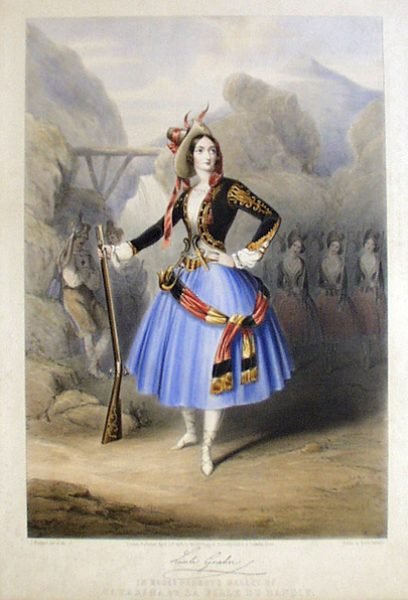
Ballet pantomime in three acts and five scenes premiered on 3rd March 1846 at Her Majesty’s Theatre, London
Choreography: Jules Perrot
Music: Cesare Pugni
Premiers Rôles
Catarina: Lucile Grahn
Salvator Rosa: Louis-François Gosselin
Lieutenant Diavolino: Jules Perrot
Florida: Joséphine Petit-Stéphan
Plot
Summary
Acte 1
Scène 1
The theatre represents a wild and mountainous scene near Rome; at the back flows a torrent surmounted by two immense rocks, one on the left is approached by steps cut in the rock; a rustic bridge serves as a passage from one rock to the other.
Salvator Rosa has just been arrested by a band of brigands. They form a wild and picturesque group around him. His paintings, studies, and sketches are scattered about, and pass from hand to hand. The savage outlaws regard them with indifference and derision; they are solely occupied in plundering his effects. The artist is absorbed by the picturesque variety of the strange group around him, and is sketching the scene in his album unmindful of the danger of his position. This strange adventure appears to furnish him with an inspiration from which he has formed in his mind the plan of one of his admirable productions.
A fresh arrival changes the aspect of affairs. Catarina appears: she is young, beautiful, and proud, with a noble step, daring look, and romantic air.
Catarina, born and brought up in the midst of this troop of bandits, since her father’s death has commanded them. Her presence inspires respect! The brigands incline before her. She, in her turn, sees and admires the works of the celebrated painter. Instinctive elevation, and innate purity of her taste, reveal to her the beauties of these compositions ” Hast thou executed these marvels,” she asks of Salvator, and when he replies in the affirmative, she orders the bandits to set him at liberty, and to prostrate themselves before so great a genius. Salvator, inspired by the loveliness of Catarina, by her strange and romantic position, by the obedience and respect paid to her by these miserable outcasts of society, is no longer desirous to break his fetters. He refuses the offer of liberty, and entreats the young girl to relate to him the history of her life. She only knows that born and reared amidst these bold and adventurous men, at the death of her father she was elected their chief.
Salvator, deeply interested by this recital, wishes to persuade the young girl to quit her wild existence, but she refuses to abandon her brave companions.
The sound of a horn echoes over the mountains and Diavolino appears on the rocks followed by brigands, conducting an officer, who is blindfolded. He is brought before Catarina and the bandage is taken off his eyes. Great is his surprise when he beholds this lovely girl surrounded by these swarthy reckless Brigands. The Officer has been surprised in ambush, by the Bandit, having imprudently quitted the troops which had been placed under his command, for the purpose of ex- terminating the Brigands. He informs Catarina of the object of his mission, telling her he is sent by the government to exterminate the whole band, but that they can obtain mercy by giving up their arms. The Bandits turn from the proposal with distaste and derision. Diavolino’s arrival is joyously welcomed; he relates, on returning from the neighbouring village, he has been chased by soldiers – they are on his track – and turning to his mistress, he exhorts her to prepare for a vigorous defence. Catarina rejoices that, as they are still far distant, she will have time to prepare them a warm and hostile recерtion. The intrepidity, coolness, and boldness of the young girl, excite still more the admiration of Salvator. In a moment of inspiration, he seizes his pencil, and seating himself on a stone, he sketches the figure of the young heroine, who with a natural movement of coquetry, remains immovable, in all her native grace, to allow the artist to design her commanding figure. Diavolino, meanwhile, asks with much anger who is this stranger and the answer clouds his brow with redoubled gloom which increases as he sees Catarina advancing towards Salvator, and place herself by him contemplating his work with unfeigned delight, her eyes fixed on the face of Salvator. But she suddenly recovers herself, and to conceal the new and hitherto unknown feeling to which his presence has given rise, she arms herself with her gun and sounds her hunting horn.
Then follows the Danse des Fusils ou Pas Stratégique. Carried away by her excitement, Catarina forgets her peril, and dances the graceful Valse à Cinq temps, to fascinate Salvator.
Throughout this scene the sound of firing has been heard in the distance.
The troops have approached-they rush in and the curtain falls at the moment the engagement within the cave is beginning.
Scène 2
The Theatre represents a room in an Inn, situated in the neighbourhood of the Gates of Rome. The back of this room is closed by large latticed windows, beyond which the country may be seen.
It is not yet day-break. The inhabitants of the Inn are buried in sleep, silence reigns throughout, when suddenly, hasty and violent knocks are heard; they awaken the host, who arrives as yet overcome with sleep, to open the door to the travellers. Catarina and Diavolino enter precipitately into the Inn, shutting the door after them with caution. Their band has been routed-they alone are free .
Soldiers are following them; their march is heard in the distance. The Innkeeper, surprised at the mysterious air of his new guests, asks them who they are, what they want, and perceiving pistols and a dagger under the cloak of Catarina, he draws back in alarm, and appears inclined to call for assistance, but Diavolino guessing his intention, rushes up to him with a pistol in his hand. Mine host is terribly alarmed and seeks to escape, but finds himself confronted by Catarina, who, however, surprises him agreeably, by the sight of a purse which she holds in her hand “choose between this purse or death.” “What would you have me do” says he, taking the purse, “shelter, clothes and secrecy” answers the maiden.
The host promises all they ask, and calls a servant girl. Catarina, meanwhile, wraps herself in her cloak. Diavolino has already concealed his arms; at this moment, the soldiers are heard outside, knocking at the door with the butt ends of their guns. Catarina rushes into a room pointed out to her by the Innkeeper, and is followed by the servant and by Diavolino.
The Innkeeper calls his waiters and opens the door to the soldiers who are in pursuit of the Bandit Maiden. They question him as to whether he has not seen the fugitive whom they describe to him; he hesitates, and is about to answer in the affirmative, when Diavolino, who in the meanwhile has dressed himself up as a waiter of the Inn, glides up to him, and showing him the hilt of a dagger concealed under his vest, reminds him of his promise. Fabricio, alarmed, then declares to the soldiers that he has seen nothing.
Diavolino makes signs that wine should be offered to the soldiers, and to avert suspicion he waits on them himself, and questions them as to their errand. The chief informs him that they have just made an expedition against the Brigands who infest the country, and that they are almost all taken. Their Chief, a young woman, has escaped, and it is her whom they are in search.
Diavolino professes his surprise, and the troop, after having drunk, resumes its march.
The day has worn on; the sun has fully risen; the inn is now open to the public. Stragglers from the neighbourhood loiter in; they begin to drink and talk. Diavolino, meanwhile, is sitting apart, solitary and dejected. He listens to the retreating steps of the soldiers, then turning his eyes to the room where Catarina is concealed, he deplores her sad fate-fugitive, wandering, and without a hope of ultimate escape.
Joyous sounds are heard without; a crowd of masqueraders in various costumes enter the inn. Salvator, with his betrothed Florida, forms one of the merry assemblage, which has met to celebrate his return to this city of art, recognises Diavolino, who knows him immediately; but the latter still remains in his melancholy attitude. The contrast of the gaiety of this merry group to his own feelings still further embitters them. Florida comes up, and gives him a familiar slap on the shoulder to arouse him from his despondency. She reproaches him with being sad, when surrounded by amusement, and begins to dance, in the hope of exciting him to join her. He reluctantly consents and then dances La Romanesque. After the dance the young girl, too volatile to enjoy such gloomy society, quits poor Diavolino to join the rest of the company, who with Salvator enter the neighbouring room, where a repast has been made ready.
A military march is heard in the distance; the sound gradually approaches, and soon a melancholy procession is seen advancing. The companions of Catarina are led in chains by the soldiers – they are about to be conducted to the state prison. The commander of this corps of soldiers orders a halt for the purpose of refreshment. Diavolino, seeing his unfortunate friends, goes to forewarn Catarina.
The maiden advances in the dress of a servant of the inn, Forgetting her own danger, she prepares to risk everything in the hope of saving her comrades. She carries wine to the soldiers who have remained outside the inn door to guard the brigands, to apprize the latter of her presence. Then returning inside she takes up a guitar which is suspended to the wall, and begins with assumed indifference to play the prelude of a songShe soon perceives that she has attracted the attention of the soldiers ; then mingling a few steps with her song, she still further excites their curiosity. Salvator emerges from the banqueting room, and the sight of him increases Catarina’s courage. The soldiers who have remained outside in charge of the bandits, enter one by one. The young girl, perceiving her advantage, quits her guitar, and suddenly changes the character of the dance, which was slow and thoughtful, she becomes all animation, life, and gaiety. Fascinated by her wondrous grace and loveliness, the soldiers have abandoned their post. Diavolino, profiting by this opportunity, has slipped out unobserved and broken the cords which bind the brigands, who now take flight. Diavolino returns to his mistress to apprise her of his success. At this news she acquires fresh spirits , and she dances, together with her faithful companion, a lively and animating Saltarelle.
When the dance is over, the soldiers perceive that their captives have disappeared. They take up their arms and rush forward in pursuit. Fresh troops arrive, commanded by the officer who had been captured by the brigands in the first act. He causes the issues of the house to be guarded. The room of Catarina is searched ; her brigand’s costume is discovered. No doubt remains. She is in the house-will be seized directly But Salvator has dragged her into the banqueting room, and there she has assumed a masquerade costume. Thus disguised she and Diavolino contrive to make their escape.
Acte 2
The theatre represents the interior of the studio of Salvator Rosa here and there are sketches of his most celebrated works .
Salvator, surrounded by Florida, his betrothed and her companions, lovely women, who serve as his living models, is engaged in the composition of a great mythological painting. artist places his models, representing Venus, the Graces, the Loves, the Nymphs and others, in the attitudes most suitable to his object. But discontented and absent, he is constantly altering their positions; they, meanwhile, obedient to his command, form into various elegant groups, giving rise to the Pas des Modèles. During this pas, Catarina, still pursued by the soldiers, seeks refuge in Salvator’s house, and conceals herself behind one of the pictures on the easel, Salvator has not perceived her; he is engrossed by Florida, who is at his side and his attention to her evidently gives the greatest pain to Catarina. Florida is the first to discover Catarina’s presence, and in her agitation drops a miniature of Salvator, which is at once seized by Catarina, and reveals to her a painful truth. Salvator now beholds and recognises her, but at this moment, the soldiers rush in and convey her to prison, in spite of the painter’s efforts to save her.
Acte 3
Scène 1
The stage represents the interior of a turret, formerly belonging to a chapel. now only used as a prison. At the back is a window opening upon the river. To the left is the entrance, and opposite it another door, leading to a cell within.
The judges enter the prison; Catarina is led before them, and they read to her her sentence of death! The young girl hears, calm and unmoved, her condemnation. After having exhorted her to prepare herself for the last ordeal, they retire.
When left alone, the courage which had till then supported Catarina, for a moment, forsakes her, and the remembrance of Salvator only increases her despair. She will see him no more! She draws from its hiding place a locket bearing the image of him whom she loves; her last thoughts will be for him. At this moment she hears a sound well known by her, for it is the rallying signal used among her comrades. She rushes to the window and tries to get a glimpse of what is going forward. A deliverer is coming. She thanks Heaven fervently; but the report of a gun from below freezes her with horror. She falls almost senseless . At that moment a man climbs in through the window, it is Diavolino.
Diavolino falls at the feet of Catarina; she eagerly enquires if he is not wounded ? then pointing to the miniature, she rejoices that she will soon see the original again. She avows her affection for Salvator, and the unhappy Diavolino bursts into tears of anguish, and impelled by grief and despair, he pours forth the secret which his respect for Catarina had till then prevented him from disclosing; he declares his ardent love for her, and swears that Salvator shall die by his hand. At this threat Catarina refuses to owe her liberty to one whose jealous rage would cause her misery. Upon this Diavolino becomes humble and repentant, he entreats her to relent and promises to renounce his designs of vengeance. But every moment is precious, he urges her to go with him. He has brought all that is necessary for their escape. In a boat below, there are some disguises waiting for them, and the season of the Carnival will be favourable for their purpose; but the alarm has been given, and the rattling of bolts is now heard in the passage, leading to the prison. What is to be done? Where can Diavolino hide?
He perceives above the door, some architectural decorations, which project from the wall behind which he may perhaps be able to conceal himself, he continues to climb up, and by remaining perfectly motionless, he is effectually hidden from view, the obscurity of the prison assisting his purpose Catarina throws herself on her pallet and feigns to be wrapped in slumber.
The jailor, accompanied by soldiers, in pursuit of Diavolino, rush on to the stage. They search every corner, and after assuring themselves that the prisoner sleeps, they again leave her alone, in order to continue their scrutiny in the other parts of the prison.
Diavolino descends from his hiding place, lets down his rope ladder from the window, and helps Catarina to escape; they both disappear.
Scène 2
The stage represents a public square in Rome. St. Peter’s in the background.
It is the last day of the Carnival; the square is crowded; a number of masks are talking, puzzling their acquaintances, dancing etc. Diavolino, profiting from the tumult of the Masquerade, appears, dragging along with him Catarina, who resists. He has just perceived Salvator in the midst of a brilliant company of maskers. She wishes to behold him once more. Diavolino is in despair, he is devoured with jealous rage; he urges her forward, but she, no longer able to resist the impulse of her heart, bursts from her liberator, and disappears in the crowd. Diavolino in vain attempts to follow her steps, and, at this moment, a brilliant and noisy assemblage, headed by Salvator and Florida, appears in the square. Mirth and merriment increase at every instant, but Salvator is sad in the midst of this scene of merriment; even Florida’s coquettish dancing cannot rouse him from his reverie. Diavolino is also there disguised; his anxiety is unbearable ; the sight of his rival awakens within him sinister designs, and he watches Salvator with a menacing eye.
“Room! Room!” is shouted on all sides, and general Vivas! announces a fresh arrival. A sorceress, brilliantly and fantastically arrayed, heads the band of newcomers. She dances the Pas du Masque. After having delighted every eye by her exquisite and graceful dancing she watches Diavolino for some moments very attentively, and then approaches Salvator to draw his horoscope: he, however, pays but little attention to what she says, until she whispers to him to fly, for an imminent danger menaces him, and then she disappears in the crowd. Salvator follows her. Diavolino, whose suspicions are roused, rushes after them, and all three disappear. Florida has also taken the arm of another masker to seek for her truant cavalier.
Catarina, who had assumed the disguise of the sorceress in order to secure her lover, soon reappears, bounding over the stage with light steps. Before long Salvator joins her; for a moment they give way to the fulness of their mutual joy, but prudence reminds Catarina of the dangers that beset them. Salvator declares that he will not fly unless she will accompany him. His persuasions prevail, and she consents.
At this juncture, Florida returns, and seizing hold of Salvator’s arm, she effectively prevents his escape. In order to divert her attention, Catarina recommences dancing; with her companions, La Folie du Carnaval. Her grace and agility so fascinate the multitude, that they leave every other amusement in order to admire her wondrous performance Salvator has at length succeeded in disengaging himself from Florida, and conceals himself in the crowd the dance becomes general and animated. The whole square, including St Peter’s, is suddenly illuminated as if by enchantment; myriads of lights glitter in the distance, and the tumult and confusion are at their height.
During the galop, several soldiers have mixed with the crowd; they are in search of the fugitives. Suddenly a movement arises in one of the groups; it half opens, and Salvator is seen with a sword in his hand defending himself against Diavolino, who is armed in a like manner. Salvator has dropped his sword, and whilst he is stooping to pick it up, Diavolino, maddened by jealousy, makes a rush at him. The blow is averted by Catarina, who receives it, and falls mortally wounded.
The hour of midnight strikes, the firing of cannon announces the end of the carnival, and the whole scene is shrouded in darkness.
History
Original Production
Catarina ou la Fille du bandit is a ballet in three acts and four scenes, with libretto and choreography by Jules Perrot and music by Cesare Pugni. The libretto is based on an incident in the life of the Italian painter Salvator Rosa and was first presented by the Ballet of Her Majesty’s Theatre in London on 3 March 1846. The ballet is alternately subtitled La Fille du Brigand.
The ballet followed in the footsteps of the other Romantic ballets by Perrot and Pugni for Her Majesty’s, namely Ondine (1843), The Vivandiere (1844), Esmeralda (1844), Éoline or The Dryad (1845) and Pas de Quatre (1845), in which Perrot managed to convince the great ballerinas Lucile Grahn, Carlotta Grisi, Fanny Cerrito and Marie Taglioni to appear onstage together.
Catarina was generally considered to be a great success, though some critics noted that it did not quite manage to equal Ondine and La Esmeralda. Benjamin Lumley, the director of Her Majesty’s, called Catarina “one of the best constructed of Perrot’s choreographic compositions.” Praise was showered on Perrot’s choreography, Grahn’s performance and Pugni’s music.
Grahn had completed her training at the Royal Danish Theatre School in Copenhagen under August Bournonville, and debuted in the Royal Danish Ballet in 1834. She created the leading rôle of Astrid in Bournonville’s 1835 ballet Valdemar, reportedly changing some of the steps to show off her footwork which resulted in Bournonville filing a formal complaint to the theatre directors. She would go on to create the titular rôle in Bournonville’s La Sylphide in 1836, following which she would leave Denmark for good, due to relations with Bournonville souring, and would not return.
She danced in Paris (1839-1845), St Petersburg, Milan, London, and it was in London that Perrot and Pugni created Éoline (1845) and Catarina (1846) for her. She would later settle in Germany, becoming balletmistress in Leipzig from 1858 to 1861 and at the Nationaltheater in Munich from 1869 to 1875.
Milan Version
In 1846, Perrot received an invitation from the Teatro alla Scala in Milan for his engagement for the 1846/7 carnival season and accepted, with the result that his London engagement for the 1847 season would be reduced from seven months to four. In Milan he would stage a revival of Catarina and also produce a new ballet, which would turn out to be Odette ou la Démence de Charles VI, which would première on 16 March 1847 to a score by Giacomo Panizza, Giovanni Bajetti and Giovanni Corfu. The titular rôle in Catarina was to be portrayed by Fanny Elssler, with Effisio Catte as Salvator Rosa and Perrot himself as Diavolino. Elssler would also take the titular rôle in Odette.
Catarina had been intended for the opening performance of the season, on 26 December 1846, but due to the preparations for the ballet and a back injury sustained by Perrot during rehearsals, the première was delayed until 8 January 1847.
For the Milanese revival, Perrot greatly revised and expanded the ballet, and it would be from this definitive version that later revivals would derive. Perrot was able to address some of the weaknesses that he had noted in the “hastily prepared” London version, which had arisen due to the fact that Perrot was not able to rework the ballet during its initial London run, owing to the hectic activity of the London season. However, in Milan Perrot could take full advantage of the advanced scenic resources and experienced mime artists, extending passages and filling out characters to make the work more dramatically effective. To accommodate this expansion, Pugni’s score was heavily revised and expanded by Giovanni Bajetti, who composed music for several new scenes.
Some of the revisions included:
- New scenes for the opening of the first scene of the first act (with music by Bajetti)
- A new dance at the beginning of the first scene of the first act entitled L’Abruzzese, presumably an ensemble dance
- The transferring of La Romanesque from the second scene of the first act (where it was danced by Salvator and Florida) to the first scene of the first act (where it was danced by Catarina and Diavolino, preceding the Valse à Cinq Temps)
- A new finale for the first scene of the first act (to new music by Bajetti)
- The inclusion of a new character, the Duke of Colle Albino, Salvator’s patron (in a room in whose mansion the second act takes place and who contributes to the plot)
- A new mime scene for Diavolino and the innkeeper where the former demonstrates his abilities as a thief (to new music by Bajetti, entitled Il Boraiulo, the pickpocket)
- A Saltarelle composed by Bajetti (though it is unclear if Bajetti composed a new dance to replace Pugni’s original or merely revised and adapted Pugni’s material)
- The expansion of the action of the second act, with Bajetti supplying new music for the various scenes that precede Catarina’s arrival and adapting the music of the remainder of the act
- Minor revisions to the Pas du Masque of the second scene of the third act
- The transferring of the galop La Folie du Carnaval to earlier in the act, now taking place after Diavolino losing Catarina in the crowd and preceding Catarina’s appearance attired as a fortune teller for the Pas du Masque
Though the ballet was in general well received, it did not completely escape criticism. The Corriere delle Dame stated it lacked “originality and tautness in the action” and offered neither “great situations” nor “proper development of passions or characters” though did concede the ballet had “a certain grandeur and imagination, a variety in the dances and groups, splendid scenery, and occasionally a really successful moment…one could have wished for a more appropriate and less precipitate development of the plot, but Elssler made one forget such quibbles.” Indeed, the ballet’s success was in no small part to due Elssler herself, who, with her expressive and powerful mime was able to move the audience. The ballet received a hugely successful run of twenty-five performances during the season.
A more complete summary of the revised plot is as follows:
Acte 1
Scène 1
The ballet opens with Salvator Rosa standing on a rock marvelling at the beauty of the mountain landscape. A group of bandits are then seen stealthily approaching. They set upon the artist and rob him. Other bandits come leaping over the rocks and discover the artist’s carriage. After the meeting of Salvator and Catarina is a number entitled L’Abruzzese. Diavolino then appears, bringing the other officer he has captured. He lays the booty he has stolen on his foray at Catarina’s feet, after which, the captured officer hands Catarina a note informing her that a full pardon awaits whoever delivers the bandits into the hands of justice. The Pas Stratégique follows next, the scenario of which conveys the bandits’ defiance and readiness for battle. During the pas, Diavolino observes that Salvator and Catarina are mutually attracted to one another, and, being secretly in love with her himself, becomes consumed with jealousy. He persuades Catarina to dance with him, and they perform, first La Romanesque and then the Valse à Cinq Temps. At the end of these dances Catarina is informed that soldiers have been seen in the vicinity. The bandits retire to their side of the mountain stream. Catarina has told Salvator to escape while he can, but he has preferred to remain and defend her. The soldiers advance across the bridge and are soon engaged in hand-to-hand fighting with the bandits. Salvator begs Catarina to flee with him to safety, but she insists on sharing the fate of her companions. He then declares his love, and she is so taken aback that she hesitates. Profiting by her momentary indecision, he hustles her across the bridge, destroying it behind them. A burst of fire is heard, and Salvator is wounded. Catarina is about to tend him when Diavolino, with soldiers at his heels, comes running up to her and forcibly carries her away. As the curtain falls the rest of the bandits are overwhelmed and taken prisoner.
Scène 2
After Catarina has left the stage to change into servant’s clothing, Diavolino plays out a mime scene titled Il Borsaiulo (the pickpocket) with the innkeeper in which the play of his hands amusingly reveals his character as a compulsive thief. This is followed by the entrance of the Duke’s page who has come to order a meal for his master and his friends. Seeing that the page is the same size as himself, Diavolino engages him in conversation and slyly persuades him to enter the inn for a drink. As day breaks, a masked lady seeks refuge in the inn, pursued by the Duke and his friends, who have been pestering her to unmask. At the same moment Salvator enters, and the lady gives a start of joy and begs him to protect her. Recognising the Duke, Salvator tells him of his recent adventure in the mountains. The mysterious lady appears greatly agitated, for reasons that become clear when she raises her mask and reveals herself as Salvator’s fiancée, Florida. Salvator then recognises Diavolino, who has reappeared wearing the page’s clothes, and is still more astonished to recognise Catarina performing the duties of a servant. He is unable to speak to her, but they exchange significant glances as Catarina shows the Duke and his friends into the adjoining room for their meal. The innkeeper sends Catarina on errand, so she is not present when a troop of soldiers arrive with their prisoners. When Catarina returns to serve beer to the soldiers, Diavolino tells her what has happened. One of the men begins to strum a tune on a lute Catarina takes it from him and plucks a melody that brings Salvator from the other room. Diavolino’s features darken at the sight of him, and he chides Catarina for not thinking of their unfortunate companions. But there is a hidden motive behind Catarina’s action, for this is the prelude to the Saltarelle which she dances with such fire that the soldiers who have been detailed to guard the prisoners are drawn in to watch her. After a while Diavolino, who has quietly slipped out, returns to tell her that he has freed the captives. The soldiers soon discover what has happened. Diavolino urges Catarina to make her escape, and is about to drag her away when the captain, the very officer whom Diavolino had captured, appears in the doorway. Diavolino hastily disappears, while Catarina grasps Salvator’s arm for protection. Salvator asks the Duke to escort her out of the inn, and holding Florida’s mask before her face, she leaves without being recognised. Diavolino is not so fortunate, but he slips from his captors’ grasp and leaps through a window with the soldiers in pursuit.
Acte 2
As the scene opens, some students are making preparations in the artist’s studio. The Duke and his friends then arrive. Salvator is summoned to receive their compliments, and asks the Duke what became of the girl he confided to his care. The Duke tells him that as soon as they were outside the inn, she slipped away and disappeared. Florida then enters, still doubting that Salvator loves her. With reassuring gestures, he takes her and the others into an adjoining room to inspect one of his pictures. Catarina then comes running into the empty studio in a state of exhaustion. A servant goes to announce her arrival but is intercepted by Florida who, suspecting that this must be the girl who has made such an impression on her lover, feigns an interest in her and hides her in a closet. When the others return, Salvator begins work on a new canvas. The Duke flirts idly with Florida and, piqued at being rebuffed mischievously shows her a portrait that Salvator has painted of Catarina. When Florida reproaches Salvator, he placates her by giving her a miniature of himself. The Pas des Modèles then follows, showing Salvator arranging the groups he requires for his new composition. The pas culminates with Florida introducing Catarina among the models. Salvator is momentarily stupefied by Catarina’s unexpected appearance, and Florida sees this as proof that he has deceived her. She dashes the miniature to the floor. Catarina quickly picks it up. At this moment a squad of soldiers enters, and Florida denounces Catarina. Salvator shows his contempt for Florida’s action. Before being led away, Catarina begs to be allowed to keep the miniature, and asks Florida to love Salvator with the same constancy that she herself would have shown.
Acte 3
Scène 1
The scene opens with the death sentence being pronounced on Catarina by the judges. Then a mysterious cloaked stranger is admitted to her cell. He asks if she has any final wishes, and when she begins to tell him of her love for Salvator he throws back his cow and reveals himself as the artist himself. They are interrupted by a sound at the window, and as Salvator moves into the shadows, Diavolino climbs into the room. He tells Catarina that he has come to rescue her. and that below the window is a boat in which they can make their escape. Catarina is overjoyed at the prospect of being united with the man she loves. Diavolino, thinking that he must be the object of this rapture, is so overcome that he confesses that he has long loved her in secret. But at the sight of the miniature the truth dawns on him that it is not him, but Salvator that she loves. Reacting with characteristic passion, he swears to kill his rival, but time is short and he produces a rope ladder. From his hiding place Salvator signals to Catarina to escape while she can. Footsteps are heard. Diavolino hides, and the jailer enters to fetch the stranger. When the lock clanks back into place, Diavolino comes out of hiding and helps Catarina climb through the window.
Scène 2
The carnival is in full swing. Diavolino enters with Catarina but loses her in the crush. Diavolino provokes Salvator but has withdraws at the approach of soldiers searching for the fugitives. What follows in an ensemble galop titled La Folie du Carnaval. Catarina enters disguised as a fortune teller and, after dancing the Pas du Masque, manages to warn Salvator that his life is in danger. He is not deceived by her disguise and begs her to flee with him. This led to the final dénouement. Burning with a desire for vengeance, Diavolino hurls himself in the path of the lovers at the very moment that the piazza and the distant dome of St. Peter’s are illuminated. All confusion. The soldiers reappear, still searching. Diavolino attacks Salvator, who draws his sword in defence and severely wounds the bandit. Diavolino’s weapon is struck from his hand, but he pulls out a stiletto and with his dying force lunges at his rival. As he does so, Catarina darts forward and receives the fatal blow. The ballet closes as she places Salvator’s hand in Florida’s and dies in his arms.
Selected Revivals
1 March 1847
Location: Théâtre Royal de la Monnaie, Brussels
Staged for Grahn with M Page as Salvator Rosa and M Duchateau as Diavolino.
This production appears to have been an abridged version of the London original in two acts and five scenes, with the Valse à Cinq Temps omitted from the first scene of the first act and La Romanesque omitted from the second scene of the first act.
16 February [O.S. 4 February] 1849
Location: Imperial Bolshoi Kamenny Theatre, St Petersburg
Staged by Jules Perrot for Fanny Elssler, with Perrot as Diavolino and Christian Johansson as Salvator Rosa. Cesare Pugni would revise his original score.
A story goes that when Emperor Nicholas I of Russia was present at one of the rehearsals for the ballet, he noticed that Elssler and the corps de ballet were not holding the guns correctly and demonstrated to them to proper way of doing so.
Louise Fleury would debut in the rôle in the 1853/4 season, after which it would pass to Gabrielle Yella (c. 1854) and later to Nadezhda Bogdanova.
1849
Location: Königliche Oper, Berlin
Staged for Lucile Grahn in two acts and five scenes as Catharina oder Die Tochter des Banditen. The printed programme states that Grahn staged the ballet herself and erroneously credits the score to Édouard Deldevez.
January 1850
Location: Imperial Bolshoi Theatre, Moscow
Staged by Frédéric (Malvergne) for Irka Mathias.
Perrot would stage a new version “transformed almost out of recognition” in May, with Elssler, Johansson and himself reprising their rôles from St Petersburg.
6 January 1850
Location: Nationaltheater, Munich
Staged by Johann Fenzl for Sophie Fenzl, with Franz Fenzl as Salvator Rosa with Herr Mich[ael] La Roche as Diavolino.
La Romanesque and the Valse à Cinq Temps seem to have been omitted from the first scene of the first act and the score was revised by Herr Kühner.
22 September 1850
Location: The Grand Theatre, Warsaw
Staged by Roman Turczynowicz for Konstancja Turczynowicz with Aleksander Tarnowski as Salvator Rosa and Feliks Krzesiński (alternately rendered Felix Kschessinsky, the father of the famous ballerina Matilda Kschessinskaya) as Diavolino. The score would be revised by Józef Stefani.
The dances for the 1850 programme are listed as follows:
Act 1, Scene 1
1) Solo – Catarina
2) Danses avec évolutions – Catarina, Diavolino, 6 ladies, corps de ballet
Act 1, Scene 2
3) Tarantella – Catarina
Act 2
4) Pas des Modèles – Catarina, chief model, corps de ballet
Act 3, Scene 2
5) Quadrille – Corps de ballet
6) Los Toreadores (Spanish dance with cloaks) – 6 ladies, corps de ballet
7) Pas de Cinq – Catarina, Rosa, 3 ladies
25 January 1853
Location: Teatro alla Scala, Milan
Staged by Signor Palladini and Antonio-Manuel Abrami for Sofia Fuoco with Giancarlo Molinari as Diavolino. The score was revised (presumably in Bajetti’s 1847 revision) by Girolamo Trigambi.
Autumn 1854
Location: Grand Teatro Comunale, Bologna
Staged by Domenico Ronzani for Elisa Albert-Bellon as Caterina ovvero La Figlia del Bandito. Gasparo Pratesi would portray the rôle of Salvator Rosa and Gustavo Carey would portray the rôle of Diavolino.
Summer 1855
Location: Teatro dell’Accademia Civica, Perugia
Staged by Antonio Coppini for Sofia Fuoco as Caterina ovvero La Figlia del Bandito. Coppini himself would portray the rôle of Salvator Rosa and Dario Fissi would portray the rôle of Diavolino.
1855
Location: Teatro Regio di Torino, Turin
Staged by Domenico Ronzani for Elisa Albert-Bellon with Antonio Ramaccini as Salvator Rosa and Angelo Cuccoli as Diavolino.
19 January 1863
Location: Königliches Hoftheater, Stuttgart
Staged in two acts as Catharina oder Die Banditentochter. The ballet would receive its final performance on 15 March 1872.
13 November [O.S. 1 November] 1870
Location: Imperial Bolshoi Kamenny Theatre, St Petersburg
Staged by Marius Petipa for Adèle Grantzow with Pavel Gerdt as Diavolino under the title of La Fille du Bandit. The score was revised by Yuli Gerber. The revival was for the benefit of the family of Cesare Pugni, who had died on 26 January.
6 November [O.S. 25 October] 1888
Location: Imperial Mariinsky Theatre, St Petersburg
Staged by Enrico Cecchetti for Luigia Algisi with Pavel Gerdt as Diavolino. The score was revised by Riccardo Drigo in Gerber’s 1870 revision. Elena Cornalba would later dance the rôle.
The ballet was given its two final performances on 9 January and 16 January 1894, with Pierina Legnani in the titular rôle. Sharing the stage were Enrico Cecchetti as Diavolino, Pavel Gerdt as Salvator Rosa, Giuseppina Cecchetti as Florida and Alexander Oblakov as the Duke of Colle Albino.
The dances for the 1894 revival are listed in the Imperial Yearbook as follows:
Act 1, Scene 1
1) Pas de Séduction – Legnani, Gerdt and other dancers
2) La Brigandaise, grande danse stratégique – Legnani and the corps de ballet
3) Il Saltarello – Marie Petipa and Alfred Bekefi
4) La Romanesca, suivie de la valse à cinq temps – Legnani and Enrico Cecchetti
Act 1, Scene 2
5) La Délivrance, tarantelle d’action – Legnani and Enrico Cecchetti
Act 2
6) Pas et scènes des modèles – Legnani and the ladies of the corps de ballet
Act 3, Scene 2
7) Pas tipique chinois – Claudia Kulichevskaya, Alexander Shiryaev and Alexander Gorsky
8) Pas rococo – Olga Preobrazhenskaya, Timofei Stukolkin and Nikolai Legat
9) Danse hongroise – Matilda Kschessinskaya and Alfred Bekefi
10) Grand Pas d’action – Legnani, Giuseppina Cecchetti, Enrico Cecchetti, Gerdt, Oblakov supported by four ladies of the corps de ballet and one male dancer, serving as an additional cavalier
11) La fête des fleurs – Legnani and the corps de ballet costumed as Pierrots, follies and other characters from the Harlequinade
The ballet was given for a total of 98 performances between its 1888 revival and 1894 final performances.
1890
Location: Imperial Bolshoi Theatre, Moscow
Staged by Josè Mendez, presumably based on the 1888 St Petersburg revival. The ballet received its last performance in 1898.
London Revivals
1899 Revival
Following William Thompson’s departure in 1887, Her Majesty’s experienced a balletic lull, with sporadic productions and no real direction. Ballet at the theatre limped along until the theatre closed in 1890 due to insolvency. In February 1896 an agreement was reached with the actor-manager Herbert Beerbohm Tree for the erection of the theatre at an estimated cost of £55,000.
The theatre was due to reopen in April 1897, and Tree sought to revive serious ballet at Her Majesty’s to capitalise on the success of Covent Garden’s Royal Ballet. That year, the expanded troupe at Her Majesty’s presented revivals of Coppelia, The Vivandiere (both which were given at Covent Garden) and Gretna Green (which was not). The ballet proved to be been well received and so Leonardo Tavano (the balletmaster that Tree had engaged) sought to present an original revival of his own. Following in the footsteps of Thompson’s 1877 revival of Ondine, Tavano decided to revive another Romantic era ballet created on the London stage: Perrot and Pugni’s 1846 ballet Catarina ou La Fille du Bandit, to be revived as Catarina.
The first issue was the matter of the score. From the outset, Tavano did not wish to use Pugni’s original London version but the definitive Milan version, in a similar vein to Thompson basing his revival of Ondine on the definitive St Petersburg version, not the original London version.
Correspondence with Milan proved slower than would have been preferred, but the two-violin répétiteur was eventually sent and Tavano could begin his choreography. The task of revising the score fell to Philip Jenson, the under-conductor of Her Majesty’s Theatre, who had similarly revised the score for the 1897 première of Gretna Green. However, it increasingly seemed that the orchestral parts and full score would not arrive by the date of the scheduled première. As such, Tavano preemptively asked Jenson to begin a new orchestration based on the répétiteur score. Thankfully, the full score arrived in time, and Jenson was instead tasked with editing the score to include Tavano’s revisions and copying out the orchestral parts, as those had not been sent with the score. Due to the delays from Milan, Jenson divided the score amongst himself and his associates as they were required to copy out the orchestral parts in haste, though they managed to do so before the dress rehearsals began in earnest.
Catarina was very well received, and its success eclipsed that of the revivals of 1897. Above all, Catarina demonstrated that grand narrative ballet could succeed at Her Majesty’s without Thompson, and its positive reception would do much to revive interest in the ballet at Her Majesty’s.
Rôles
TBC
Musical Revisions
TBC
Résumé des Danses
Acte 1
Scène 1
L’Abruzzese
- Corps de ballet
Pas Stratégique
- Catarina
- Corps de ballet
La Romanesque
- Catarina, Diavolino
Valse à Cinq Temps
- Catarina, Diavolino
Scène 2
La Salterelle
- Catarina
Acte 2
- 3 dames du ballet
Pas des Modèles
- Catarina
- Corps de ballet
Acte 3
Scène 2
La Folie du Carnaval – Grand Galop
- Corps de ballet
Pas du Masque
- Catarina, Salvator
- 4 dames du ballet