Faust
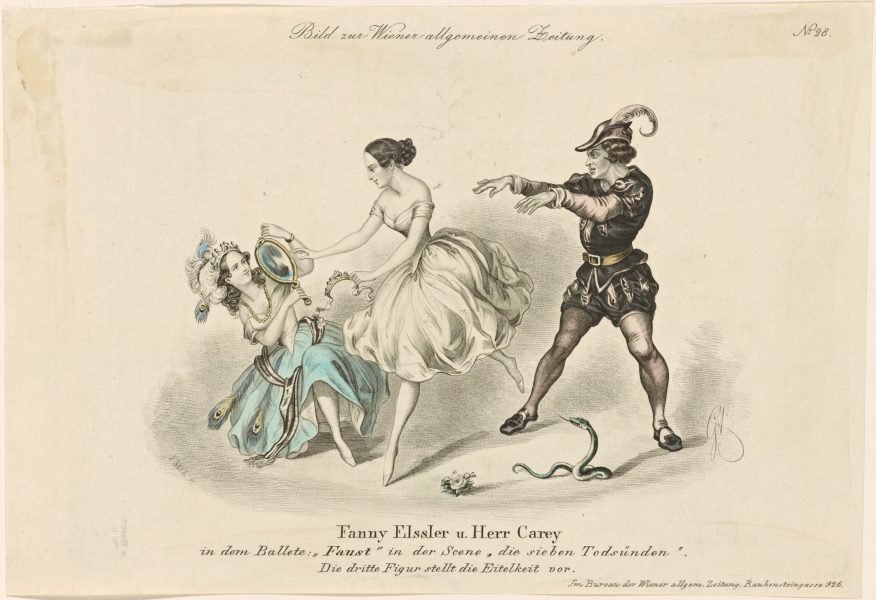
Grand ballet in four acts and seven scenes premiered on 12th February 1848 at the Teatro alla Scala, Milan
Choreography: Jules Perrot
Music: Giacomo Panizza, Michael Andrew Costa and Niccolò Bajetti
Premiers Rôles
Faust: Effisio Catte
Marguerite: Fanny Elssler
Valentine: Gaspare Pratesi
Martha: Mlle C. Bagnoli-Quattri
Mephistophélès: Jules Perrot
Bambo: Caterina Constantini
Plot
Summary
Acte 1
Scène 1
Dr. Faust’s laboratory.
As the curtain rises, Faust is concluding a lecture on physics to his pupils. When they have left he becomes depressed at his inability to fulfil his ambitions. At this point an ancient tome falls from one of the bookshelves. He picks it up and idly turning the leaves observes that it is a compilation of instructions for summoning the spirits of the underworld.
In his state of intense dissatisfaction, he decides to put these precepts into practice. Flames rise from the ground and Mephistopheles appears. Faust shrinks back in fear and orders the evil
spirit to depart. When he refuses, Faust pronounces a certain incantation and forces him to vanish.
Wolger, hearing the noise in the doctor’s study, hastens to his help. Faust, annoyed at his intrusion, tells him he was merely trying an experiment. Wolger, however, is inclined to investigate, when the Demon spirits him away and takes his place disguised as a student.
Astonished at the presence of the stranger, Faust enquires into his business. Mephistopheles replies that since the doctor objected to his previous appearance, he has assumed a guise which he thought would please him better. Faust fears to have dealings with the powers of evil but, unable to quell his curiosity, enquires how he can accomplish his desires.
The Demon replies that he has only to seal a pact with his blood when all his wishes will be granted, but after his death he in return must serve the powers of evil. Faust declines the offer.
A mist fills the room and disappears to reveal Marguerite’s bedroom. The young girl is seen plaiting a garland of flowers with which she decks her mother’s portrait; then she kneels and prays.
The Demon, unable to bear the sight of virtue, vanishes.
The mist returns and Marguerite’s room disappears to give place to a cemetery. At the Demon’s command an evil spirit in the guise of Marguerite appears. The cemetery changes to a fantastic garden filled with lovely visions.
Mephistopheles, observing that Faust is attracted by these apparitions, again produces the pact, which Faust refuses. Then the Demon summons the female spirit and, giving her a cup, directs her to induce Faust to drink from it.
She succeeds and as Faust lifts the cup to his lips he feels a molten fire course through his veins. Again the Demon presents the pact and this time Faust consents to sign it. The female spirit vanishes. Faust reproaches Mephistopheles, who counsels patience.
He spreads his cloak on the ground and signs to Faust to stand on it, when they both disappear.
Scène 2
A village market-place. On one side Marguerite’s house, on the other an inn.
Village-folk gradually fill the square; some go to the inn, others gossip.
On this day a prize is to be awarded to the maiden judged to be the most virtuous in the village. Members of the nobility and the Mayor are assembled to take part in the ceremony. A number of girls enter for the competition.
A visitor arrives in the person of a young soldier who excites curiosity by his questions regarding the village. At last a villager called Peters recognises him as Valentine, a friend of his youth. He enquires about his old sweetheart Marguerite and seeks for her among the damsels. At this moment Marguerite arrives.
He goes to greet her and they are joined by her mother, Berta.
Distant music is heard and Mephistopheles enters disguised as a charlatan; he is accompanied by Faust, who has recovered the appearance of youth. The latter indicates Marguerite as the woman he desires.
Meanwhile the Demon has observed Marguerite’s friend, Martha, who has been endeavouring to attract the attention of the strangers, for he conceives her to be a useful aid to his plans.
The Mayor is suspicious of the charlatan and inclined to send him packing, but he declares that he is only there to amuse the people and suggests that everyone should join in a dance. He assumes the guise of a carefree youth and induces Marguerite to dance with him. She is visibly disturbed by his captivating manners and tries in vain to master her emotions.
The Demon leaves her and dances in turn with the other damsels, who all fall under his spell. Marguerite grows calm or animated at the Demon’s wish while the other maidens dance at his will. She stops breathless near Faust, who watches the proceedings with the greatest interest.
Mephistopheles, with a rapid gesture, seems to tear from his breast some of the fire that consumes him and places it on Marguerite’s heart. She is so overcome with emotion that she is about to faint; but the Demon catches her in his arms and whirls her in a mad dance at the end of which she is left breathless.
Now the Mayor calls on everyone to vote as to the award of the prize. The voting is unanimously in favour of Marguerite. Valentine and Berta are delighted. The young men approve, but the other competitors are filled with envy. Mephistopheles, with a sardonic smile, congratulates Marguerite, but she ignores him and turns homewards, escorted by Berta and Valentine.
The Demon takes a glass and, filling it with wine, proposes a toast to the peerless Marguerite. The company raise their glasses but, finding them empty, call for wine.
“Here you are, friends!” cries Mephistopheles, plunging his dagger into the table at which he is sitting. Wine gushes forth from the holes and the young men run to fill their glasses. Faust is annoyed at this delay, but the Demon bids him be patient.
Suddenly the wine changes to gouts of flame. The villagers draw back in fear. The Demon gives a mocking laugh and vanishes with Faust, while the crowd take to flight.
Acte 2
Marguerite’s bedroom, with an alcove in the background.
Faust and Mephistopheles appear in the room where the young girl lies asleep in bed. While Faust gazes upon her, the Demon places a casket in a cupboard.
Marguerite begins to stir and Faust is about to kneel at her feet, when the Demon drags him away, although not before he has picked up her handkerchief and thrust it in his doublet.
Marguerite leaps from her bed as though fleeing from some dreadful dream; the tune of the dance with the stranger still lingers into her ears. She recalls the other fair stranger with whom she did not dance, and, to banish him from her thoughts, tries to think of Valentine. There is a knock at the door. She looks for her handkerchief and unable to find it goes to the cupboard where she discovers the casket. The knocking is renewed. She dresses quickly and opens the door.
It is Martha, who tells her that one of the strangers has given her a beautiful ring. Marguerite shows her the casket, which proves to be filled with gems. Martha feigns surprise although she has already spoken with the stranger, and urges her to adorn herself with the jewels; but Marguerite’s modesty prevents her from doing so.
Mephistopheles enters and signs to Martha to leave. Marguerite, wishing to dispel her thoughts, sits at her spinning-wheel. Now the Demon summons his familiar evil spirits: Pride, Gluttony, Sloth, Envy, Anger, Avarice, and Lust, who, unseen by the young girl, pour their evil counsels in her ear. Sloth induces her to stop spinning; Pride and Envy tempt her to put on the jewels. She notices the contrast between the rich gems and her homely dress and, at the bidding of Anger, tears off the jewels and flings them to the floor. But Pride and Avarice counsel her to keep the gems, which she gathers up and conceals in her dress. The Demon and his spirits rejoice in her downfall.
At the Demon’s command the room becomes a fantastic garden full of strange flowers and fruit. It is Lust who now whispers in her ear and fills her body with strange yearnings. She sees a vision of the youthful Faust and becomes enamoured of him. Suddenly the voice of Virtue warns her of danger and in an instant everything becomes horrible to her. She utters a prayer and the spell is broken, the spirits vanish, and Marguerite throws herself into the arms of her mother who enters at this moment.
Acte 3
Scène 1
A room in an enchanted palace.
Faust sits at a banquet in which he takes no pleasure, for he is haunted by thoughts of Marguerite. The Demon, having failed to dispel his melancholy, causes a vision of Marguerite to appear as if she were going to receive her prize for virtue. Faust greets her with joy and together they watch a dance which precedes the prize-giving. As the garland of white roses passes through the hands of Vice the flowers wither and blacken. The onlookers are troubled by this evil transformation.
Scène 2
This scene is divided into two, so that Marguerite’s room is on the left and the garden on the right.
Faust and Mephistopheles enter the garden, the former reproaching the latter for his failure to induce Marguerite to fall in love with him. The Demon assures him that his desires will soon be fulfilled, but first it will be necessary to put Berta to sleep, and to this end he gives him a vial containing a sleeping potion. Faust accepts the vial on being assured that the contents are harmless.
Footsteps are heard and Marguerite and Berta enter the garden, followed by Valentine and Martha. The Demon bids Faust hide while he keeps watch.
Valentine is in high spirits for Marguerite has agreed to marry him on the morrow. Berta blesses the lovers and tells Valentine that they must part as the hour grows late, but she and the two girls will see him on his way.
Valentine and Berta go first, the two girls follow. Mephistopheles reveals himself to Martha who shrinks back in fear. Marguerite turns to see what is the matter, but is assured that all is well. The Demon whispers to Martha that he must speak with her. Meanwhile Faust appears and kneels at Marguerite’s feet, but she takes fright and runs to the house. Martha wishes to follow but the Demon holds her back.
Faust implores Marguerite to permit him to speak with her.
When she answers that her mother would disapprove, Faust shows her the vial, saying that a few drops will make her sleepy.
Suddenly, Martha runs in with the news that Valentine and Berta, alarmed at not seeing the girls, have returned in search of them. But Faust refuses to leave until Marguerite has given her promise to see him later. The Demon touches his arm and they vanish as the others come into the house.
In response to their enquiries Martha declares that she was taken ill. Marguerite, ashamed of such an untruth, looks away. Berta tells Martha that she must stay with them and tells Valentine that he must leave for they will see him on the morrow, and she hands him the key of the garden-gate.
Valentine bids his friends good-night but, on passing through the garden, has a presentiment of evil; he is half-minded to guard the house, but finally decides to leave. As soon as he goes the Demon tells Faust, who is overjoyed.
Martha has retired and Marguerite and her mother are alone.
But the latter, instead of going to bed, asks for a book and settles herself to read. Marguerite is frightened at the promise she has given to Faust and is about to confess all to her mother when she sees the hateful stranger.
Berta asks for a cup of water. Marguerite fills a cup with water into which, at the Demon’s direction, she empties the vial. She hands the cup to her mother who drinks, becomes seized with trembling, and falls back, inert. Mephistopheles places his hand on her heart and expresses his satisfaction. Then he leads Marguerite into the garden where Faust awaits her.
The Demon goes to Martha and they leave together. Marguerite awakes from the spell to find herself in her lover’s arms. She wishes to go, but is forced to stay by Faust’s entreaties and avowals of love, and finally confesses that she loves him. At last she tells him that they must part and, seeing Martha and the stranger return, implores her lover to break off his friendship with the latter whom she detests. but he declines.
Martha warns Marguerite that Valentine is approaching and she immediately goes into the house. The young soldier dashes at Faust, sword in hand, while Martha calls for help. They fight, but the Demon guides Faust’s blade and his opponent falls mortally wounded. Faust and Mephistopheles vanish. Neighbours, bearing torches, hurry in; they tend the dying man.
Marguerite hears the noise but, finding her mother still asleep, becomes seriously alarmed. She kisses Berta and tries to revive her, but in vain, she is dead. The door opens and she sees Valentine’s prostrate body.
She runs to his side but, gathering his strength, he repulses her.
The bystanders draw away in horror, while he curses Marguerite with his failing breath. She falls on her knees and vainly pleads for forgiveness. Valentine is dead.
Marguerite rises and, moving as if in a trance, goes towards the onlookers, laughing wildly. Finally she disappears among the trees.
The bodies of Berta and Valentine have vanished and all is confusion.
Acte 4
Scène 1
A bleak part of the Harz Mountains.
Faust enters with Mephistopheles who tells him that he is leading him to a great festival where he will find Marguerite. Weird and fantastic spirits invade the scene. Screams are heard and Faust listens. The Demon, who has recognised Marguerite’s voice, urges Faust in the opposite direction from which she approaches, pursuing a will o’ the wisp. She kneels and carries her arms to her breast as if she were nursing a child, which she holds out to an imaginary Faust. But that vision appears to vanish, for weeping and kissing her imaginary child she covers it with the folds of her dress. Then she goes to the edge of a deep stream and, again kissing the child, drops it in the water. She is about to leap in herself when she swoons.
Faust, unable to witness the dreadful witches’ sabbath, returns.
He sees the prostrate Marguerite and, taking her in his arms, presses her to his heart. Recognising her lover, she tells him of her sufferings, and of the death of their child. He takes Marguerite by the hand and tries to lead her away, but she shrinks from his touch.
The Demon returns and seeing Faust urges him to fly, for soldiers are approaching to apprehend Marguerite. Faust implores Mephistopheles to save her and, when he refuses, swears that he will die with her. But she repulses him, saying that she belongs to God. The soldiers arrive and seize the girl. “Come!” cries the Demon, “she is lost.” They vanish as Marguerite is led away.
Scène 2
Another part of the Harz Mountains.
Witches and necromancers are preparing incantations while other evil spirits dance. The dancing grows wilder and wilder.
Devils play weird instruments while witches give vent to eldritch screeches. On the entrance of Mephistopheles the dancing abruptly ceases. He places Faust, who is fast asleep, on the ground.
Beckoning to one of the witches Bambo, the Demon orders her to assume the likeness of Marguerite for Faust’s entertainment. She changes her shape and captivates him so that he follows her. But soon he returns, pale and trembling.
A great noise attracts everyone’s attention. The clouds lift and on the topmost peak can be seen Marguerite surrounded by soldiers
and people. She kneels and prays. A headsman appears with his axe which he raises in the air. The vision fades. Faust wipes the sweat of anguish from his brow, while the witches resume their infernal festival.
A tiny flame flickers over the ground. Faust believes it to be the soul of his beloved. Reproaching Mephistopheles for his failure to save her from a shameful death he attacks him with his sword which snaps in two at a sign from the Demon, who reminds him that his soul is his.
Faust kneels and prays for divine forgiveness, but Mephistopheles draws the fatal pact from his breast and cries: “You are mine, Faust, mine for all eternity!” Suddenly the flame lengthens and burns up the agreement. The Demon is furious at being deprived of his prey.
The flame travels towards the mountain and is followed by Faust who reaches the peak. Mephistopheles summons all the powers of Hell to his aid. The earth opens, flames shoot forth, terrible screams are heard, and a black vapour hides everything from view, as the Demon fights to regain possession of Faust.
Gradually the evil vapour clears to reveal Marguerite, surrounded by angels, who is seen holding out her arms to welcome Faust who is carried towards her, while Mephistopheles vainly continues to rage.
History
Original Production
Faust premièred in three acts and seven scenes on the 12 February 1848 at the Teatro alla Scala, Milan. It was choreographed by Jules Perrot with music by Giacomo Panizza, Michael Andrew Costa and Niccolò Bajetti.
While Goethe’s poem was the principal source, an English friend may have directed Perrot’s attention to Christopher Marlowe’s Doctor Faustus, from which the idea of introducing the Seven Deadly Sins could have come. However, Perrot used them to ensnare Marguerite and not, as Marlowe had done, to tempt Faust himself with their forbidden delights.
Perrot divided the action into seven scenes, skilfully designed so as to introduce a varied succession of dances and dances, and accompanied by stage effects that he was assured would present few problems to the resourceful machinists of La Scala under their chief machinist, Giuseppe Ronchi. Since Faust was to be the only new ballet of the season, no expense was spared to make it as splendid a production as the designer, Carlo Fontana, and the costumier Raviglia could achieve. At the same time Giacomo Panizza was hard at work on the score, which was to contain two interpolations by other hands: the Pas de Fascination in the second scene of the first (whose music was composed by Michael Costa, a borrowing the dance from his 1842 ballet Alma ou La Fille de Feu) and the Pas de Sept in the first scene of the second act (whose music was composed by Niccolò Bajetti).
A work on such a grand scale demanded more time than usual to prepare, but there was to be an added distraction that Perrot could hardly have taken into account: the growing spirit of restiveness and excitement that was taking hold of the Italian population, as if they subconsciously knew that the hour was at hand to rise against their Austrian overlords. But more serious still, as it then seemed, was the foot injury sustained by Fanny Elssler, his chosen Marguerite. It soon became apparent that Faust could not possibly be ready by the opening of the season, and to fill the gap an old ballet by Louis Henry had to be revived, Edoardo III o l’Assedio di Calais. For a while it must have seemed that Perrot’s Faust was doomed to the same fate as that of Blasis, but early in February (responding, perhaps, to a politically motivated pressure aimed at distracting attention from the growing unrest in the city) Elssler agreed to appear even though her injured foot had not fully recovered its strength. The management announced ‘with certainty’ that the long promised ‘grandiose spectacle’ of Faust would be presented in a week’s time, on February 12th, 1848.
It may have been against Perrot’s better judgment that the curtain rose on his ballet when still in an imperfect state, but rise it did on a performance that was to be chiefly remembered as a portent of the revolution that was to break out a few weeks later.
The ballet was revived the following year at La Scala, and was revived three times between 1848 and 1854.
Selected Revivals
4th February [O.S. 2nd February] 1854
Location: Imperial Bolshoi Kamenny Theatre
Staged by Perrot for Guglielmina Salvioni as Marguerite, with Marius Petipa as Faust and Perrot himself as Mephistopheles.
4th November [O.S. 2nd November] 1867
Location: Imperial Bolshoi Kamenny Theatre
Staged by Petipa for his first wife Maria Surovshchikova Petipa as Marguerite.
London Revival
1889 Revival
In 1889 the ballet was revived by Thompson for Emma Ashfield with Péchard revising the score. No expense was spared for the production, with lavish sets, costumes and machinic effects. Originally planned in three acts and seven scenes, it was, following its first performance, presented in four acts, with Act 1, Scene 3 becoming its own standalone act.
The ballet was principally revived for the benefit of Ashfield, who was to retire at the end of the season. In 1888, she had originated the rôle of Élodie in The Fairy of the Forest and had unfortunately injured herself partway through the run. The remainder of the run was completed by Ivy Gregson, with Thompson ordering Ashfield to rest and recover for what he was planning for the following season.
What Thompson had been planning for the following season was a revival of the Taglioni-Hertel ballet Satanella oder Metamorphosen. Satanella enjoyed similar popularity in Berlin as Das schlecht bewachte Mädchen, which had been successfully received in London in 1886 when Thompson staged the work as The Wayward Daughter. By the time of Ashfield’s injury, Thompson was already in correspondence with Berlin and was quite frustrated by their continued disagreement on the price of the score for Satanella. The price demanded by Berlin for the score of The Wayward Daughter had been notably expensive, and for Satanella the price was higher still. Thompson tried to negotiate but Berlin refused his counter offers, stating their price was a final one.
Thus, Thompson was forced to turn his attention elsewhere, to find another ballet to revive. The next item on his list was Faust, and correspondence with St Petersburg resulted in a much more favourable agreement being reached. Thus, the Costa-Pugni score was sent and Thompson could begin to work on the revival before the 1888 season had drawn to a close.
Ashfield was to portray the rôle of Marguerite with Rafael Caravetti as her Faust. However, when Ashfield returned in earnest to rehearsals the full extent to which her injury had affected her dancing soon became apparent. Despite her frustrations, Thompson continued to choreograph the ballet and work around her limitations with the aim that the revival should première as scheduled.
Though the lavish production was praised by the critics and public, both in regards to its mise-en-scène, dances and drama, Ashfield’s performances as Marguerite received mixed reviews. Some were congratulatory, praising her dancing and acting while others lamented the noticeable loss of the finesse of her technique. Though her injury had begun to bother her some time before the première, she persisted, dancing five performances as Marguerite. She decided to withdraw after her fifth performance due to her doctor’s advice that persisting would negatively impact her future health. The newspapers were informed and tickets quickly sold out. She was able to retire partway through the run as an alternate (Joséphine Decoin) had already been arranged for her by Thompson during the rehearsal period, with the idea that with an alternate she could allow herself adequate rest to dance the most important performances.
Despite the positive reception of the ballet, due to its large expense to mount it could not hope to regain its investment. Thus, the ballet was retired following its 1889 run and was not revived again. Carolina Ferreira requested that the ballet be revived for benefit in the 1906 season, but this request was refused and Naïla was revived for her instead.
Rôles
Faust: Rafael Caravetti
Marguerite: Emma Ashfield
Valentine: Frederick Hale
Martha: Mary Butler
Méphistophélès: Jean Rousset
Bambo: Ivy Gregson
Musical Revisions
Péchard extensively revised the Costa-Pugni score, supplying music for no less than seven new variations in addition to other dances. Though the ballet was not again revived, some of Péchard’s supplemental pieces made their way into other works.
The Pas de Fascination was expanded with an Allegretto for the three coryphées and a Variation for Marguerite.
In 1901, La Fille de Marbre (1847) was revived at Her Majesty’s Theatre as The Marble Maiden. The Marble Maiden had originated in London as Alma ou La Fille de Feu in 1842, choreographed by Perrot for Fanny Cerrito as Alma, and was restaged in Paris by Arthur Saint-Léon as La Fille de Marbre in 1847. The Pas de Fascination, danced by Cerrito, originated in Alma in 1842 and was retained in the 1847 revival. The pas was only later interpolated into Faust (1848), likely by Perrot, who choreographed both Alma and Faust. For the 1901 revival of The Marble Maiden at Her Majesty’s, Péchard’s Allegretto was retained, but a new Variation was composed as the ballet master did not feel that the variation Péchard provided suited either the character of Fatma or the danseuse who was to portray the title rôle in the revival.
The Variation de Marguerite in the Pas de Fascination (Péchard’s 1889 variation) was revived for the unsuccessful 1908 revival of Esmeralda staged at The Alhambra, where it was interpolated into the second act Grand Pas des Corbeilles as a variation for Fleur de Lys.
Grande Valse, composed by Giacomo Panizza (1848)
Thompson’s ambitious expansions resulted in problems of length, particularly in the first act. His expansion of the Pas des Septs Péchés Capitaux in particular caused the length of Act 1 to increase to the point where several people, including the conductor, thought it too long. Thompson dismissed these worries and the ballet premièred in three acts and seven scenes, as he had originally planned. However, the critics, though complementary, near universally agreed that the first act was too long and needed to be split or shortened. Following these reviews, Thompson begrudgingly conceded and split the first act, with Act 1, Scene 3 becoming the new Act 2.
Following the splitting of the first act, Thompson was now faced with the opposite problem: Act 2 was now too short in comparison to the other three acts. Butler, who had long been angling for a pas to be arranged for herself, again proposed the idea of doing so in the newly created second act. This time Thompson was receptive to the idea, deciding to add a new pas into Act 2 for Martha where she would unsuccessfully attempt to entice Marguerite to adorn herself with the jewels prior to the successful attempt of the seven deadly sins.
But how to arrange the music and the choreography for the pas? The next performance of Faust was scheduled for just over a week after the first, meaning that Thompson would have to arrange the pas in a matter of days. He would have asked Péchard for the music, as Péchard would likely have been able to supply the music and orchestrations in a matter of days, if not hours, but as Péchard was not in London at the time Thompson turned instead to an interpolation.
One of the suggestions from Henry Scott, Péchard’s assistant, was the Polka from The Five Senses which had been revived by Thompson in 1880. However, Thompson thought the Polka unsuited to his conception of the new pas. However, the suggestion of The Five Senses drew Thompson’s attention to the Valse à Cinq Temps from the same ballet. Thompson decided it would better suit his conception, and with the addition of a new Coda (arranged by Scott from the Coda of the Pas de Deux from the same ballet) the pas was named the Pas de Tentation.
However, the pas was still too short and Thompson began to search for music for an Andante. This search proved to be more difficult, as Thompson and Scott could not seem to find suitable music that fit Thompson’s conception or the interpolated music from The Five Senses. Scott suggested he try his hand at composition, and Thompson, having few other options, agreed. A few hours in the rehearsal room together resulted in a perfectly serviceable Andante, which was added to the pas.
Thompson quickly set to work on the choreography and Butler eagerly practised it, relishing in finally being given her own pas. The second performance of the ballet was presented in four acts and seven scenes, with the newly minted Pas de Tentation debuting in the second act, which now better approached the expected length. The new arrangement of scenes was better received by the critics, who echoed their previous comments with observations that the new configuration was much less trying for the audience’s attention.
The Pas des Sept Péchés Capitaux was expanded by a new Adage and three Variations for the Spirit of Pride (danced by Marta Draeger), the Spirit of Greed and the Spirit of Lust.
The Variation d’Orgueil was interpolated into the second act Divertissement of the 1899 revival of Pygmalion as the Variation Saphir. The interpolation was retained for subsequent revivals of the ballet and became part of the ballet’s performance tradition.
The Grand Pas de Séduction was expanded by a new Grand Adage and three Variations for a female sujet (Sarah Nicholson), Faust and Marguerite.
The Variation II of the Grand Pas de Séduction was a newly written variation for Sarah Nicholson, who was a leading sujet at the time. In 1890 she interpolated the variation into the Act 2 Pas de Deux of The Wayward Daughter as a Variation for Lise. She retained the variation for her performances of the rôle in subsequent revivals, giving rise to an alternative variation for Lise in the pas.
The Variation de Marguerite in the Grand Pas de Séduction was interpolated into the Pas de Six of the 1901 revival of Ondine as the variation for Giannina, replacing the variation which had been added in 1877. The new variation was occasionally substituted for a variation written in 1888 for Draeger’s performances in Giselle.
A new Tarantelle Diabolique was composed for the Walpurgisnacht sequence.
Résumé des Scènes et Danses
Acte 1
Scène 1
1) Prélude
2) Scène 1re – Le Laboratoire de Faust
3) Scène 2e – Faust seul
4) Scène 3e – Apparition de Méphistophélès
5) Scène 4e – Vision de Marguerite
6) Grand Ballabile
a) Andante Maestoso
b) Valse
c) Coda
7) Scène 5e
Scène 2
8) Entr’acte
9) Scène 6e – Le peuple se réjouit
10) Scène 7e – Entrée du Bourgmestre
11) Scène 8e – Entrée de Valentine
12) Scène 9e – Entrée de Marguerite et sa mère
13) Scène 10e – Entrée de Méphistophélès
14) Scène 11e – Le Prix du Rosier
15) Grande Valse
a) Introduction
b) Valse
c) Galop
16) Pas de Fascination
a) Introduction
b) Valse
c) Allegretto
d) Variation de Marguerite
e) Coda
17) Scène Finale
Acte 2
18) Entr’acte et Scène 1re – Faust et Méphistophélès
19) Scène 2e – Réveil de Marguerite
20) Scène 3e – Entrée de Martha
21) Pas de Tentation
a) Andante (Scott)
b) Valse à Cinq Temps (from the Pas de Trois from The Five Senses)
c) Coda (from the Pas de Deux from The Five Senses)
22) Scène 4e – Départ de Martha et Entrée des Sept Péchés Capitaux
23) Pas des Sept Péchés Capitaux
a) Andante
b) Variation à Quatre – Paresse, Envie, Gourmandise, Colère
c) Variation d’Orgueil
d) Variation d’Avarice
e) Variation de Luxure
f) Coda
24) Scène Finale
Acte 3
Scène 1
25) Entr’acte
26) Scène 1re
27) Scène 2e – Entrée de Marguerite
28) Pas des Tziganes
29) Grand Pas de Séduction
a) Entrée – Valse
b) Grand Adage
c) Variation I
d) Variation II
e) Variation III – Valentine
f) Variation IV – Martha
g) Variation V – Faust
h) Variation IV – Marguerite
i) Coda
30) Scène 3e
Scène 2
31) Entr’acte et Scène 4e
32) Scène 5e – Entrée de Valentine, Berthe, Martha et Marguerite
33) Scène 6e – La Séduction de Marguerite
34) Scène Finale – Le Duel
Acte 4
Scène 1
35) Entr’acte
36) Scène 1re – Scène de Marguerite
37) Scène 2e – Entrée de Faust et Méphistophélès
Scène 2
38) Entr’acte et Scène 3e
39) Ballabile de Walpurgisnacht
40) Scène 4e – Entrée de Faust et Méphistophélès
41) Scène 5e – La Vision de Marguerite
42) Tarentelle Diabolique – Danse générale pour séduir Faust
43) Scène 6e – Scène de Faust et Méphistophélès
44) Scène Finale