Her Majesty's Theatre
A brief history of ballet at Her Majesty's Theatre
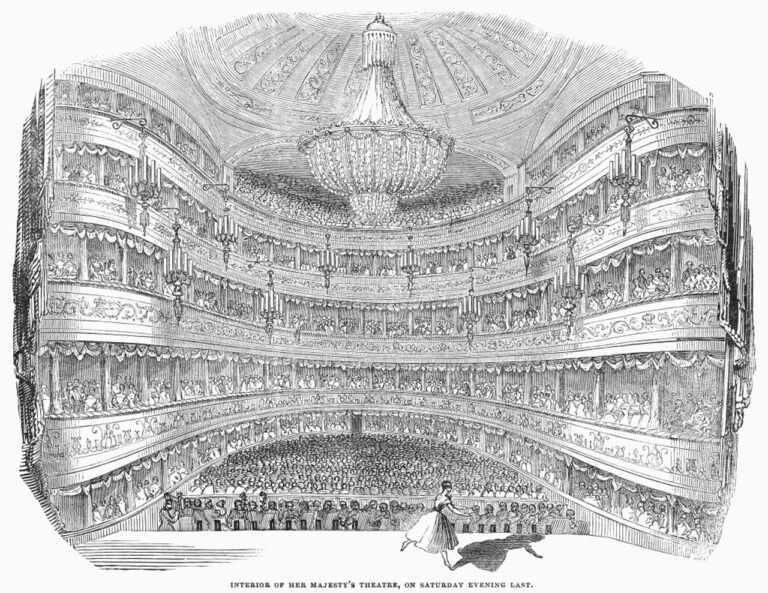
History
Her Majesty’s Theatre was, during the Romantic Ballet era, one of the leading stages alongside the Salle Le Peletier (whose official name changed several times during the period) in Paris. Several important works were premiered on the stage with the balletmaster Jules Perrot at the helm: Ondine ou La Naïade in 1843, La Esmeralda in 1844, Pas de Quatre in 1845 (where Perrot succeeded in the not insignificant task of engaging Lucile Grahn, Carlotta Grisi, Fanny Cerrito and Marie Taglioni on the same stage) and Catarina ou La Fille du Bandit in 1846. As such, Perrot was named Premier Maître de Ballet in 1842. During this period, most of the ballets were created to music by Cesare Pugni, and a new position was created for him: Composer of the Ballet Music to Her Majesty’s Theatre in 1843.
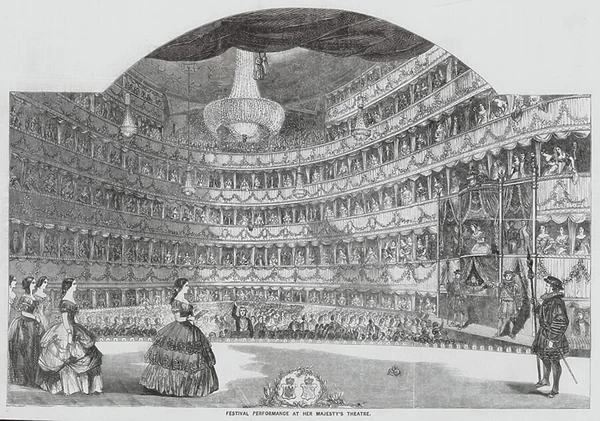
However, this golden era of London ballet was to come to an end as Perrot relocated to Russia in 1850 and Pugni followed him. The revival of interest in ballet in London began with James Henry Mapleson returning to Her Majesty’s Theatre in 1877. In an unprecedented move, Mapleson engaged William Thompson‘s ballet troupe to stage a ballet for the reopening of the theatre. It was decided to mount a new production of Pugni’s 1843 ballet Ondine, to call back to London’s golden era of ballet under Perrot and Pugni. This set off a renewed interest in ballet in England as the ballet soon became as much a part of the London season as the opera or the theatre. For the premiere Thompson engaged the popular Isabella Velluti as première danseuse, and she went on to dance several principal roles.
In 1886 strains began to show between Thompson and Mapleson. Thompson had wanted to create a new ballet but Mapleson insisted he continue to revive older works, believing that advertising productions “as danced by Grisi, Elssler, Cerrito, Rosati” or some other great name they could attach to the production would improve success. This argument reached a head in the 1886 season, where Mapleson repeatedly opposed the revival of The Wayward Daughter, stating that it had been created by “an unknown danseuse and was sure to fail.” However, The Wayward Daughter proved to be very popular, much to Thompson’s triumph. The following year, in 1887, Thompson again pushed for a new ballet to be created but was again denied. This disagreement led Thompson to move his troupe to The Royal Italian Opera at Covent Garden, where he was allowed to première his new ballet The Amphitrite.
Following Thompson’s departure in 1887, Her Majesty’s experienced a balletic lull, with sporadic productions and no real direction. Ballet at the theatre limped along until the theatre closed in 1890 due to insolvency. In February 1896 an agreement was reached with the actor-manager Herbert Beerbohm Tree for the erection of the theatre at an estimated cost of £55,000.
The theatre was due to reopen in April 1897, and Tree sought to revive serious ballet at Her Majesty’s to capitalise on the success of Covent Garden’s Royal Ballet. That year, the expanded the troupe at Her Majesty’s presented a revival of Perrot and Pugni’s 1846 ballet Catarina ou La Fille du Bandit, revived as Catarina. With Franco Tavano providing the choreography and Philip Jenson, the head conductor of His Majesty’s Theatre being commissioned to revise the score, the revival’s success demonstrated that ballet at Her Majesty’s could succeed without Thompson. Revivals of Ondine (1898) and Giselle (1899) followed, presented much as they were danced at Covent Garden. The ballets of Greta (1900), The Fallen Star (1903) and The Blue Bird (1907) were created to Jenson’s music and Jenson also contributed to the celebrated 1900 revival of Mazilier and Deldevez’s 1846 ballet Paquita, a ballet which had long been absent from the London stage. The theatre’s balletic reputation was soon much improved, with the troupe being considered second only to the Royal Ballet at Covent Garden.
Following the accession of King Edward VII in 1901 (for which the theatre presented a gala which included the première of Albion Triumphant), the theatre became known as His Majesty’s Theatre and would continue to be known as such until the accession of Queen Elizabeth II in 1952.
Productions
During Thompson’s Tenure (1877-1886)
1877
- Ondine
1878
- Esmeralda
1879
- Giselle
1880
- The Five Senses
1881
- The Corsair
1882
- The Fairies’ Goddaughter
- Marco Spada
1883
- The Buccaneers
- The Devil to Pay
1884
- Ondine
- The Devil to Pay
1885
- Coppelia
- Giselle
1886
- The Wayward Daughter
- Sylvia
The Fourth Theatre (rebuilt 1896-1897)
1897
- Catarina
1898
- Ondine
1899
- Giselle
1900
- Greta
- Paquita
1901
- The Vivandiere
- The Marble Maiden
1902
- Albion Triumphant
- Catarina
1903
- The Fallen Star
- Coppelia
1904
- Ondine
- Giselle
1906
- The Two Pigeons
1907
- The Blue Bird