Galas and Special Occasions
Notable ballet performances in late 19th and early 20th century London
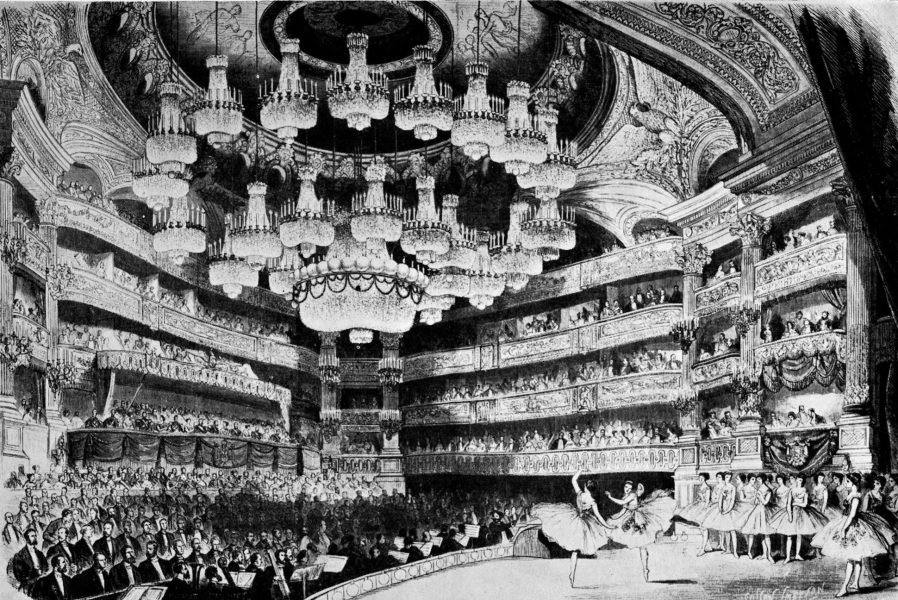
History
Following the re-introduction of narrative ballet to the London stage in the late 1870s and early 1880s, ballet began to be seen as a Society event, as much so as opera and theatre. This intensified through the 1880s and by the 1890s ballet had become an intrinsic part of the social Season.
At Her Majesty’s Theatre, William Thompson, as part of his efforts to restore ballet to what he believed to be its rightful place, wished to return ballet to galas and state performances. Up until then, galas and state performances had entirely consisted of extracts from operas, with few, if any, ballet diversions included as part of the programme. Thompson eventually succeeded in his efforts, resulting in the inclusion of a ballet (or an extract from a ballet) in galas and state performances becoming the norm rather than the exception.
Galas
Unlike in St Petersburg, it was not a usual thing to hold gala performances where the evening consisted solely of extracts from various ballets. Instead, a gala performance in London would usually consist of extracts from both opera and ballet, with the former generally preceding the latter. In general, the ballet extracts would be either a fully contained diversion or a complete act of a ballet as opposed to a programme of various pas taken from various ballets.
There were two main types of galas given at Covent Garden. The first were state performances held for occasions connected to the royal family, such as coronations, weddings and jubilees. These galas usually included both opera and ballet, with the ballet, as was the practice, given after the opera. The usual format included three acts excerpted from different operas and one act excerpted from a ballet to conclude the evening.
The second were the Graduation Galas for the Royal Ballet School. These end of year performances were created to showcase the talents of the graduating students, to display the skills of the school to the public and to allow the balletmaster the opportunity to see the students in a performance context and thus inform his decision as to whom invitations would be extended to join the troupe. These graduation galas usually consisted of extracts from different ballets performed by the graduating students, more in the manner of an extended divertissement than a plot driven evening. Under Richard Hague, these graduation performances began to feature complete one-act diversions from the Royal Ballet’s repertory, with the dances slightly adapted for the students.
State Performances
State performances were performances requested by the monarch or wider royal family for a special occasion. They differed from Royal Command Performances in their form and function. Royal Command Performances were usually specific plays, operas or performances that were requested by the reigning monarch at their personal discretion, and so did not even need to be held in a theatre, with Queen Victoria requesting command performances to be held at both Windsor Castle and Balmoral. State performances, on the other hand, were near universally held in theatres, and were requested for specific occasions such as coronations, weddings, jubilees and visits of foreign royalty and other dignitaries.
The first State Performance for which Thompson staged a ballet was the State Performance for the Wedding of the Duke of Albany (Queen Victoria’s fourth son) and Princess Helen Frederica of Waldeck-Pyrmont in 1882. Placed after extracts from two operas, the ballet that was staged was The Vivandiere. Thompson initially wished to stage the second act of The Corsair (the revival of which was well received the previous year 1881) but James Henry Mapleson (the theatre manager at the time) refused for so long an extract to be staged, especially since Mapleson preferred a complete diversion to be staged rather than an extract from a larger work. Thompson would continue to stage ballets (and later extracts from ballets) until his 1896 retirement, and Hague, his successor, would continue to do so into the twentieth century.
List of Ballets Staged for State Performances
Her Majesty’s Theatre
State Performance for the Wedding of the Duke of Albany and Princess Helen Frederica of Waldeck-Pyrmont (2 August 1882)
- Ballet: The Vivandiere
- Kathi: Isabella Velluti
- Hans: Samuel Penrose
- Pas Seul: Marguerite Lemoine
- Jacob: Rafael Caravetti
State Performance for the Wedding of Princess Beatrice and Prince Henry of Battenberg (27 July 1885)
- Ballet: Diavolina
- Diavolina: Isabella Velluti
- Gennariello: Samuel Penrose
State Performance for the Coronation of King Edward VII and Queen Alexandra (13 August 1902)
- Ballet: Albion Triumphant
Covent Garden
State Performance for the Golden Jubilee of Queen Victoria (23 June 1887)
- Gli Ugonotti, Meyerbeer
- Ballet inserted into Act 3 (music taken from The Beauty of Ghent)
- Pas Bohémien
- Julie: Emma Ashfield
- Zéphiros: Samuel Penrose
- Pas Bohémien
State Performance for the Visit of the Shah of Persia (2 July 1889)
- The Mad Scene from Lucia di Lammermoor, Donizetti
- Act 4 of Fausto, Gounod
- Act 1 of Mefistofele, Boito
- Ballet: Act 2 of The Corsair
- Médora: Marta Draeger
- Conrad: Rafael Caravetti
- Gulnare: Sarah Nicholson
- Birbanto: Charles Jennings
- Odalisques: Ivy Gregson, Mary Butler and Joséphine Decoin
- Seyd Pasha: Edward Lamb
- Lanquendem: Jean Rousset
- Head Eunuch: George Cox
State Performance for the Visit of the German Emperor and Empress (8 July 1891)
- Act 1 of Lonhegrin, Wagner
- Act 4 Romeo and Juliet, Gounod
- Act 4 of Gli Ugonotti, Meyerbeer
- Ballet: Act 2 of Ondine
- Ondine: Marta Draeger
- Mattéo: Frederick Hale
- Hydrola: Sarah Nicholson
- Naiads: Ivy Gregson and Mary Butler
State Performance for the Wedding of the Duke of York and Princess Mary of Teck (4 July 1893)
- Romeo and Juliet, Gounod
- Ballet inserted into Act 4, Scene 2: Divertissement: Bacchus and Ariadne
- Ariane: Marta Draeger
- Bacchus: Frederick Hale
- Vénus: Sarah Nicholson
- Cupidon: Antoine Férat
- Thésée: Jean Rousset
State Performance for the Diamond Jubilee of Queen Victoria (23 June 1897)
- Act 2 of Tannhäuser, Wagner
- Act 3 of Romeo and Juliet, Gounod
- Act 4 of Gli Ugonotti, Meyerbeer
- Ballet: Act 3 of The Buccaneers
- Rôles:
- Jovita Cavallines: Sarah Nicholson
- Don Altamirano: Antoine Férat
- Notary: George Cox
- Don Cavallines: Jean Rousset
- Catarina, Inès and Amalia: Marie Saunier, Giulia Moretti and Louise Grignon
- Don Alvar: James Elton
- Dances:
- Danse de Caractère Mexicaine: Lucia Rinaldi and Patrick Walsh
- Danse de Caractère Européenne: Clara Whitmore and James Elton
- Danse des Demoiselles: Marie Saunier, Giulia Moretti, Louise Grignon, Lily Clifford, Teresa Montoro, Jane Wheaton, Ada Ross and Sofia Zacchini
- Ballabile des Enfants: Students of the Royal Ballet School
- Grand Pas Classique: Sarah Nicholson and Frederick Hale
- Variation: Harriet Linwood
- Finale: Dancers of the Royal Ballet
- Rôles:
State Performance for the State Visit of Her Majesty Queen Victoria (16 July 1900)
- Fausto, Gounod
- Act 5 Walpurgisnacht Ballet
- Cléopâtre: Giulia Moretti
- Hélène: Harriet Linwood
- Phryné: Sarah Nicholson
State Performance for the Coronation of King Edward VII and Queen Alexandra (16 August 1902)
- Ballet: Fairest Isle
- Britannia: Sarah Nicholson
- Her Cavalier: James Elton
- The Four Winds: Teresa Montoro, Elisabeth Charron, Helen Davenport, Sofia Zacchini
- Commerce: Lily Clifford
- Agriculture: Jane Wheaton
- Science: Harriet Linwood
- Art: Louise Grignon
State Performance for the Visit of the French President (7 July 1903)
- Act 1, Scene 2 of Rigoletto, Verdi
- Act 2 of Carmen, Bizet
- Act 2 of Romeo and Juliet, Gounod
- Ballet: Act 3 of Coppelia
- Swanilda: Sarah Nicholson
- Franz: James Elton
- Dawn: Giulia Moretti
- Prayer: Louise Grignon
- Work: Harriet Linwood
- Hymen: Teresa Montoro
- Discord: Jane Wheaton
State Performance for the Visit of the King of Spain (8 June 1905)
- Act 2 of Romeo and Juliet, Gounod
- Act 3 of La Bohème, Puccini
- Act 4 of Gli Ugonotti, Meyerbeer
- Ballet: The Two Peasant Girls
- Justine: Harriet Linwood
- Irène: Giulia Moretti
State Performance for the Visit of the King and Queen of Denmark (11 June 1907)
- Act 1 of Madama Butterfly, Puccini
- Act 1 of La Bohème, Puccini
- Act 3 of Die Meistersinger von Nürnberg, Wagner
- Ballet: Act 2 of Esmeralda
- Esmeralda: Giulia Moretti
- Fleur de Lys: Louise Grignon
- Diane: Sofia Zacchini
- Beranger: Carolina Ferreira
- The Rose: Jane Wheaton
State Performance for the Visit of the President of the French Republic (27 May 1908)
- Act 1 of I Pescatori di Perle, Bizet
- Act 2 of Fausto, Gounod
- Ballet: Act 2, Scene 2 of The Beauty of Ghent
- Béatrix: Jane Wheaton
- Julie: Giulia Moretti
- Diane: Louise Grignon
- Masked Revellers: Dancers of the Royal Ballet
State Performance for the Coronation of King George V and Queen Mary (26 June 1911)
- Act 2 of Aida, Verdi
- Act 2 of Romeo and Juliet, Gounod
- Act 2 of Il Barbiere di Siviglia, Rossini
- Ballet: The Birth of Aurora
- Aurora: Jane Wheaton
- Diana: Helen Davenport
- The North Star: Sofia Zacchini
State Performance for the State visit of the King and Queen of Denmark (11 May 1914)
- Act 1 of Tosca, Puccini
- Act 2 of La Bohème, Puccini
- Act 2 of Aida, Verdi
- Ballet: The Automaton
Retirement Benefit Performances
Retirement benefit performances were held for the retirement of a notable dancer, choreographer or composer. The privilege of a retirement benefit performance was part of the contract of a première danseuse or premier danseur, and would, on occasion, also be allowed for long serving and respected sujets or character artists of the troupe. The beneficiary would request management for a certain ballet to be revived or newly created for their benefit, and management would either approve, reject or amend the proposal. A portion of the revenue generated by the performance (usually pre-specified in the contract) would go to the beneficiary as a parting gift to their years of service to the stage.
Below is a list of benefit performances and their beneficiaries:
- The Devil to Pay, revival, for the benefit of Marguerite Lemoine (1884)
- Giselle, revival, for the benefit of Johann Faber (1885)
- Sylvia, revival, for the benefit of Isabella Velluti (1886)
- The Amphitrite, new creation, for the benefit of Samuel Penrose (1887)
- The Fairy of the Forest, new creation, for the benefit of François Bardet (1888)
- Faust, revival, for the benefit of Emma Ashfield (1889)
- The Peri, revival, for the benefit of Rafael Caravetti (1892)
- Esmeralda, revival, for the benefit of Marta Draeger (1894)
- The Swords of Toledo, new creation, for the benefit of William Thompson (1896)
- Pygmalion, revival, for the benefit of Frederick Hale (1899)
- The Devil to Pay, revival, for the benefit of Antoine Férat (1900)
- The Peri, revival, for the benefit of Sarah Nicholson (1903)
- Tristan and Yseult, new creation, for the benefit of Auguste Péchard (1903)
- The Buccaneers, revival, for the benefit of Harriet Linwood (1906)
- Naïla, revival, for the benefit of Carolina Ferreira (1906)
- Pygmalion, revival, for the benefit of Giulia Moretti (1910)
- The Corsair, revival, for the benefit of Louise Grignon (1911)
- The Pearl of Iberia, revival, for the benefit of Jane Wheaton (1912)