Bacchus et Ariane
Or Bacchus and Ariadne
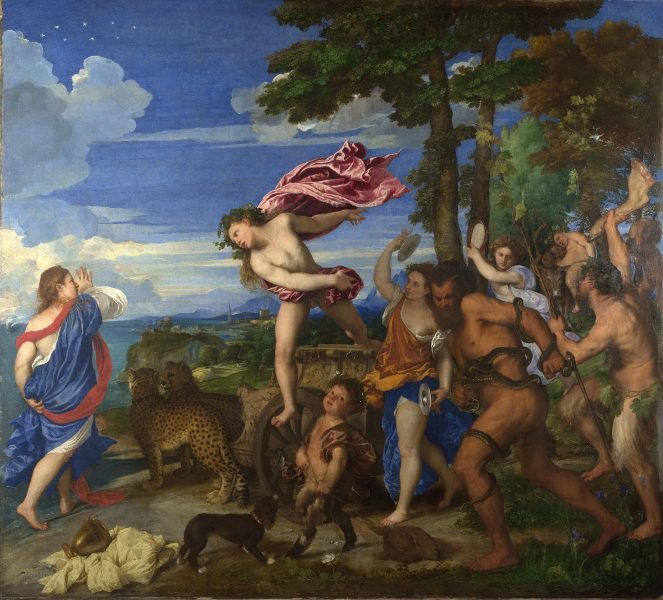
Ballet anacréontique in one act premiered on 4th July 1893 at the Royal Opera House, London
Choreography: William Thompson
Music: Auguste Péchard
Premiers Rôles
Ariane: Marta Draeger
Bacchus: Frederick Hale
Vénus: Sarah Nicholson
Cupidon: Antoine Férat
Thésée: Jean Rousset
Plot
Summary
Thésée enters, followed by Ariane. He means to abandon her on Naxos, but she does not wish him to go. He will heed none of her pleas and so departs, leaving Ariane dejected and alone.
Bacchus, guided by Vénus, espies the grieving Ariane. Struck by her beauty, he goes to her and asks why she is crying. She tells of her abandonment at the hands of Thésée and Bacchus is moved. Vénus guides her son, Cupidon, to pierce both Bacchus and Ariane with his arrows, to ensure the two fall into contentment and love with one another.
At the order of Vénus, Ariane is given ambrosia and nectar to grant her immortality. Bacchus calls his Bacchantes and after a frenzied dance they depart with Ariane for Olympus.
History
Original Production
Bacchus and Ariadne began its life not as a ballet anacréontique in one act but as a ballet divertissement. It was choreographed by William Thompson to music by Auguste Péchard and was created to be inserted into the State Performance of Gounod’s Romeo and Juliette given at Covent Garden on 4 July 1893 as part of the celebrations for the Wedding of the Duke of York and Princess Mary of Teck. For this State Performance, a ballet was to be inserted into the second scene of the fourth act, so that the Royal Ballet (renamed as such in 1892) could pay homage alongside the opera company.
Though the original work did not include a ballet, Gounod was obliged to provide ballet music when the work was staged at the Paris Opéra in 1888. However, the ballet was not exported with the rest of the opera and so was unknown in London. Though Thompson may have wished to use Gounod’s ballet music, he was unable to obtain the score from the Paris Opéra. Thus, Thompson was commissioned to arrange a new Divertissement to be inserted into the fourth act celebrations for Juliette’s wedding to Pâris (the same place Gounod’s 1888 ballet had been inserted).
Thompson’s first idea was a plotless Divertissement des Fiancés, set to a pastiche of music arranged from various sources by Péchard. In this initial conception of the pas, Marta Draeger was to take the lead rôle, partnered by Frederick Hale and supported by a corps of twelve ladies. As for the music, Thompson initially investigated pas from previously revived ballets. Among the pas he considered was the Pas de Distraction from the first scene of the third act of The Corsair, the Grand Pas de Séduction from the first scene of the third act of Faust, the Grand Pas des Cartes from Alice’s Adventures in Wonderland. Ever fond of Adolphe Adam (whom Thompson considered the finest ballet composer who had ever lived), Thompson went back to Griseldis and, with Péchard, arranged a Divertissement from the airs of the ballet. This was not the first time Thompson had interpolated music from Griseldis into another ballet, as he had interpolated the Valse à Cinq Temps and a Coda from the ballet into the 1889 revival of Faust.
However, Thompson eventually decided to create a divertissement with a miniature narrative, themed around a pair of lovers from Classical mythology. Cupid and Psyche were initially considered, but as Thompson considered the idea a touch too cliché, the lovers Bacchus and Ariadne were chosen instead. Péchard would now be commissioned to compose new music for the divertissement, now titled Divertissement: Bacchus and Ariadne, with the pastiche score being set aside.
However, Sarah Nicholson, the second première danseuse at the time, was furious at being excluded on such an occasion. She pressed for her inclusion, citing the fact that Covent Garden had not one, but two première danseuses, and the inclusion of one with the exclusion of the other would send the wrong message to the public and the royals present. With this last point, Augustus Harris (the Manager of Covent Garden) was obliged to agree, and so Nicholson was to be added to the divertissement. Thankfully for Thompson, it had not been long since he had begun the choreography and Péchard the music, so Nicholson was able to be worked into the divertissement as Vénus without too much trouble, with Antoine Férat brought on as her cavalier Cupidon.
Résumé des Scènes et Danses
1) Introduction et Entrée de Thésée et Ariane
2) Scène
a) Entrée de Bacchus, Vénus et Cupidon
b) Récit d’Ariane et Bacchus
c) La flèche de Cupidon
3) Pas de Vénus et Cupidon [Miss Nicholson and Mr Férat]
a) Valse
b) Galop
4) Pas d’Action
a) Andante [Miss Draeger and Mr Hale]
b) Allegretto
c) Variation d’Ariane [Miss Draeger]
5) Bacchanale
London Revivals
1895 Revival
By the year of 1894, Richard Hague was Thompson’s de facto second in command. Hague had joined the faculty of the Royal Ballet School from its founding in 1888 and had risen to become one of Thompson’s closest collaborators. Though opinions differ as to the extent of the assistance rendered by Hague to Thompson, it seems plausible that by the 1892 season Hague was contributing to “Thompson’s ballets” in a meaningful way, which then, as now, would have been entirely attributed to Thompson.
In the 1895 season, Thompson was preparing revivals of The Sylph and Coppelia, both for Sarah Nicholson, and a revival of The Harvest Festival for the guest danseuse Anita Ramos. There would be a fourth ballet that would première that season: Bacchus and Ariadne, choreographed by Hague for the graduating students of the Royal Ballet school. It was to be based on the divertissement that had been created two years prior, and Péchard would expand his score into a one-act ballet anacréontique with Hague providing new choreography for the students.
It would be reasonable to assume that Thompson meant this as an opportunity for Hague to display his choreography on the Covent Garden stage. By asking Hague to choreograph for the Royal Ballet School, Thompson could avoid many of the worries that management would raise over an unknown balletmaster choreographing a full work, even if it was one act. As the Royal Ballet School graduation performances were attended by the critics (though less so by members of Society), Hague would still have his work seen by those penning the reviews without the worry of disappointing the members of Society who had come during the London Season to see Thompson’s grand narrative ballets. Additionally, as Thompson publicly announced his retirement that he wished to retire at the end of the 1896 season during the 1895 season (having privately informed Hague before the announcement), the ballet could be seen as Thompson’s effort to legitimise his successor. Nevertheless, there were those who opposed both Hague creating Bacchus and Ariadne and Hague’s appointment as balletmaster following Thompson’s 1896 retirement, but as the ballet was eventually premièred and Hague’s promotion eventually confirmed, it would seem that Thompson succeeded in his goal of establishing Hague.
Bacchus and Ariadne would première with students in the titular rôles. It can be assumed that Hague altered Thompson’s choreography for the students, but as there were parts of the ballet that were newly composed, the new choreography could safely be attributed to Hague. Nevertheless, the creation was billed as being co-created by Thompson and Hague (a concession Thompson had to make), but it was made known to the critics that Thompson had little hand in the creation of 1895.
The work was retained as one of the main showcases of the Royal Ballet School for their graduation performances. Oddly, there seems to have been no attempt to have the work performed by the main Royal Ballet troupe. This could have been due to Hague focusing on the troupe’s existing repertory and expanding his own creational footprint rather than revisiting past works. Additionally, there may have been a certain stigma and the work may have been labelled “juvenile,” discouraging the members of the troupe from being receptive to dancing it.
Revised Plot Summary
TBC
Résumé des Scènes et Danses
TBC