Griseldis
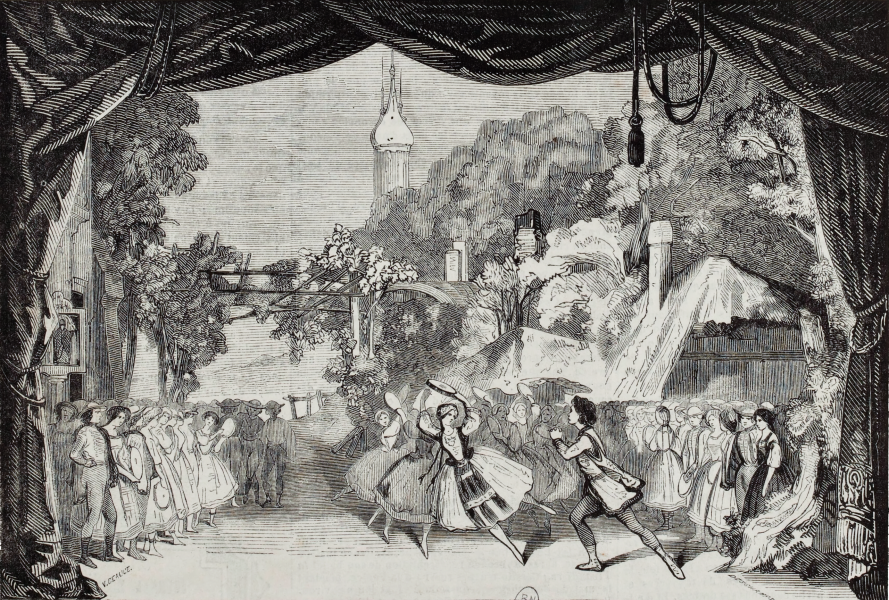
Ballet pantomime in three acts and five scenes premiered on 16th February 1848 at the Théâtre de l’Académie Royale de Musique, Paris
Choreography: Joseph Mazilier
Music: Adolphe Adam
Premiers Rôles
Griseldis: Carlotta Grisi
Prince Elfrid of Bohemia: Lucien Petipa
King Wladislas of Bohemia: Joseph Mazilier
Jacobus: M Berthier
An Ambassador: M Lenfant
The Governor of Belgrade: M Monnet
Plot
Summary
Acte 1
Scène 1
Prague – A gallery in the royal residence, from which the view extends over a park.
Prince Elfrid of Bohemia is lounging carefree, half asleep, while young girls dance around him and play various instruments, but he is indifferent to everything because he dreams of the mysterious maiden he saw in his dream. The King, his father, relays his plan to Jacobus, squire of Elfrid, that he plans to break his son’s “cold heart” by betrothing him to Griseldis, the Princess of Moldova. Upon the entry of the Moldovan ambassador and the formal request, Elfrid eventually agrees to the marriage.
After the company has left the stage, Griseldis appears, disguised as a shepherdess. She recognises the young prince’s hunting weapons, but seeing the golden crown, is disappointed because she wants to be loved not for her origins, but for her real self. After making sure no one can see her, she hides the prince’s golden crown and puts her own crown of flowers in its place.
Elfrid returns, pensive and sad, wondering what kind of princess this is that he should marry. He looks at the crown of flowers in surprise. Griseldis passes quietly behind him, but slips and drops his locket with her portrait before disappearing.
The prince finds the locket, sees the portrait, and recognises the girl from his dream. He presses the locket to his chest and covers it with kisses. Upon the re-entry of the Bohemian king, the Moldovan ambassador and the remainder of the court, Elfrid now rejects the engagement and tells his father that this is the woman he loves, showing him her portrait. The king is enraged. However, Elfrid is forced to obey and leaves the kingdom, accompanied by Jacobus, to travel to Moldova.
Scène 2 – Hearing
A village square. On the right, in the foreground, an inn with a sign: TO THE KING OF BOHEMIA. In the middle ground, a grove of trees. In the foreground, on the left, the ruins of an old Gothic chapel. In the background, a blacksmith’s house, a wheelwright’s house, and a clog maker’s hut. When the curtain rises, it is barely light, and all these houses are still closed.
Farmers and shepherds prepare for work in the fields. Elfrid is staying at the royal inn. Griseldis passes by and leads some goats. Everyone wonders who this unknown maiden is. She shows a small mandolin she carries on her back and, accompanying herself, begins to dance. When she sees Elfrid, she hides in the ruins of a chapel. The Prince examines the medallion, thinking of this mysterious angel. Suddenly, music and a singing voice is heard from the ruins.
THE VOICE:
Stop, child, stop!
Do not leave these places!
I am the mysterious voice,
The voice that comes from heaven.
Elfrid listens in rapt attention.
THE VOICE:
A great voice of storms,
The whisper of streams,
From the forests wild cries,
Songs of little birds,
Terrible or touching music,
Funeral or soft sounds,
The sounds of the earth when I sing,
Shut up! Silence!…
The prince remains dreamy. He rushes to the chapel, but no one is there. Jacobus tries to compel him to leave but to no avail. As the voice is heard several times from different directions, Jacobus concocts a plan. He gathers the villagers and instructs them to make a great tumult to drown out the voice. Upon the return of the voice, Jacobus gives a signal and the villagers begin with different noises: village bells, hammer blows, drums, hunting horns and the like. In this Jacobus is successful, and is able to drag the young prince away with him.
Acte 2 – Touch
In Belgrade. The gardens of the palace of Hassan, governor of Belgrade. Groves illuminated by lanterns, pools from which water springs. To the left, an exterior gallery of the palace, a kind of terrace, which one ascends by a wide staircase. To the right, a hammock tied between two trees, which form a green canopy around it. In the background, a kiosk, surrounded by a spiral staircase.
Hassan, the governor of Belgrade, sits in the gardens of his palace, surrounded by women who form his harem. While coffee and sorbet are being served to Hassan, the women engage in various games. An officer announces the arrival of visitors and the women are instructed to lower their veils. Elfrid and Jacobus are solemnly welcomed. Hassan orders the best rooms to be prepared, but Elfrid indicates that he would prefer to sleep outside in a hammock. Hassan shows Elfrid a ring he may pull to darken the gallery when it suits him.
Left alone, he examines the medallion and falls asleep. He is approached by Griseldis in white. She is in love with him, and upon seeing the locket, her doubts disappear and she kisses Elfrid on the forehead. The prince wakes up and, with her gone, rushes to find her. Griseldis pulls the ring, and in the darkness the two collide, embrace passionately, but when the light Griseldis has disappeared.
Elfrid vows that he will find her and searches everywhere. Every woman he sees is not her, he searches in vain among the women of the harem. He catches sight of her among the women but by the time he has embraced the woman and lifted her veil, it is Griseldis no more. Griseldis laughs from her hiding place as the women of the harem surround Elfrid.
Acte 3
Scène 1 – Smell and Taste
A forest.
A hunting meet. The hunting party await the arrival of the remainder of their party. Griseldis is the last to appear, mounted on horseback. She dismounts, picks a bouquet of flowers, pins it to her breast, and rejoins the others.
Gardeners enter, celebrating the bountiful harvest. Following the dance, they perceive Elfid, sat apart and invite him to take part. However, he is indifferent to their invitations, despite the several quantities of flowers they offer him. Suddenly Griseldis appears, throws the bouquet at his feet, and quickly walks away. The prince takes it up and lifts it to his nose, his sense renewed. The gardeners mock him, that he prefers a small bouquet to their large baskets of the choicest flowers.
Jacobus, however, is more interested by the repast that is being given. Elfrid instructs him to partake if he wishes and Jacobus does so, becoming drunk and falling asleep. For Elfrid, however, neither food nor drink presents him with any pleasure.
Griseldis appears, and unperceived by Elfrid magnetises him to fall asleep and perceive celestial visions. Upon his awakening, the taste of the wine is now available to him, and he drinks with pleasure as the hunters reappear.
Scène 2 – Sight
The Palace of the Hospodar at Iasi.
The Prince is at the palace in Moldova. The ambassador requests the engagement ring that Elfrid is to return to the princess.
Left alone, Elfrid is in agony, he must marry this unknown princess and abandon the woman of his dreams. He covers the locket and the bouquet with kisses, and is about to break them, averting his eyes…
THE VOICE:
Stop, child, stop!
Guard the prized possession.
I am the secret way,
The voice that comes from heaven!
Elfrid rushes towards the direction from where he hears the voice. Griseldis appears, dressed as a goatherd. The prince recognises her, he kneels and places the ring on her hand. She explains that each woman was her, the voice in the chapel ruins, the woman of the harem, the huntress. Elfrid declares himself completely to her, rejecting the marriage to the princess. However, a fanfare is heard and Griselis flees.
Jacobus enters. The prince wishes to flee to find his beloved Griseldis but Jacobus does not permit this. The court appears with the princess, covered by a long veil. She begins to sing and her veil falls.
THE VOICE:
Do not leave these parts.
I am the mysterious voice.
The voice that comes from heaven!
Elfrid is astonished, Princess Griseldis is the mysterious maiden with whom he is in love! She reaches out to him and shows him her engagement ring. The two lovers are happily united.
History
Original Production
Griseldis ou Les Cinq Sens (Griseldis or The Five Senses) is a ballet pantomime in three acts and five tableaux. It was choreographed by Joseph Mazilier to a libretto by Philippe François Pinel Dumanoir and music by Adolphe Adam. The ballet premièred on 16 February 1848 at the Théâtre de l’Académie Royale de Musique, Paris.
The title of the ballet was originally to be simply Les Cinq Sens (The Five Senses) as the ballet had no connection to the legend of Griseldis. However, the Opéra advertised and billed the ballet after its heroine as Griseldis, leading to Les Cinq Sens being amended as a subtitle to distinguish it from the aforementioned legend.
The ballet contained several novelties, the most notable of which was perhaps that Grisi not only danced, but sang. The song first heard in the second scene of the first act (that would become the idée fixe representing Griseldis throughout the ballet) was first sung offstage by Cécile d’Halbert and then was sung by Grisi onstage in the final scene, the second scene of the third act. By all accounts, Grisi herself was an accomplished singer, and acquitted herself in the vocal sections.
The ballet’s most spectacular scene was the first scene of the third act, which began with Grisi appearing on horseback, prompting one critic to note:
“A première danseuse on horseback! What temerity! What impudent daring!… Suppose that the noble animal that then carried the Opéra and its fortune had fallen or stumbled! God protect France!”
Also included in the first scene of the third act were actual equestriennes from the Hippodrome in the hunting party and a mobile parterre, improvised by the gardeners, whose design was changed two or three times. The Valse des Jardinières was led by Adèle Dumilâtre, who perhaps is more well known for creating the rôle of Myrtha in Giselle (1841), in which Grisi portrayed the titular rôle. Grisi’s performance of the magnetism scene was praised, with the critic of Le Ménestrel noting of this scene that:
“[Grisi’s performance was] admirable in its grace and mimetic power, while conforming her gestures to the most correct prescriptions of [Franz Anton] Mesmer‘s followers.”
The magnetism scene also included flying visions, with danseuses hoisted on wires and arranged in “picturesque groups.”
Despite the initial success and the praise accorded to both Grisi’s performance and Adam’s score, several factors collided with the result that the ballet did not stay very long in the repertory.
Firstly, the concentration of the various spectacles in the first scene of the third act caused the remainder of the production to look comparatively plain, and moreover they were recorded as being somewhat poorly executed.
Secondly, though Elfrid is central to the story and is onstage for almost the entire ballet, he is given very little to do in the way of dancing, a fact for which Mazilier was criticised. In fact, Elfrid only danced in the Pas Final of the final scene, where Petipa’s Elfrid partnered Grisi’s Griseldis. Additionally, Petipa was criticised for appearing bored throughout the entire evening, which, though true to the character, had the misfortune of causing the audience to become bored with him as well.
Thirdly, Adam himself was going through a financial crisis. In early 1847, Adam had taken over the management of the Opéra-Comique jointly with Achille Mirecour, rechristening it the Opéra-National. Adam had invested much of his own money into the refurbishment of the theatre, going into debt to do so. Unfortunately, the revolution of February 1848 closed the theatres, and when the theatres were permitted to re-open, there was little demand for tickets at Adam’s opera house. The Opéra-National closed on 28 March 1848, after the production of nine operas during its four months of existence, leaving Adam financially ruined. The revolution also spelled an early death for Griseldis, as theatres were shut before the ballet could establish itself. It would receive a total of 14 performances at the Opéra.
Selected Revivals
12 November 1850
Location: Théâtre Royal de la Monnaie, Brussels
Staged by Henri Desplaces.
London Revivals
1880 Revival
In 1880 the ballet was revived by William Thompson for Marguerite Lemoine as Griseldis with Johann Faber as Prince Elfrid. Musical revisions were undertaken by François Bardet.
Since William Thompson’s troupe became resident at Her Majesty’s in 1877, Isabella Velluti had been the leading danseuse of the troupe. Thompson had given Velluti the leading rôles in the two full-length revivals that he had created so far beginning with Ondine in 1877 and most recently Esmeralda in 1878.
What this resulted in, was the sidelining of Marguerite Lemoine. Lemoine, who had been the leading danseuse with Thompson’s troupe at the Linden Theatre, i.e. before he had become resident at Her Majesty’s, quickly found herself relegated to second place behind the newly engaged Velluti. Though Thompson revived Diavolina for Lemoine, it was only a one-act work, and in the full-length works Lemoine had been relegated to Velluti’s second, being cast in the rôles of Giannina in Ondine and Fleur de Lys in Esmeralda.
Thus, when it was announced that Giselle would be revived in 1879 for Velluti, Lemoine’s dissatisfaction spilled over into outright resentment. Velluti was to receive a third full-length revival while she was still to be confined to her one-act diversion. Lemoine promptly requested a leave of absence, not even waiting until her request was officially granted before departing for France. Lemoine elected to not dance in 1879, and in her absence, Diavolina went to Adèle Vernay (a friend of Lemoine’s) while Thompson proceeded with the revival of Giselle for Velluti.
To entreat her to return for the 1880 summer season, Thompson promised to revive Griseldis for Lemoine. Upon much convincing, she agreed to return from France where she had been dancing at the Théâtre Graslin in her native Nantes, appearing as a substitute for the local première danseuse who had fallen seriously ill.
The revival of Griseldis premièred in the summer of 1880, with Lemoine as the titular heroine. Griseldis was received rather lukewarmly, not reaching the praises of a success but not being criticised heavily enough to consider it a failure.
With his revival, Thompson aimed to take heed of some of the criticisms of 1848, namely the amount of dancing included in Elfrid’s rôle and the concentration of the spectacle in the first scene of the third act.
The former proved the easier issue to address. Instead of Elfrid remaining bored throughout the ballet, he would gradually become more and more animated as his senses were reawakened. For the first act, as before, Elfrid would not dance. For the second, Elfrid would begin to dance, first in a subdued way, taking part in the dances of the harem scene. He would now take part in the Valse des Jardinières, at first refusing to take part but being pulled into the dance by the lead danseuse, who he would partner. The second scene of the third act would include the grand pas, in which his dancing would reach its highest level of animation upon being united with his beloved Griseldis.
As for the latter issue, the spectacle of the first scene of the second act was already to be decreased as a result of financial constraints. Though the flying visions were retained, the number of horses were decreased and the mobile parterre was dispensed with in favour of baskets of flowers borne by the dancers. Additionally, due to the second act being comparatively much shorter than the first and third acts, Thompson had planned to add three new pas to the second act: the Pas de Quatre which takes place at the beginning of the act to amuse Hassan, the Valse du Harem which Hassan orders to be performed for Elfrid and Jacobus as his guests and the Pas d’Évasion in which the Elfrid searches for Griseldis amongst the women of the harem and she continuously evades him.
Additionally, there was the case of the singing required from the titular rôle in the second scene of the third act. As it was central to the narrative the singing could not be cut, but since Lemoine had neither the skill nor the inclination to sing onstage it was instead decided that she should mouth the words while a concealed singer would vocalise the notes and melody for her. Critics were divided as to the effectiveness of this strategy, some noted it worked rather well and did not spoil the immersion (with one even going so far as to insist that Lemoine must have sung herself), while others noted that there were at times slight discrepancies between the concealed voice and Lemoine’s mime. Additionally, James Henry Mapleson, the manager of the theatre, insisted that the verses be rewritten in English, much to Thompson’s dismay.
Rôles
Griseldis: Marguerite Lemoine
Prince Elfrid: Johann Faber
Musical Revisions
A new Variation was composed for Lemoine in the Pas de Griseldis of the second scene of the first act.
Three new dances were composed for the second act: the Pas de Quatre, the Valse du Harem and the Pas d’Évasion, the third featuring a variation for Griseldis.
A new Pas de Deux was composed to replace Adam’s original Pas Final.
The Coda of Adam’s original Pas Final was fashioned into a general dance, somewhat confusingly called the Danse Finale.
Résumé des Scènes et Danses
Acte 1
Scène 1
1) Introduction
2) Scène 1re – Scène du Palais
3) Scène 2e – Récit de Jacobus
4) Scène 3e – Elfrid prend ses armes
5) Scène 4e – Entrée du Roi
6) Scène 5e – Entrée de l’Ambassadeur
7) Scène 6e – Entrée de Griseldis
8) Scène 7e – Rentrée d’Elfrid
9) Scène 8e – Rentrée du Roi
10) Scène 9e – Départ d’Elfrid
Scène 2 – l’Ouïe
11) Entr’acte et Scène 10e
12) Pas de Trois
a) Entrée – Valse à Cinq Temps
b) Variation I [homme]
c) Variation II [femme]
d) Variation III [femme]
e) Coda
13) Polka [deux femmes]
14) Scène 11e – Entrée de Griseldis
15) Pas de Griseldis
a) Entrée
b) Allegretto
c) Variation de Mlle Lemoine
e) Coda
16) Scène 12e – Après le Pas
17) Scène 13e – Entrée de Jacobus
18) Scène 14e – La voix mystérieuse
19) Scène Finale – Le bruit des villageoises
Acte 2 – Le Toucher
20) Entr’acte et Scène 1re – Scène du Jardin de Belgrade
21) Pas de Quatre
a) Andante
b) Valse
c) Coda
22) Scène 2e – Entrée d’Elfrid et Jacobus
23) Valse du Harem
24) Scène 3e – Elfrid reste seul
25) Scène Dansante d’Elfrid et Griseldis
26) Pas d’Evasion
a) Andante
b) Allegretto
c) Variation à trois
d) Variation de Griseldis
e) Coda
27) Scène 5e – Elfrid et les dames du harem
28) Scène Finale
Acte 3
Scène 1 – l’Odorat et le Goût
29) Entr’acte et Scène 1re – Scène de la chasse
30) Marche des Jardiniers
31) Valse des Jardinières
32) Scène 3e – Après la Valse
33) Scène 4e – Le repas
34) Scène 5e – Scène de magnétisme
35) Scène 6e – Rentrée de la chasse
Scène 2 – La Vue
36) Entr’acte et Scène 7e
37) Scène 8e – Elfrid seul
38) Scène 9e – Rentrée de Jacobus
39) Scène 10e – Rentrée de la cour
40) Pas de Deux
a) Adage
b) Variation d’Elfrid
c) Variation de Griseldis
d) Coda
41) Danse Finale (fashioned from the Coda of Adam’s original Pas Final)