Giselle
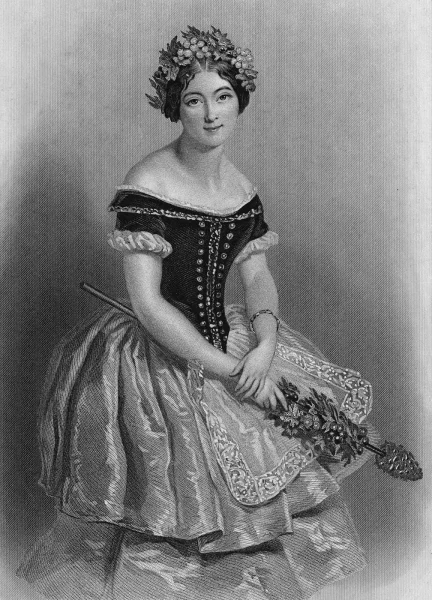
Ballet pantomime in two acts premiered on 28th June 1841 at the Théâtre de l’Académie Royale de Musique, Paris
Choreography: Jules Perrot and Jean Coralli
Music: Adolphe Adam
Premiers Rôles
Giselle: Carlotta Grisi
Albrecht: Lucien Petipa
Hilarion: Jean Coralli
Myrtha: Adèle Dumilâtre
Plot
Summary
Acte 1
In a medieval Rhineland village during the grape harvest, Duke Albrecht, disguised as the villager Loys, courts Giselle, a beautiful peasant girl. Unbeknownst to her he is secretly engaged to a noblewoman, Bathilde. Hilarion, a jealous gamekeeper who is also in love with Giselle, uncovers Albrecht’s true identity and exposes him during the harvest festivities. Heartbroken by Albrecht’s betrayal, Giselle succumbs to madness and dances until her weak heart gives out, dying in Albrecht’s arms.
Acte 2
At night Hilarion comes to mourn at Giselle’s grave but flees as the vengeful Willis, ghostly spirits of betrayed maidens, appear. Led by their Queen, Myrtha, the Willis compel any man whom they happen upon to dance to their deaths. Myrtha rouses Giselle’s spirit as a Willi, who is now under Myrtha’s rule. Albrecht also comes to her grave to mourn, but Giselle forgives him. The Willis happen upon Hilarion and dance him to exhaustion before throwing him into a lake. They then begin to do the same to Albrecht, but Giselle’s love protects him until sunrise. As day breaks, the Willis are forced to retreat, and Giselle bids Albrecht a tender farewell before returning to her grave to rest in peace.
History
Original Production
It would not be a understatement to state that Giselle ou Les Willis is one of the most, if not the most popular and enduring works from the era of Romantic Ballet. It was the rôle that launched Grisi to stardom, bringing favourable comparisons to Marie Taglioni (for whom the ballet La Sylphide was created and whom many believed to be the greatest ballerina of her period). It was in many ways a successor to Taglioni’s La Sylphide, as both included hallmarks of the Romantic Ballet era such as a human man in love with a supernatural woman and a “white act” populated by otherworldly maidens dressed in white.
In 1879 Thompson revived the ballet for Isabella Velluti. This was the third full length ballet he revived, and Velluti herself had a hand in the choice of ballet. The ballet proved to be quite popular with the London audiences, who were charmed with Adam’s music and the story as Parisian audiences had been decades prior.
Selected Revivals
12 March 1842
Location: Her Majesty’s Theatre, London
Staged by Deshayes and Perrot for Carlotta Grisi.
30 December [O.S. 18 December] 1842
Location: Imperial Bolshoi Kamenny Theatre, St Petersburg
Staged by Antoine Titus for Elena Andreyanova
30 March 1843
Location: Her Majesty’s Theatre, London
Staged by Benjamin Lumley for Fanny Elssler.
20 October [O.S. 8 October] 1850
Location: Imperial Bolshoi Kamenny Theatre, St Petersburg
Staged by Jules Perrot for Carlotta Grisi with Christian Johansson as her Albrecht. Perrot arranged a Pas de Cinq for Grisi to the music of Pugni to be inserted into the first act, presumably to replace the Pas des Vendanges.
17 February [O.S. 5 February] 1884
Location: Imperial Mariinsky Theatre, St Petersburg
Staged by Marius Petipa for Maria Gorshenkova with Pavel Gerdt as her Albrecht.
Ludwig Minkus revised the score, and Petipa added a Pas de Deux to Minkus’ music to the first act, again presumably to replace the Pas des Vendanges. While this music is usually attributed to Minkus, the pas is in fact not original music by him, but consists of re-orchestrated and rearranged numbers from Adam’s 1852 ballet Orfa.
1852
Location: Théâtre de l’Académie Nationale de Musique, Paris
Staged for Regina Forli.
8 May 1863
Location: Théâtre Impérial de l’Opéra, Paris
Staged for Marfa Muravieva with Louis Mérante as her Albrecht. They were joined by Eugène Coralli as Hilarion, Laure Fonta as Myrtha and Zina Mérante and M Chaupy in the Pas des Paysans.
11 May 1866
Location: Théâtre Impérial de l’Opéra, Paris
Staged for Adèle Grantzow.
1887
Location: Imperial Mariinsky Theatre, St Petersburg
Staged by Petipa for Emma Bessone with Enrico Cecchetti as her Albrecht.
1889
Location: Imperial Mariinsky Theatre, St Petersburg
Staged by Petipa for Elena Cornalba. It was Cornalba that interpolated the now famous Pas Seul into the first act. It was composed by Riccardo Drigo for Cornalba’s performances in Fiametta in 1887 and she likely transferred it into the first act of Giselle when Petipa revived the ballet for her.
17 September [O.S. 5 September] 1899
Location: Imperial Mariinsky Theatre, St Petersburg
Staged by Petipa for Henrietta Grimaldi. Olga Preobrazhenskaya danced the rôle of Myrtha in this production.
13 May [O.S. 30 April] 1903
Location: Imperial Mariinsky Theatre, St Petersburg
Staged by Petipa for Anna Pavlova with Nikolai Legat as her Albrecht.
London Revivals
1879 Revival
In 1879 William Thompson revived the ballet in two acts for Velluti as the heroine Giselle. The score received relatively minor revisions by François Bardet and he also composed some new music as per Thompson’s request.
Thompson had actually wished to revive Adam’s The Five Senses for Marguerite Lemoine for the 1879 season. Lemoine was his Première Danseuse before he had engaged Velluti and for the past two years Velluti had been given the titular rôles (in the revivals of Ondine in 1877 and Esmeralda in 1878) while Lemoine was relegated to the secondary rôles (Giannina in Ondine and Fleur de Lys in Esmeralda). Thus, Lemoine decided she was not going to dance in the 1879 season and requested to take a leave of absence, ostensibly to visit her family back in France. Lemoine’s displeasure at being sidelined in favour of Velluti was well known, and Thompson had planned to soothe this by reviving The Five Senses with Lemoine as the heroine and Velluti as her second. However, this plan was thwarted by Lemoine’s leave of absence, the permission of which the theatre management granted without discussing the matter with Thompson.
As a result, Thompson would have to revive The Five Senses without her. However, Velluti did not much care for the ballet and instead requested if Giselle could be revived for her instead. Thompson was hesitant at first but eventually relented, leading to the 1879 revival of Giselle with Velluti in the titular rôle. Thompson did revive The Five Senses the following year with Lemoine as Griseldis, a move which only temporarily soothed her annoyance.
A point of note is the positioning of the Pas des Paysans (a.k.a the Peasant Pas de Deux). Modern productions differ on whether the pas is danced to entertain the nobles as they rest from their hunt or whether the pas is danced as part of the harvest celebrations. In the original production the pas occurred during the harvest celebrations (before the Pas des Vendanges) and when Petipa staged the ballet the pas also occurred during the harvest celebrations (after the Pas Seul and before the Galop Général).
When Thompson staged the ballet in 1879 he followed the Parisian convention. Subsequent London revivals followed the traditional positioning of the pas.
Rôles
Giselle: Isabella Velluti
Albrecht: Samuel Penrose
Musical Revisions
A variation was composed for Giselle in the Pas des Vendanges of the first act. This pas (which does not appear in the vast majority of revivals today) was originally placed before the Galop Général of the first act and after Giselle is crowned Queen of the Vintage. A classically structured four-part Pas de Deux, the pas was danced by Albrecht (under the disguise of Loys) and Giselle.
The only part of this pas that is included in productions today is the Coda, which is the music that occurs after the Valse of the first act where Giselle and Albrecht dance together. The complete pas was retained by Thompson and continued to be part of the London performance tradition of the ballet for many years.
A variation was composed for Giselle in the Grand Pas de Deux of the second act and was danced between Albrecht’s variation and the Coda.
Résumé des Scènes et Danses
Acte 1
1) Introduction
2) Scène Première – Les Vendangeurs
3) Scène – Entrée du Prince
4) Scène – Entrée de Giselle
5) Scène – Entrée d’Hilarion
6) Scène – Le Retour de la Vendange
7) Valse
8) Scène – Récit de Berthe
9) Scène – Entrée des Chasseurs
10) Scène d’Hilarion
11) Marche des Vignerons
Divertissement
12) Pas des Paysans
a) Entrée
b) Adage
c) Variation du danseur
d) Variation de la danseuse
e) Deuxième variation du danseur
f) Deuxième variation de la danseuse et Coda
13) Pas des Vendanges
a) Andante
b) Variation de Loys
c) Variation de Giselle
d) Coda
14) Galop Général
15) Scène Finale
Acte 2
16) Entracte et la Halte des Chasseurs
17) Scène – Apparition de Myrtha
18) Scène – Apparition des Willis
a) l’Evocation Magique
b) Andante
c) Valse des Willis
d) Variation de Myrtha
e) Coda
19) Scène – l’Apparition de Giselle
20) Scène – Entrée des Paysans
21) Scène – Entrée d’Albrecht
22) Scène – La Réconciliation
23) Bacchanale des Willis
24) Scène – La Sortie des Willis
a) Entrée d’Albrecht
b) Fugue des Willis
25) Grand Pas de Deux
a) Andante
b) Allegretto
c) Variation d’Albrecht
d) Variation de Giselle
e) Coda
26) Scène Finale
1885 Revival
In 1885 Thompson revived the ballet for Emma Ashfield who had that year been promoted to the rank of première danseuse. It was to be her first leading rôle, as prior to then (due to her rank) she was confined to supporting rôles (though she notably danced the Marchesa opposite Lemoine’s Angela in the 1882 revival of Marco Spada). Few changes were made to the score for Ashfield and she danced both of Velluti’s additional variations.
Sarah Nicholson (who would later rise to the rank of première danseuse and would be remembered as the rival of the celebrated Marta Draeger) was selected to dance the Pas des Paysans following her successful performances as Dawn in the third act of Coppelia a few weeks before Giselle‘s run was scheduled to begin. Thompson recognised her talent and so cast her in this rôle in Giselle, which she alternated with another female sujet. Nicholson was partnered by Rafael Caravetti and her success in the rôle led to her promotion to coryphée later that year.
Rôles
Giselle: Emma Ashfield
Myrtha: Mary Butler
Pas des Paysans: Sarah Nicholson and Rafael Caravetti
1888 Revival
In 1888 Thompson revived the ballet for Marta Draeger with Bardet again composing additions to the score. This was to be the last ballet that Bardet would edit for London as he retired from London and moved back to France. Butler (rumoured to be dissatisfied with not having yet received a promotion to première danseuse and being eclipsed by Nicholson) would also retire from the London stage that year, joining the troupe of the Théâtre Royal de la Monnaie in Brussels.
Rôles
Giselle: Marta Draeger
Myrtha: Sarah Nicholson
Pas des Paysans: Mary Butler
Musical Revisions
A new Pas de Deux was composed for Draeger to replace the Pas des Vendanges of the first act. This relatively simple charming pas unexpectedly became one of Draeger’s favourite creations, to the surprise of Thompson and several others. She interpolated the pas into other works, and she notably performed the pas near the end of the fifth act of the 1890 revival of Shakespeare’s As You Like It at the Lyceum Theatre. She also interpolated the pas into the third act of the 1894 revival of The Devil to Pay to replace the Grand Pas de Deux Noble, resulting in the male variation from the Giselle pas becoming the new standard variation for the Grand Pas de Deux Noble of The Devil to Pay.
Résumé des Scènes et Danses
Acte 1
1) Introduction
2) Scène Première – Les Vendangeurs
3) Scène – Entrée du Prince
4) Scène – Entrée de Giselle
5) Scène – Entrée d’Hilarion
6) Scène – Le Retour de la Vendange
7) Valse
8) Scène – Récit de Berthe
9) Scène – Entrée des Chasseurs
10) Scène d’Hilarion
11) Marche des Vignerons
Divertissement
12) Pas des Paysans
a) Entrée
b) Adage
c) Variation du danseur
d) Variation de la danseuse
e) Deuxième variation du danseur
f) Deuxième variation de la danseuse et Coda
13) Pas de Deux
a) Adage
b) Variation I
c) Variation II
d) Coda
14) Galop Général
15) Scène Finale
Acte 2
16) Entracte et la Halte des Chasseurs
17) Scène – Apparition de Myrtha
18) Scène – Apparition des Willis
a) l’Evocation Magique
b) Andante
c) Valse des Willis
d) Variation de Myrtha
e) Coda
19) Scène – l’Apparition de Giselle
20) Scène – Entrée des Paysans
21) Scène – Entrée d’Albrecht
22) Scène – La Réconciliation
23) Bacchanale des Willis
24) Scène – La Sortie des Willis
a) Entrée d’Albrecht
b) Fugue des Willis
25) Grand Pas de Deux
a) Andante
b) Allegretto
c) Variation d’Albrecht
d) Variation de Giselle (1879)
e) Coda
26) Scène Finale
1898 Revival
In 1898 the ballet was revived for Sarah Nicholson. She requested to dance the Pas de Deux that had been added for Draeger in 1888 but was not allowed to do so, and so instead danced the Pas des Vendanges in its 1885 version with Velluti’s 1879 variation.
Rôles
Giselle: Sarah Nicholson