La Esmeralda
Or Esmeralda
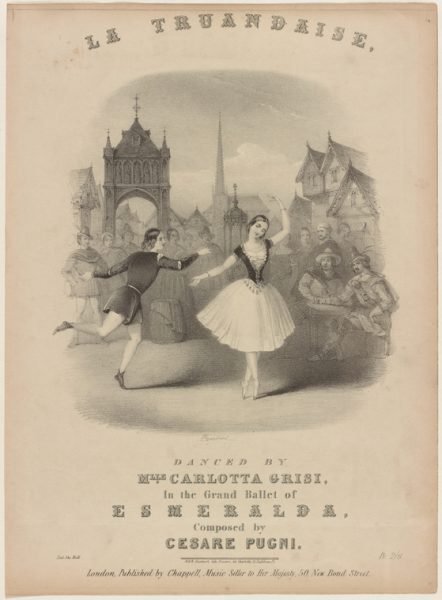
Ballet pantomime in three acts and five scenes premiered on 9th March 1844 at Her Majesty’s Theatre, London
Choreography: Jules Perrot
Music: Cesare Pugni
Premiers Rôles
Esmeralda: Carlotta Grisi
Phoebus: Arthur Saint-Léon
Gringoire: Jules Perrot
Fleur de Lys: Adelaide Frassi
Plot
Summary
Esmeralda marries the poet Pierre Gringoire, to save him from death in the hands of the Romani king. The groom is smitten with his new bride, but she makes it clear that the marriage is strictly one of convenience. Gringoire is not the only one infatuated with Esmeralda, the archdeacon of Notre Dame cathedral, Claude Frollo, is dangerously obsessed with the girl and orders his deformed henchman, Quasimodo, to abduct her. When Quasimodo attacks Esmeralda in the street, she is rescued by the King’s Archers, led by their handsome captain Phoebus de Chateaupers, who capture Quasimodo. They plan to torture him, but Esmeralda asks for his release. The hunchback is deeply touched by her kindness. Phoebus is enchanted by the girl and gives her a scarf that was given to him by his fiancée, Fleur de Lys.
The next day, Fleur de Lys and her mother hold a grand celebration for her engagement to Phoebus, who is distracted by thoughts of Esmeralda. She arrives to entertain the guests, but is left heartbroken when she sees that Fleur de Lys’ fiancé is none other than her beloved Phoebus. Fleur de Lys notices that Esmeralda is wearing the scarf that she gave to Phoebus and realising that he has fallen in love with another, angrily calls off the engagement. Phoebus leaves with Esmeralda.
Alone in a tavern, the two declare their love for each other, unaware that the archdeacon Frollo is also there, eavesdropping on them. Taking a dagger that he stole from Esmeralda’s room, Frollo sneaks up behind the lovers and stabs Phoebus, who falls unconscious to the ground. Frollo calls for the authorities, shows them the body of Phoebus and the dagger that was used to stab him, which is identified as Esmeralda’s. The poor girl is taken away and sentenced to death.
At dawn the following morning, the Festival of Fools is under way and Esmeralda is due to be hanged for the murder of Phoebus. Her friends and Gringoire are all present and bid her farewell, while Frollo watches in triumph. Just as Esmeralda is led to the gallows, Phoebus arrives alive and well, having survived and recovered from the stabbing. He reveals the true culprit to be Frollo and announces that Esmeralda is innocent of any crime. Frollo takes a dagger and attempts to do away with them, but Quasimodo wrests the dagger from his master and stabs him to death. Esmeralda and Phoebus are happily reunited.
History
Original Production
La Esmeralda was based on the famous novel Notre-Dame de Paris by Victor Hugo, published in 1831. A hugely popular novel, it had already been adapted for the stage by Louise Bertin who wrote an opera titled La Esmeralda in 1836. The libretto was written by Hugo himself and shifted the focus to the love story between Esmeralda and Phoebus, transforming the narrative into a more character driven one. Pugni and Perrot built on this, creating a ballet that premièred in one act and five scenes.
In 1878 Thompson revived the ballet for Isabella Velluti under the title of Esmeralda (the same title would be used for subsequent London revivals of the ballet). This was the second full-length ballet he revived, the first being Ondine the previous year. Though he had high hopes for the ballet, it did not prove to be one of his most successful and did not quite find its feet on the London stage until he revived the ballet for Marta Draeger in 1894.
Selected Revivals
2 January 1849 [O.S. 21 December 1848]
Location: Imperial Bolshoi Kamenny Theatre, St Petersburg
Staged by Perrot for Fanny Elssler with Pugni revising his score.
29 December [O.S. 17 December] 1886
Location: Imperial Mariinsky Theatre, St Petersburg
Staged by Petipa for Virginia Zucchi with musical revisions by Riccardo Drigo. It was for this revival that the famous Pas de Six was added for Zucchi.
3 December [O.S. 21 November] 1899
Location: Imperial Mariinsky Theatre, St Petersburg
Staged by Petipa for Matilda Kschessinskaya. Olga Preobrazhenskaya danced the rôle of Fleur de Lys in this production.
London Revivals
1878 Revival
In 1878 Thompson revived the ballet in three acts and five scenes for Velluti as the titular heroine. The score was revised by François Bardet and he also composed the music for the new pas and variations.
Though Thompson and Velluti both had high hopes for the ballet it was not very popular with the London audiences. The theatre management noted a drop in ticket sales from the previous year’s production of Ondine and the critics were lukewarm in their reviews of the ballet. One critic noted:
“While the first act of Esmeralda is both diverting and lively, the ballet, alas, grows weaker as it progresses through the second and third acts. Much like the heroine herself, it seems to march inexorably toward the scaffold.”
Despite this, Velluti did receive praise for her dancing and dramatic acting, particularly in La Truandaise of the first act. The ballet’s lukewarm reception greatly worried Thompson, who was concerned that Mapleson would revoke the residency of his troupe at Her Majesty’s Theatre if the ballet were deemed no longer a worthwhile investment. However, this fear was averted with the successful revivals of Giselle in 1879 and The Corsair in 1881.
Rôles
Esmeralda: Isabella Velluti
Phoebus: Samuel Penrose
Fleur de Lys: Marguerite Lemoine
Musical Revisions
A Valse was composed for the Grand Pas des Corbeilles of the second act.
Two variations were added for Diane and Beranger (the two female companions of Fleur de Lys) in the Grand Pas des Corbeilles, danced by two female sujets. Neither of these variations were originally by Bardet, as he instead arranged two variations from Pugni’s original score.
A new variation was composed for Fleur de Lys in the Grand Pas des Corbeilles. This variation (with some minor edits) would later be interpolated by Marta Draeger into the Pas de Grisi of the 1894 revival of The Devil to Pay as the variation of Mazourka.
A Pas de Deux was composed for Esmeralda and Gringoire in the second act. This pas replaced Pugni’s original music and followed the Russian tradition of arranging a new pas to display the individual talents of the subsequent danseuses who danced the title rôle. In St Petersburg Petipa had added:
- A Pas de Deux for Claudina Cucchi in 1866 to the music of Cesare Pugni
- A Pas de Dix for Eugenia Sokolova in c. 1871 to the music of Yuli Gerber
- A Pas de Cinq for Adèle Granztow in 1872 to the music of an unknown composer
- A Pas de Six for Virginia Zucchi in 1886 (the famous Esmeralda Pas de Six that we know today) to the music of Riccardo Drigo
A Pas de Deux titled Scène d’Amour was added to the first scene of the third act. This pas was added due to Velluti’s disappointment that Esmeralda did not properly dance with Phoebus for the duration of the ballet. Thompson agreed with Velluti’s observations and so arranged a pas for Esmeralda and Phoebus that was danced shortly after Phoebus came to find Esmeralda in her house. The pas was an Adage (i.e. not a Classical four part Pas de Deux) and even included passages of mime as Esmeralda and Phoebus declared their love for each other.
Résumé des Scènes et Danses
Acte 1
Scène 1 – Le Cour des Miracles
1) Introduction
2) Grand Scène – Le Cour des Miracles
3) Scène
4) Valse de Vieux Paris
5) Scène – Entrée de Gringoire
6) Scène – Entrée d’Esmeralda
7) Scène Mimique
8) Danses des Truands
a) Galop
b) La Truandaise (Danse d’Esmeralda)
c) Bacchanale
9) Scène – Le Couvre-Feu
10) Scène – Entrée de Frollo
11) Scène – Phoebus et Esmeralda
Scène 2 – Le Nuit de Noces
12) Entracte et Scène
13) La Rêverie
14) Scène – Entrée de Gringoire
15) Variation d’Esmeralda
16) Scène – Leçon de Danse
17) Scène – Le Sommeil
18) Finale
Acte 2 – l’Hôtel Gondelaurier
19) Entracte
20) Scène
21) Grand Pas des Corbeilles
a) Valse
b) Adage
c) Ballabile
d) Variation I – Diane (rearranged from Pugni’s score)
e) Variation II – Beranger (rearranged from Pugni’s score)
f) Variation III – Fleur de Lys
g) Coda
22) Marche
23) Scène – Entrée d’Esmeralda
24) Pas de Deux
a) Adage
b) Variation de Gringoire
c) Variation d’Esmeralda
d) Coda
25) Scène Finale
Acte 3
Scène 1 – La Chambre d’Esmeralda
26) Entr’acte et Scène
27) Scène
28) Scène – Entrée de Phoebus
29) Scène d’Amour
30) Scène – Le combat
Scène 2 – La Fête des Fous
31) Entr’acte
32) Scène
33) La Fête des fous – Danse d’Ensemble
34) Cortège Funèbre
35) Scène Dramatique
36) Scène Finale
1894 Revival
In 1894, Marta Draeger was to retire at the end of the season. For her benefit she requested that Esmeralda be revived for her, a request which both the theatre management and Thompson were hesitant to grant due to the lukewarm reception of 1878. Thompson offered to revive Coppelia instead for her (which had not been staged in London since 1885) but Draeger still wished to dance in Esmeralda. Eventually it was tentatively decided to proceed with the revival.
The score was to be revised and supplemented by Auguste Péchard. Thompson, taking into account the criticisms from the 1878 staging of the ballet, completely rechoreographed much of the second and third acts, including the Grand Pas des Corbeilles and the Danse d’Ensemble in the Feast of Fools scene. To Thompson’s great relief, the revival with Draeger as the titular heroine was a great success, with critics praising Draeger’s dancing and dramatic acting and Thompson’s choreography.
Rôles
Esmeralda: Marta Draeger
Fleur de Lys: Sarah Nicholson
Musical Revisions
A Pas de Six for the friends of Esmeralda was added to the first act. The music was not by Péchard but was taken from Pugni’s original music for the Pas de Galop, the original 1844 pas written for Esmeralda to dance in the second act.
Two new variations were added for Diane and Beranger to the Grand Pas des Corbeilles, replacing the variations of 1878.
A new variation was composed for Phoebus in the Grand Pas des Corbeilles.
A new pizzicato variation was composed for Fleur de Lys in the Grand Pas des Corbeilles.
A Grand Pas d’Action was added to the second act for Esmeralda, Gringoire and six female coryphées, replacing the Pas de Deux that was added in 1878. The argument for the pas was Esmeralda’s distress at having to dance before Phoebus (the man she loved) and his fiancée while Gringoire could not quite understand what was causing her such distress. The pas also included mime for Phoebus and Fleur de Lys, with the former trying to conceal his feelings for Esmeralda and the latter trying to understand why her fiancé looked so downcast. This differed from the 1878 scenario, where the Pas de Deux was more an entertainment for the guests of Fleur de Lys than a pas that contributed to the narrative. In fact, Phoebus was not even present for the 1878 Pas de Deux, having departed just before Esmeralda’s arrival and returning after the pas had ended to continue the story. This meant that in the 1878 production Esmeralda’s despair at seeing Phoebus engaged did not occur until near to the end of the second act, whereas in the 1894 staging her despair occurred during and through the Grand Pas d’Action.
A Pas de Deux was added for Esmeralda and Phoebus to the second scene of the third act. The pas served as a tender reconciliation after Esmeralda’s acquittal and served the dual purpose of giving Esmeralda and Phoebus one more chance to dance together. The pas was closer to a Pas d’Action than a Pas Classique, with the focus being on Esmeralda and Phoebus’ joint relief at Esmeralda’s acquittal and them declaring their love for each other.
Résumé des Scènes et Danses
Acte 1
Scène 1 – Le Cour des Miracles
1) Introduction
2) Grand Scène – Le Cour des Miracles
3) Scène
4) Valse de Vieux Paris
5) Scène – Entrée de Gringoire
6) Scène – Entrée d’Esmeralda
7) Scène Mimique
8) Danses des Truands
a) Galop
b) Pas de Six (rearranged from Pugni’s score)
c) La Truandaise (Danse d’Esmeralda)
d) Bacchanale
9) Scène – Le Couvre-Feu
10) Scène – Entrée de Frollo
11) Scène – Phoebus et Esmeralda
Scène 2 – Le Nuit de Noces
12) Entracte et Scène
13) La Rêverie
14) Scène – Entrée de Gringoire
15) Variation d’Esmeralda
16) Scène – Leçon de Danse
17) Scène – Le Sommeil
18) Finale
Acte 2 – l’Hôtel Gondelaurier
19) Entracte
20) Scène
21) Grand Pas des Corbeilles
a) Valse (1878)
b) Adage
c) Ballabile
d) Variation I – Diane
e) Variation II – Beranger
f) Variation III – Phoebus
g) Variation IV – Fleur de Lys
h) Coda
22) Marche
23) Scène – Entrée d’Esmeralda
24) Grand Pas d’Action
a) Adage
b) Danse des Coryphées
c) Variation de Gringoire
d) Variation d’Esmeralda
e) Coda
25) Scène Finale
Acte 3
Scène 1 – La Chambre d’Esmeralda
26) Entr’acte et Scène
27) Scène
28) Scène – Entrée de Phoebus
29) Scène d’Amour (1878)
30) Scène – Le combat
Scène 2 – La Fête des Fous
31) Entr’acte
32) Scène
33) La Fête des fous – Danse d’ensemble
34) Cortège Funèbre
35) Scène Dramatique
36) Pas de Deux – La Réconciliation
37) Scène Finale
1901 Revival
In 1901 the ballet was revived for Sarah Nicholson. No significant revisions were made, save the inclusion of a new variation in the Pas des Corbeilles for Diane.
Rôles
Esmeralda: Sarah Nicholson
Musical Revisions
A new variation was added to the Grand Pas des Corbeilles for Diane, one of the friends of Fleur de Lys. This variation was a supplemental variation by Péchard for the Pas des Quatre in the 1892 revival of The Peri, but the variation was eventually cut before the revival’s première. The interpolation was requested by the danseuse who was cast in the rôle of Diane. She disliked the 1894 with the variation and instead requested to substitute a new variation, a request which was granted.
1907 State Performance
In 1907, the second act of the ballet was given as part of the State Performance for the Visit of the King and Queen of Denmark. Giulia Moretti, at the time the most senior première at Covent Garden, was cast in the rôle of Esmeralda.
Rôles
Esmeralda: Giulia Moretti
Fleur de Lys: Louise Grignon
Diane: Sofia Zacchini
Beranger: Carolina Ferreira
The Rose: Jane Wheaton
Musical Revisions
The Pas de Six de la Rose from the third act of Pygmalion was interpolated into the act, placed between the Marche and the scene where Esmeralda enters with her suite. The interpolation was not retained when the complete ballet was revived in 1911.
Additionally, the variation added to the Pas des Corbeilles for Diane in 1901 was retained.
Résumé des Scènes et Danses
1) Entracte
2) Scène
3) Grand Pas des Corbeilles
a) Valse (1878)
b) Adage
c) Ballabile
d) Variation I – Diane (supplemental variation for the Pas de Quatre in the 1892 revival of The Peri)
e) Variation II – Beranger (1894)
f) Variation III – Phoebus (1894)
g) Variation IV – Fleur de Lys (1894)
h) Coda
4) Marche
5) Pas de la Rose (Pas de Six) (interpolation from Pygmalion)
a) Andante
b) Danse des Boutons de Rose (Pas de Quatre)
c) Pizzicato pour la Rose
d) Coda
6) Scène – Entrée d’Esmeralda
7) Grand Pas d’Action (1894)
a) Adage
b) Danse des Coryphées
c) Variation de Gringoire
d) Variation d’Esmeralda
e) Coda
8) Scène Finale
1908 Revival
In 1908 the ballet was revived at The Alhambra Theatre, another theatre in London. Covent Garden was neither informed nor involved in the staging of the ballet, which was staged by the Alhambra management as an ongoing attempt to try to capitalise on the London audience’s love for narrative ballets (as opposed to the mere diversions that The Alhambra usually presented).
Due to reduced number and technical ability of the dancers at The Alhambra, the ballet was not so nearly as lavish as it had been at the 1894 or 1901 Covent Garden productions. The score was reduced from three acts and five scenes to two acts and four scenes, with the second scene of the first act (the Nuit des Noces scene) cut. Additionally, in an effort to modernise the score the music was edited and parts of Pugni’s score were discarded in place of newly added music.
The reviews of the production were decidedly mixed, though generally unfavourable. Some critics dismissed it as a “woeful production,” drawing unfavourable comparisons to the Covent Garden staging from seven years earlier. Even those who acknowledged the ballet’s potential noted:
“Although the ballet is on the same subject as the one played at Covent Garden, it diverges significantly in interpretation and execution.”
The production’s run was underwhelming, and the ballet was not revived.
Musical Revisions
Various revisions to the music were made, with the result that about two-thirds of the Covent Garden score was retained. The additional music was taken from various places; from supplemental pieces by Bardet and Péchard for other ballets, to popular parlour music of the day, newly written music by the theatre’s resident composer and even arrangements of music of other composers such as Chopin, Strauss and even Saint-Saëns.
A notable feature of this revival was the variation of Fleur de Lys in the Grand Pas des Corbeilles. The variation was neither the 1878 nor the 1894 variations but was instead a variation by Péchard written for Marguerite from the Pas de Fascination in the 1889 revival of Faust.