Ondine
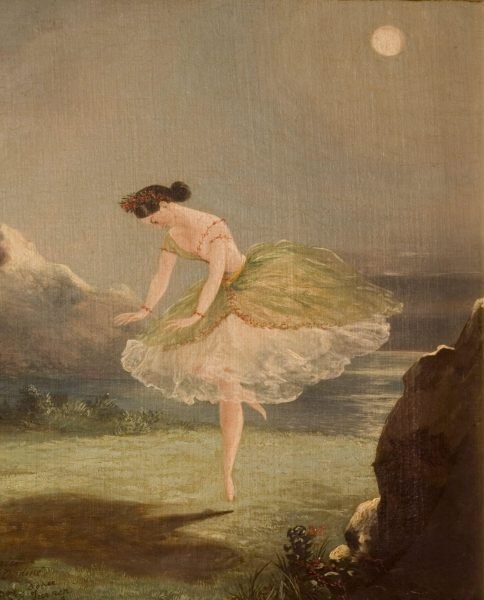
Ballet pantomime in three acts and five scenes premiered on 22nd June 1843 at Her Majesty’s Theatre, London
Choreography: Jules Perrot
Music: Cesare Pugni
Premiers Rôles
Ondine: Fanny Cerrito
Mattéo: Jules Perrot
Giannina: Marie Guy-Stephan
Hydrola: Mme Copère
Theresa, mother of Mattéo: Mme Camille
Plot
Summary
Act 1
Scène 1
A portion of the seashore on the coast of Sicily, with a huge arched rock in the background.
At the rise of the curtain the peasants and fisher-folk are seen making preparations for the Festival of the Madonna. Matteo, a young fisherman, is present with Giannina, his betrothed, and he invites his friends to the wedding, to be held on the morrow. Giannina is overwhelmed with congratulations which end in a general dance. Then all depart, save Matteo, who wishes to catch a fish for his supper.
He casts his net and draws it to the shore. As he does so a shell rises from the water. It contains a lovely being who has often haunted his dreams. The naiad, who is called Ondine, has fallen in love with Matteo, and has chosen this means of making her presence known to him.
Matteo, however, loves Giannina, and resists the tempting naiad. But she fascinates him in a dance so that he follows her along the shore and up the rock until, arriving at the highest point, she drops gently downwards into the waters, her arms outstretched towards him, inviting the infatuated Matteo to follow.
Regardless of danger, he is about to do so, when some peasants enter and save him. Their intervention breaks the spell and he kneels and offers a prayer of thanksgiving for his escape.
Scène 2
Matteo’s hut.
Theresa, Matteo’s mother, and Giannina anxiously await the return of Matteo, who presently enters, musing on his recent adventure. Giannina soothes away his melancholy and both she and his mother try to fathom its cause. He tells them of the naiad, but his mother dismisses the matter as a daydream. Then she sits down to her spinning wheel, and Giannina, taking up a skein of silk, gives it to Matteo to hold, while she winds it.
A sudden gust of wind blows the window open and Ondine bounds into the room. Jealous of Matteo’s attention to his future bride, she snaps the thread which Giannina is winding and strikes the distaff from his mother’s hand. Then the naiad makes herself visible to Matteo. Dazzled by her rare beauty he vainly pursues her. She is next discovered by Giannina, who also tries to secure the naiad, but she darts to the window, and leaps through it into the water beneath, inviting Matteo to follow.
He is withheld by Giannina, who reproaches him for his inconstancy on the eve of their wedding. But his mother restores the situation and retires with Giannina, while Matteo flings himself down on his simple couch.
The naiad, determined to possess Matteo, resolves to reveal to him in a dream something of the lovely world beneath the sea.
Act 2
A submarine cavern peopled with nymphs in pale blue, their hair adorned with branches of coral.
Matteo finds himself in the abode of the naiads. Before his bewildered gaze, the nymphs perform various dances. Ondine rises in their midst and dances with her sister naiads. Matteo pursues her, but she continues to evade and fascinate him.
Ondine, believing that she has secured Matteo’s affection, throws herself at his feet. At this moment Hydrola, Queen of the Waters, appears. She warns her of the danger of losing her immortality should she choose to marry a mortal. But Ondine’s love is too intense for this warning to be heeded, and she replies by plucking a rose and declaring that she would willingly perish with it and as it, if Matteo were hers alone. In vain the Queen chides her daughter, but the wilful naiad is resolute and is most reluctantly led away from the sleeping fisherman.
Act 3
Scène 1
The eve of the Festival of the Madonna, whose statue is in a shrine, and at whose feet the assembled peasants place their gifts and offer their prayers.
After prayers, the company joins in a tarantella in which ‘‘all is wild, animated, and in picturesque disorder, and the colours of the various dresses, rapidly intermingled, flash upon the eyes most brilliantly.” Suddenly the dance is interrupted by the bells for vespers, when the dancers kneel and join in the evening prayer.
While the fisher-folk are at their devotions, Ondine rises from a fountain near the shrine and attracts the attention of Matteo who, springing to his feet, vainly pursues her in and out of the maze formed by the kneeling throng. But Giannina perceives her lover’s agitation and brings him back to his devotions. He gazes on the face of the Madonna which suddenly changes to the features of the naiad. An instant later Ondine disappears.
Once the prayer is ended, the dance is resumed until sunset, then the peasants retire, leaving Matteo and Giannina to themselves. They, too, make preparations for departure and Matteo goes to unmoor his boat to row her home.
Meanwhile, the wicked Ondine contrives to lure Giannina into the water. She bends down and before she realises what is happening, is pulled beneath the waves by the naiads. As she vanishes from sight, the naiad, having stolen the form of Giannina, leaps exultingly to the shore.
The moon rises. The light is strong enough for the Naiad to see her shadow, which fills her with wonder “She first thinks it to be her rival, who pursues her; but soon she finds it is one token of her mortality, and then returns, in her assumed form, all the caprice, vivacity, and joyousness of her naiad temperament.”
When Matteo arrives with his boat, the naiad has assumed Giannina’s cloak and hat. She takes her place and is rowed across the stream, while the real Giannina is seen beneath the water, borne by naiads to the palace of Queen Hydrola.
Scène 2
Giannina’s bed-chamber.
The naiad is asleep in Giannina’s bed and the alarmed Hydrola watches her sadly. Presently Ondine opens her eyes and the Queen vanishes.
Already the naiad feels weak and exhausted. She seeks strength in prayer. Hydrola reappears and urges her daughter to relinquish her mortality before it is too late, but she obstinately refuses. The Queen vanishes.
Matteo and his mother enter and now the lovers dance the Pas de la Rose Flétrie, a tarantella in which Ondine, wearied by dancing, continually strives to overcome that exhaustion. The fisherman, believing Ondine to be Giannina, is sorrowful at the thought that he must wed an ailing bride, for whose sake he has renounced an immortal.
The fisher-folk enter and the wedding-procession forms. The naiad, hardly able to support herself, advances with difficulty, assisted by Matteo.
Hydrola and her attendant naiads make one last effort to rescue Ondine. She is in no state to resist, and the Queen restores Giannina, full of health and joy, to Matteo, who can hardly believe the miraculous recovery which, to him, Giannina seems to have made. Matteo recovers his true love and is happy once more, while the wayward naiad resumes her immortal state and is borne in triumph by the Queen and her subjects to her home beneath the sea.
History
Original Production
Ondine ou La Naïade was one of the many creations by Jules Perrot and Cesare Pugni during their tenure at Her Majesty’s Theatre in London and was created as a vehicle for one of the five greatest Romantic ballerinas, the Italian Prima Ballerina Fanny Cerrito. The London season of 1843 was one of the most successful and highlights of Cerrito’s career because it saw not only the creation of Ondine, but a famous Pas de Deux she danced with Fanny Elssler. Cerrito was a favourite of the London audiences; she had previously enjoyed two successful appearances in the English capital in 1840 and 1841 and returned in May 1843 after a series of successful performances in her native Italy. For her return, Perrot and Pugni would create a new ballet for her that would become one of her most famous signature pieces. Diving once again into the world of the supernatural, the new ballet would be Ondine in six scenes, based on the story of a naiad, a maiden of the sea, who falls in love with a mortal man, who is already betrothed to a mortal woman.
The ballet was premièred at Her Majesty’s Theatre in London on the 22nd June 1843 and was a huge success, with Cerrito dazzling the audience. The critic of The Morning Post noted:
“We have beheld ballets for thirty years at Her Majesty’s Theatre – we have seen some of the most successful of such performances in some of the most celebrated theatres in the greatest capitals of Europe – and we must in justice place Ondine far above them all. Music and dancing, painting and poetry – in this ballet all four comprised. We could never have believed that such a mise en scene could be effected; such scenic illusion produced in the few yards square that form the scanty stage at Her Majesty’s Theatre. We should feel greatly at a loss to apportion to the ballet-master, Perrot, the scene painter Grieve, etc., the share of praise each may justly claim. Good as the music is – sprightly, characteristic and descriptive – it is the least extraordinary portion of the ballet. Perrot’s maestria is perceptible in the minutest detail of the action of the ballet. The scenes are as varied as they are fascinating; at one moment representing nature with surpassing truth; at another embodying the poet’s imaginings in fairyland.”
Perrot’s tenure as Ballet Master in London would come to an end in 1848 after nearly a decade of staging many acclaimed and successful works and from 1849 he would serve as Premier Maître de Ballet to the Saint Petersburg Imperial Theatres until his retirement in 1858. Pugni followed Perrot to Russia, where the composer was given the post of Official Composer of the Ballet Music to the Saint Petersburg Imperial Theatres.
Selected Revivals
1843
Location: Nationaltheater, Munich
Staged by Herr. Lepitre for Mme. Pecci-Ambrogio in two acts as Undine.
27 July [O.S. 15 July] 1850
Location: Peterhof Palace, St Petersburg
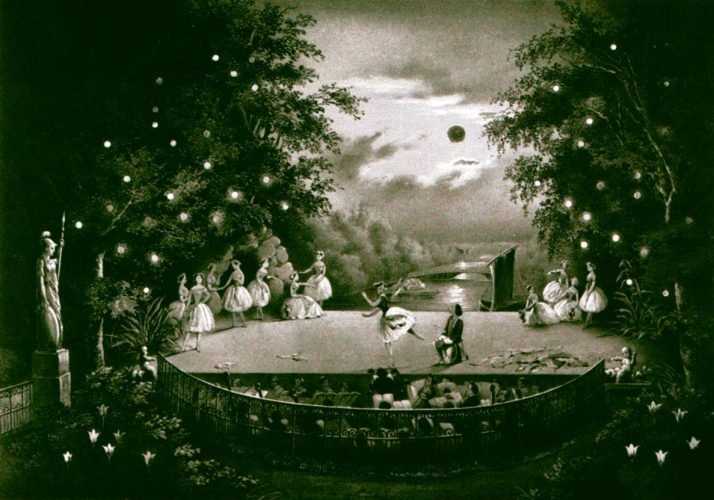
Staged by Perrot on a stage was erected above the water of the lake of the Ozerky Pavilion at the Peterhof Palace.
A ballet divertissement was to be given as part of an Imperial fête for the name day of Grand Duchess Olga Nikolaevna, daughter of Tsar Nicholas I. Perrot based the divertissement on scenes from Ondine (and possibly from La naïade et le pêcheur, the revised version that would première the following year) likely inspired by the aquatic setting of the fête.
A quoted synopsis of the divertissement, titled L’Ile des Naiades, is as follows:
“The divertissement opened with the arrival of a young fisherman – called, as in “Ondine” Matteo, and played by the choreographer himself – rowing his boat to the stage and disturbing the naiads who are sporting themselves there.
They hide at his approach. As he steps ashore, the song of a nightingale reminds him of his fiancée Giannina, whom he is to marry in the morning.
After casting his net, he leaves to gather flowers for a bouquet to take back to her. The naiads then appear from the bushes at the sides. One of them, Azurina [the new name Ondine was given] – played by Anna Prikhunova, one of the most promising of the younger Russian dancers – has fallen in love with Matteo. Determined to practice her charms on him, she persuades her companions to fill his net with silver and golden fishes. On his return, Matteo is astonished by such a catch.
He casts his net again, but when he draws it in, it contains, not more fish, but Azurina herself. This was the introduction that led to a scene, probably adapted from the Scène dansante in Lida [ou la Laitière suisse, the 1849 St Petersburg version of the 1832 ballet Nathalie ou La Laitière suisse], in which the naiad demands his bouquet in return for her gift of fishes, and becomes angry when Matteo refuses. He then begins to tease her, extending the bouquet towards her in exchange for a kiss. Azurina manages to seize it, and Matteo demands and receives his reward before she slips from his grasp and disappears.
The mood of the music then changed, and a jaunty melody announced the approach of a noisy crowd of villagers. Among them is Giannina, played by Zina Richard [who would later marry the danseur-choreographer Louis Mérante], another up-and-coming young ballerina who was half French, her father being the French dancer, Joseph Richard. The naiad is forgotten, and Matteo joins in the boisterous tarantella. The dancing is interrupted by the sound of a distant bell. Along with the villagers, the young couple kneel and pray for their happiness. As the villagers leave, the naiads re-emerge, but Azurina, realising the hopelessness of her passion, is filled with melancholy.
The divertissement ended with Matteo continuing on his way, and Azurina disconsolately letting the bouquet fall from her hands.”
11 February [O.S. 30 January] 1851
Location: Imperial Bolshoi Kamenny Theatre, St Petersburg
Staged by Perrot for Carlotta Grisi under the title La naïade et le pêcheur with Pugni extensively revising his 1843 score.
Like most European theatres of that time, Her Majesty’s Theatre in London only produced ballets as one or two-act diversions between scenes of operas, but the opera houses of Russia devoted entire evenings exclusively to ballet, separate from those of opera. In light of this, Perrot staged many of his works that had been mounted previously in London in elaborately expanded editions for the Saint Petersburg stage, requiring not only that Perrot add and embellish his original dances and mise-en-scène, but also that Pugni expand his scores.
One such expansion was Ondine, which was expanded from two acts and six scenes to three acts and five scenes. Additionally, the plot was extensively revised, so extensively that it was considered by some to be a “virtually new work.” The reason for the extensive revisions is unfortunately not known, though Grisi could have possibly influenced the changes to the plot. In addition to the reworked plot, the dances were also reworked, with new dances replacing the original pas.
Some of the revisions to the ballet include:
- The Scène Dansante d’Entraînement was moved to the top of the first scene, differing from the original version, where it had occurred towards the end of the scene, after the conclusion of the other dances
- A new Barcarolle danced by Giannina and Matteo in the first scene
- A new Grand Pas Scénique for the first scene, whose argument involved two fishermen competing for a decorated oar, chided by their two sweethearts. The two couples were interrupted by a pretty stranger carrying a basket of coral flowers, Ondine in the guise of human form. Matteo is enamoured by her, drawing Giannina’s jealousy
- The first scene now ended with Ondine throwing herself from the cliff into the water, stunning the fisherfolk, as they believe her to be an ordinary mortal. However, she reappears, visible only to Matteo in her naiad form
- The second scene of the ballet was the only scene left unchanged from the original version
- A new version of the Scène Dansante du Bouquet of the third scene, where Matteo throws his net, endeavouring to catch fish, but draws Ondine instead. Matteo teases her with the bouquet as she evades him. He comes to his senses, remembers Giannina and throws his net once more. When he withdraws it, he finds the naiads have filled it with a plentiful catch of fish
- A new configuration of the fourth scene, which now took place at the wedding of Giannina and Matteo. The happy couple are completely absorbed with one another when, suddenly, the naiad rises out of a well and appears to Matteo. He turns away, and, in an attempt to banish the vision from his mind, joins a group of his friends who are drinking outside a tavern
- Following the previous action, a new Scène de Séduction was created for the fourth scene, where Ondine appears as a handsome fisherman playing a mandolin to seduce Giannina (Elena Andreyanova). Giannina nearly succumbs to “his” charms until “he” is chased away by the returning Matteo, who forgives Giannina once he realises that the “young fisherman” was really Ondine in disguise
- A new Pas de Cinq for the fourth scene
- A new configuration of the fifth scene, which now took place at the Festival of the Madonna, including the scene where Matteo kneels to pray with the others but is distracted by the repeated appearance of Ondine, whom only he can perceive
- A new ending for the fifth scene, where Ondine reprimands Matteo for his cruel indifference and rushes into the water. Horrified, and unable to resist, he follows her and drowns. The apotheosis depicted the underwater court of Hydrola, Queen of the Naiads. The lovelorn Ondine and the drowned Matteo kneel before the Queen, who blesses their union, while the poor Giannina is seen vainly striving to reach her lover, prevented by a wall of water that rises out of the fountains
6 November 1851
Location: Königliches Hoftheater, Stuttgart
Staged in two acts and four scenes as Undine, die Wassernixe. The score would be revised by Peter Joseph von Lindpaintner in 1853 and the ballet would receive its final performance on 8 December 1871.
9 December [O.S. 27 November] 1857
Location: Imperial Bolshoi Theatre, Moscow
Staged by Théodore Chion (known mononymously as “Théodore”) for his wife, Thérèse Théodore. Théodore would also portray the rôle of Matteo.
1867
Location: Imperial Bolshoi Kamenny Theatre, St Petersburg
Staged by Marius Petipa for Ekaterina Vazem. Two new variations were added for her, presumably to new compositions by Pugni.
7 November [O.S. 27 October] 1874
Location: Imperial Bolshoi Kamenny Theatre, St Petersburg
Staged by Marius Petipa for Eugenia Sokolova with Pavel Gerdt as Matteo and Alexandra Kemmerer as Giannina. Musical revisions were undertaken by Ludwig Minkus.
23 April [O.S. 11 April] 1879
Location: Imperial Bolshoi Theatre, Moscow
Staged by A. F. Smirnov for E.N. Kalmykova, based on the 1857 version of Théodore. The rôle of Matteo was portrayed by Sergei Petrovich Sokolov.
2 October [O.S. 20 September] 1892
Location: Imperial Mariinsky Theatre, St Petersburg
Staged by Petipa for Varvara Nikitina with Pavel Gerdt as Matteo and Marie Petipa as Giannina. Musical revisions were undertaken by Riccardo Drigo.
16 October [O.S. 4 October] 1898
Location: Imperial Bolshoi Theatre, Moscow
Staged by Ivan Clustine. The production remained in the repertory until 1900, when it received its final performance.
20 December [O.S. 7 December] 1903
Location: Imperial Mariinsky Theatre, St Petersburg
Staged by Alexander Shiryaev, Pugni’s grandson, for Anna Pavlova. Shiryaev was second ballet master of the Imperial Theatres at the time. Drigo composed a new Pas de Deux for Pavlova.
2 April 1912
Location: The Empire Theatre of Varieties, London
Staged by Lydia Kyaksht under the title of The Water Nymph. Billed as a “dance-idyll” it was presumably a heavily abridged version of Pugni’s full-length ballet (called Pouney in the programme). Kyaksht danced the titular rôle with Edward J. Kurylo, premier danseur of the Imperial Opera House, Warsaw as her partner.
It can be speculated that Kyaksht based her choreography on the 1903 St Petersburg revival for Pavlova, though she added new variations to the music of Andrei Kadletz.
London Revivals
1877 Revival
In 1877 William Thompson decided to revive the ballet at Her Majesty’s Theatre to open the residency of his troupe there. He engaged Isabella Velluti to dance the title role as he did not believe that the première danseuse of his troupe, Marguerite Lemoine, was quite right to portray the titular nymph. Lemoine was instead cast as Giannina.
However, once Ondine was chosen to be revived, the question arose of whether the scenario (and indeed the score) should be based on the original 1843 London version (which shall be referred to as Ondine) or the 1851 revision for St Petersburg (which shall be referred to as La naïade et le pêcheur). Though Ondine and La naïade et le pêcheur had similar plots, they were by no means identical works, and included a different configuration of scenes and a different set of dances.
Thompson preferred the scenario of Ondine, as did Mapleson, but as the score of Ondine could not be located (only an incomplete violin répétiteur was found in the archives), the full score of La naïade et le pêcheur was to be procured from St Petersburg. Correspondence with St Petersburg proved fruitful, and the score was sent to London.
Thus, Thompson had the task of reconciling the old scenario (with the incomplete violin répétiteur) with the new score. To accomplish this he approached his friend, the composer François Bardet, requesting whether Bardet would accept the task to revise and supplement the score. Bardet accepted, beginning the partnership that would define Thompson’s so-called ‘Middle Period’ and would last until 1888.
As part of the reconciliation, Thompson decided to condense the ballet from three acts and six scenes to three acts and five scenes, combining the fifth and sixth scenes (the scene of the withered rose and the wedding scene respectively) into one scene that took place in Giannina’s abode. The fisherfolk would enter for the wedding of “Giannina” and Matteo, bearing gifts for the happy couple. Ondine, still weary, would be led offstage by Matteo’s mother, before returning in her wedding dress. The remainder of the scene would proceed as in the original London version, Hydrola and her naiads would rescue the wilting Ondine and Matteo and Giannina would be reunited as Ondine returned to her naiad form.
The ballet was a great success, and proved to be one of the more important events to attend during the 1877 London Season. Thompson’s choreography was well received, but the majority of the praise went to Velluti’s performance as the titular nymph, and to her effective mime and poetic dancing. The work’s success sparked a renewed interest in ballet among the English public, with one critic praising:
“Enough praise cannot be bestowed upon Messrs Thompson and Mapleson for what they have accomplished upon the stage of Her Majesty’s Theatre. So ably and attractively have they restored grand ballet to the London stage that we are led, almost without resistance, through the poetic seduction of a fisherman by a naiad.
Signora Velluti moves with surety and grace across the stage, a veritable nymph to charm our fisherman’s heart. So effective is the poetry of her dancing that the entire scenario seems suffused with poetry, for which Mr Thompson must be given due credit for his graceful and pleasingly arranged groupings.
The whole cannot but stir the senses and sensibilities with a depth of feeling that certainly meets, if not surpasses, the days of Messrs Perrot and Pugni.“
Rôles
Ondine: Isabella Velluti
Matteo: Samuel Penrose
Giannina: Marguerite Lemoine
Hydrola: Francesca Bonera
Musical Revisions
The Pas de Trois of the first scene of the first act was arranged into a Pas de Six. The pas was danced by Giannina and Matteo supported by two ladies and two men.
A new variation was composed for Giannina in the Pas de Six.
A waltz was composed for the Grand Pas des Nayades.
Two variations were added for female sujets in the Grand Pas des Nayades. These variations were rearrangements by Bardet of two of Pugni’s original variations for this pas.
A new variation was composed for Hydrola in the Grand Pas des Nayades.
Variation for Hydrola in the Grand Pas des Nayades, composed by François Bardet (1877)
A new variation was composed for Ondine in the Grand Pas des Nayades.
The Pas de la Rose (also called the Scène Dansante du Bouquet) was retitled to the Pas de la Fleur by Thompson, in order to distinguish it from the similarly named Pas de la Rose Flétrie.
Résumé des Scènes et Danses
Acte 1
Scène 1
1) Introduction
2) Scène 1re
3) Scène 2e – Apparition d’Onine
4) Scène Dansante d’Entraînement
5) Scène 4e – Rentrée des Pêcheurs
6) Ballabile
7) Pas de Six (adapted from Pugni’s score)
a) Entrée
b) Adage
c) Allegro Moderato
d) Variation de Matteo
e) Variation de Giannina
f) Coda
8) Galop
9) Scène 5e
Scène 2
10) Entr’acte et Scène 6e
11) Scène 7e – Entrée de Giannina
12) Scène 8e – Le Filage
13) Scène Dansante – Valse
14) Scène Finale
Acte 2
15) Entr’acte
16) Scène 1re – Entrée des Nayades
17) Scène 2e – Entrée d’Ondine
18) Scène 3e – Récit d’Ondine
19) Grand Pas des Nayades
a) Adage
b) Valse des Nayades
c) Variation I (rearranged from Pugni’s score)
d) Variation II (rearranged from Pugni’s score)
e) Variation III – Hydrola
f) Variation IV – Ondine
g) Coda
20) Scène 4e – Après le Pas
21) Pas de la Fleur
a) Andantino
b) Valse
c) Allegretto
d) Coda
22) Scène Finale
Acte 3
Scène 1
23) Marche et Scène 1re
24) Scène 2e
25) La Furlana
a) Danse d’Ensemble
b) Scène de Prière
c) Reprise de la Danse
26) Scène 3e – Départ des Pêcheurs
27) Scène de la Séduction
a) Allegretto
b) Valse
c) Galop
28) Pas de l’Ombre
a) Andante
b) Allegro
Scène 2
29) Entr’acte et Scène 5e
30) Scène 6e
31) Pas de la Rose Flétrie – Salterelle
32) Scène 7e – Entrée des Pêcheurs
33) Scène 8e – Le Mariage
34) Scène Finale
1884 Revival
In 1884 the ballet was revived with Velluti again as the titular nymph. As Lemoine was retiring that year, the rôle of Giannina was given to Ashfield and the rôle of Hydrola to Mary Butler, a danseuse who had joined the troupe in 1883 as a sujet. No musical revisions were made to the ballet from the 1877 version.
Rôles
Ondine: Isabella Velluti
Giannina: Emma Ashfield
Hydrola: Mary Butler
1887 Revival
In 1887 Thompson revived the ballet to open his residency at the Royal Italian Opera at Covent Garden due to quarrels with the theatre director at Her Majesty’s Theatre.
Following the retirement of Isabella Velluti, Thompson had invited Marta Draeger to become première danseuse in his troupe. She accepted and made her debut on the Covent Garden stage as the titular nymph in Ondine, two weeks after the previously scheduled date at Her Majesty’s Theatre. Her performances were well received by the critics, though better received by some more than others, with those who appreciated her performances praising her ease, technical skill and dramatic acting, especially in the third act.
Despite the broadly positive reception of the ballet by the public, Draeger allegedly did not much like the rôle. She particularly disliked the first act, was indifferent to the second and most enjoyed the third, the Pas de la Rose Flétrie of the second scene of the third act being her favourite part of the ballet. Despite Draeger’s personal opinions of the ballet, the second act was revived with Draeger as the titular nymph for a State Performance given on the 8 July 1891 for the German Emperor and Empress.
Musical revisions were again undertaken by Bardet, who composed supplemental additions for Draeger.
Rôles
Ondine: Marta Draeger
Matteo: Samuel Penrose
Giannina: Emma Ashfield
Hydrola: Sarah Nicholson
Naiad: Mary Butler
Musical Revisions
A new variation was added for Penrose as Matteo in the Pas de Six of the first scene of the first act. This variation was originally composed for a Pas de Trois that was intended to be inserted into the first scene of the third act, but it was eventually decided to transfer the variation to the Pas de Six.
A new variation was composed for Draeger as Ondine in the Grand Pas des Nayades of the second act.
A Pas de Trois was added to the first scene of the third act. Though Pugni had composed a Pas de Cinq to be inserted into this scene of the ballet when it was expanded in Russia, Thompson chose to replace the pas. It was initially planned to adapt Pugni’s pas into a Pas de Trois, with the Entrée, Coda and two female variations (Variation I and Variation III) being adapted from Pugni’s music while the male variation (Variation II) would be newly composed by Bardet. However, such an insertion would have made the third act comparatively too long (as a new Pas de la Rose Flétrie was to be added to the second scene of the third act) so it was decided to cut the pas. The male variation was transferred to the Pas de Six as a variation for Matteo and new music for a shorter Pas de Trois (on the rhythm of a polka mazurka) was composed by Bardet.
A brand new Pas de la Rose Flétrie was added to replace Pugni’s original tarentelle. This pas was set to Bardet’s original music and was composed for Draeger’s debut. It went on to become a celebrated part of the ballet, with Draeger being praised for her acting in portraying the gradually wearying nymph.
Variation à Deux from the Pas de la Rose Flétrie for Miss Draeger as Ondine, composed by François Bardet (1887)
Résumé des Scènes et Danses
Acte 1
Scène 1
1) Introduction
2) Scène 1re
3) Scène 2e – Apparition d’Onine
4) Scène Dansante d’Entraînement
5) Scène 4e – Rentrée des Pêcheurs
6) Ballabile
7) Pas de Six
a) Entrée
b) Adage
c) Allegro Moderato
d) Variation de Matteo
e) Variation de Giannina (1877)
f) Coda
8) Galop
9) Scène 5e
Scène 2
10) Entr’acte et Scène 6e
11) Scène 7e – Entrée de Giannina
12) Scène 8e – Le Filage
13) Scène Dansante – Valse
14) Scène Finale
Acte 2
15) Entr’acte
16) Scène 1re – Entrée des Nayades
17) Scène 2e – Entrée d’Ondine
18) Scène 3e – Récit d’Ondine
19) Grand Pas des Nayades
a) Adage
b) Valse des Nayades (1877)
c) Variation I
d) Variation II
e) Variation III – Hydrola (1877)
f) Variation de Mlle Draeger
g) Coda
20) Scène 4e – Après le Pas
21) Pas de la Fleur
a) Andantino
b) Valse
c) Allegretto
d) Coda
22) Scène Finale
Acte 3
Scène 1
23) Marche et Scène 1re
24) Scène 2e
25) Pas de Trois
26) La Furlana
a) Danse d’Ensemble
b) Scène de Prière
c) Reprise de la Danse
27) Scène 3e – Départ des Pêcheurs
28) Scène de la Séduction
a) Allegretto
b) Valse
c) Galop
29) Pas de l’Ombre
a) Andante
b) Allegro
Scène 2
30) Entr’acte et Scène 5e
31) Scène 6e
32) Pas de la Rose Flétrie
a) Andante
b) Valse – Variation à Deux
c) Coda
33) Scène 7e – Entrée des Pêcheurs
34) Scène 8e – Le Mariage
35) Scène Finale
1901 Revival
In 1901, after 14 years of absence from the troupe’s repertory, the ballet was revived for Sarah Nicholson.
The ballet had fallen out of the repertory primarily due to Draeger, who, though praised for her 1887 portrayal of the titular naiad, did not particularly like the ballet. She disliked the first act, was indifferent to the second and most enjoyed the third, particularly the Pas de la Rose Flétrie. In fact, it could be said that Draeger was not fond of the Romanticism of the first act, with its seduction of a mortal man by an otherworldly maiden. The third act, particularly the Pas de la Rose Flétrie, was more dramatic in the conventional sense, as Ondine tried to dance with Matteo while visibly suffering from the exhaustion of being mortal. Such theatricality was aligned to Draeger’s strengths, and was likely the reason why it was Draeger’s preferred scene.
Nicholson, on the other hand, was at home in the Romantic. Thompson had revived several Romantic works for Nicholson: The Peri in 1892, The Fairies’ Goddaughter in 1893 and The Sylph in 1895. Even his 1895 revival of Coppelia for her could be considered to continue this tradition. As such, when Nicholson asked Richard Hague if the ballet could be revived for her and he granted the request, the Romanticism and poetry of the ballet returned in earnest, aptly portrayed by Nicholson. Lucien Rigaud, who had been cast as Matteo, also leaned into the Romanticism, aligning with Nicholson’s take on the titular rôle. Nicholson’s performances as Ondine received very good reviews, and succeeded in re-establishing the ballet in the repertory and setting the new standard for danseuses to come.
Rôles
Ondine: Sarah Nicholson
Matteo: Lucien Rigaud
Giannina: Louise Grignon
Musical Revisions
Auguste Péchard was commissioned to revise the score, contributing new orchestrations to the second act to include harp figurations reminiscent of the movement of water.
A new variation was added for Giannina in the Pas de Six. This variation was a supplemental variation composed for Marguerite in the Grand Pas de Séduction in the 1889 revival of Faust.
The Faust variation was retained for the 1907 and 1910 revivals of the ballet and became the standard variation for this pas. However, when the ballet was re-choreographed in the 1960s a new variation was interpolated for Giannina, a variation taken from a supplemental Pas de Deux that had been written in 1888 for Draeger’s performances in Giselle. It is also worth noting that the male variation from Draeger’s Giselle pas is danced in the modern staging of the Grand Pas de Deux Noble from The Devil to Pay, being interpolated there by Frederick Hale in 1894. Modern productions are divided as to which of the two variations to use, as the Royal Ballet has reverted to the Faust variation since 1994 while the Paris Opera Ballet has retained the Giselle variation.
A new variation was interpolated into the Grand Pas des Nayades for the second sujet. This variation was a supplemental variation composed for one of the sujets in the Grand Pas des Sylphides in the 1895 revival of The Sylph.
A new variation was interpolated for Nicholson as Ondine in the Grand Pas des Nayades. This variation was also taken from the 1895 revival of The Sylph, and was originally composed as Nicholson’s variation in the Grand Pas des Sylphides. Despite the ballet’s place in the history of the art form (having been made famous by Marie Taglioni, considered to be the greatest ballerina of her age) the revival was not very popular with the London audiences. Nevertheless, Nicholson liked the variation well enough and so interpolated it into Ondine, where it became the standard variation in the pas.
Résumé des Scènes et Danses
Acte 1
Scène 1
1) Introduction
2) Scène 1re
3) Scène 2e – Apparition d’Onine
4) Scène Dansante d’Entraînement
5) Scène 4e – Rentrée des Pêcheurs
6) Ballabile
7) Pas de Six
a) Entrée
b) Adage
c) Allegro Moderato
d) Variation de Matteo (1887)
e) Variation de Giannina (supplemental variation written for Marguerite in the Grand Pas de Séduction in the 1889 revival of Faust)
f) Coda
8) Galop
9) Scène 5e
Scène 2
10) Entr’acte et Scène 6e
11) Scène 7e – Entrée de Giannina
12) Scène 8e – Le Filage
13) Scène Dansante – Valse
14) Scène Finale
Acte 2
15) Entr’acte
16) Scène 1re – Entrée des Nayades
17) Scène 2e – Entrée d’Ondine
18) Scène 3e – Récit d’Ondine
19) Grand Pas des Nayades
a) Adage
b) Valse des Nayades (1877)
c) Variation I
d) Variation II (supplemental variation written for the Grand Pas des Sylphides in the 1895 revival of The Sylph)
e) Variation III – Hydrola (1877)
f) Variation IV – Ondine (supplemental variation written for the Sylph in the Grand Pas des Sylphides in the 1895 revival of The Sylph)
g) Coda
20) Scène 4e – Après le Pas
21) Pas de la Fleur
a) Andantino
b) Valse
c) Allegretto
d) Coda
22) Scène Finale
Acte 3
Scène 1
23) Marche et Scène 1re
24) Scène 2e
25) Pas de Trois (1887)
26) La Furlana
a) Danse d’Ensemble
b) Scène de Prière
c) Reprise de la Danse
27) Scène 3e – Départ des Pêcheurs
28) Scène de la Séduction
a) Allegretto
b) Valse
c) Galop
29) Pas de l’Ombre
a) Andante
b) Allegro
Scène 2
30) Entr’acte et Scène 5e
31) Scène 6e
32) Pas de la Rose Flétrie (1887)
a) Andante
b) Valse – Variation à Deux
c) Coda
33) Scène 7e – Entrée des Pêcheurs
34) Scène 8e – Le Mariage
35) Scène Finale
1907 Revival
In 1907 the ballet was revived for Louise Grignon with Jane Wheaton as second cast.
1910 Revival
In 1907 the ballet was revived for Louise Grignon with Helen Davenport as second cast. This was Davenport’s first leading rôle in a full-length production, as she had recently been promoted to première following the 1909 season.