La Filleule des Fées
Or The Fairies' Goddaughter
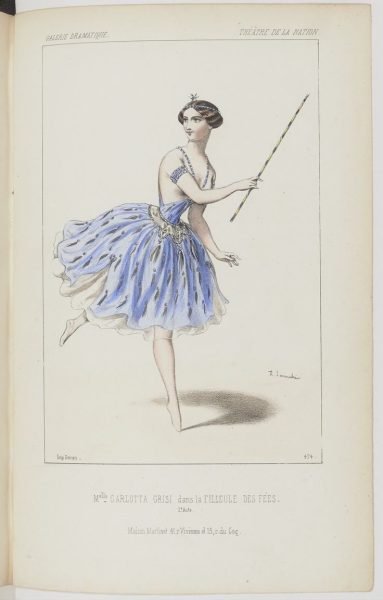
Ballet fantastique in three acts and seven scenes premiered on 8th October 1849 at the Opéra-Théâtre de la Nation, Paris
Choreography: Jules Perrot
Music: Adolphe Adam and Alfred de Clémenceau de Saint-Julien
Premiers Rôles
Ysaure: Carlotta Grisi
Hugues, Comte de Provençe: Lucien Petipa
Alain: Jules Perrot
La Fée Rose: Louise Taglioni
La Fée Blanche: Célestine Emarot
La Fée Noire: Louise Marquet
Plot
Summary
Acte 1
A large room in a farm-house with wide folding doors the whole length of the background, opening on to a landscape. In the distance is a hill leading to the village church, of which the main door is visible. There is a side door and to the left a great Gothic fire-place.
At the rise of the curtain, farmhands are seen decorating the room with flowers. Bells ring out from the church and down the hill comes a happy crowd escorting Father Guillaume, whose little daughter, Ysaure, has just been baptised. The godfather and godmother join hands and lead the procession. They are followed by Berthe, the nurse, carrying the child in her arms. The godfather distributes sugared almonds and Father Guillaume invites his friends to supper.
The table is laid, the guests take their seats, and the repast is served. The godfather and godmother begin to dance a Saraband when there is a knock at the door. Guillaume orders the door to be opened and an old woman enters and begs hospitality. He orders her to be placed at the end of the table.
The dancers recommence when there is another knock. The visitor proves to be another beggar woman who is likewise invited to sit at the table.
The dancers resume when there is yet another knock at the door. The newcomer is another beggar woman whom the farmer again invites to the table. But the godfather notices that this makes thirteen at table. Thereupon the farmer asks her to leave. She refuses and has to be forcibly ejected.
The repast ended, Guillaume proposes the health of little Ysaure and the festival is at an end.
At nightfall the guests depart. Guillaume kisses his child in her cradle and leaves, telling the two old women that they may rest until daybreak.
The nurse rocks the cradle and presently falls asleep. At this moment the two old women each stands beside the cradle and make various signs, which cause the room to be filled with a swarm of little old women who suddenly shed their drab clothes and appear in splendid dresses. The
White Fairy and the Rose Fairy, for so they are called, arch their arms over the cradle and the background fills with mist. All the fairies surround the cradle and confer their gifts. “She shall be white as a lily,” declares the White Fairy, throwing a lily into her cradle. “And fresh as a rose,” adds the Rose Fairy, placing a rose beside the lily. The fairies dance about the cradle then take off their shining belts and place them on their god-child to preserve her from evil.
Suddenly there is a clap of thunder and the third old woman emerges from the fireplace. The other fairies are terrified at her approach. She flings off her cloak and is seen to be dressed in black. She goes to the cradle and waves her wand, of serpents intertwined, over the cradle. She waves her wand again and there passes across the background a black cloud inscribed in letters of fire: “Fear for her. I shall withhold my gifts until her fifteenth year.”
The good fairies leave in dismay, then the Black Fairy disappears amid a black mist. The atmosphere of magic clears and the nurse, awakening with a start, lifts Ysaure from her cradle and clasps her tenderly in her arms.
Acte 2
Scène 1
A pleasant countryside with Ysaure’s house; opposite, a cistern with a curb. In the background a hill leading to a plateau covered with trees and flowers. In the distance the castle of the Prince Hugues de Provençe. Sunrise.
It is the festival of Spring and villagers are busy culling flowers and fashioning them into garlands. They play games and dance.
Enter Ysaure, now fifteen, who is followed by Alain, in love with his foster-sister. The village girls offer him flowers but he disdains their advances, saying that he loves Ysaure. When they mock him, he tells Ysaure of his love for her, but she laughs at him. Remarking his sadness she tells him that if she cannot love him, she will always be his friend. A trumpet sounds and the girls run to take part in the festival, while Berthe takes Ysaure into a hut to change.
Alain, alone, gives way to despair. Suddenly a little old woman leaps out of the cistern. She inquires the reason for his grief and on being told promises to make him happy if he will kiss her.
At first he hesitates then kisses her, when immediately she changes into a beautiful fairy, the Black Fairy seen at Ysaure’s baptism. Alain leaves with her as a distant hunting-horn is heard.
Presently a young huntsman enters, weary from the chase. No sooner does he rest on a seat than two old women ask him for alms. He gives them some pieces of gold and they tell him that soon he will fall in love and they point to Ysaure’s hut.
The huntsman laughs and wishes to knock at the door, but the old women hold him back. Then they point their crutches at the hut, the wall of which becomes transparent, to reveal Ysaure dressing.
Seized with admiration the huntsman wishes to break through the fragile wall of the hut, but the Black Fairy appears and, raising her crutch, causes the wall to become opaque.
The huntsman knocks at the door but the Black Fairy renders the knocks noiseless. Foiled in his efforts he blows his horn and huntsmen run in from all sides. He orders them to force the door. While they go to fetch trees for battering-rams, the Black Fairy causes the hut to vanish and reappear at the summit of the hill.
The huntsman returns and is amazed to find the hut vanished. But the two old women tell him to have patience. They leave, taking him with them.
Enter the village girls dressed in their best and led by Jobin. Ysaure and Berthe descend the hill. Alain also arrives but is surprised to find Ysaure’s hut vanished. Sure of the Black Fairy’s
protection he attempts to dominate Ysaure, who is much amused by his behaviour. Jobin is about to crown Ysaure Queen of Spring, when he vanishes to be replaced by the huntsman, who is none other than the Prince Hugues de Provençe. Ysaure is much troubled by the sight of the handsome nobleman. Fanfares are heard and the Prince’s suite enters.
The Prince invites Ysaure to dance a pas with himself and Alain. This is followed by a general dance until nightfall, when huntsmen appear with torches to escort the Prince to his castle. He begs Ysaure to grant him another meeting, but, before she can reply, Alain steps between them and takes Ysaure’s arm in his. The Prince is in despair but the good fairies wave their wands and the Prince vanishes to reappear in Ysaure’s chamber.
Meanwhile Ysaure climbs the hill to return to her dwelling. The huntsmen, who cannot find the Prince, run hither and thither searching everywhere by the light of their flaming torches.
Scène 2
Ysaure’s chamber. To the right an entrance door. On a slope of the wall is the window seen in the previous scene. The room is furnished with rustic seats and cupboards. In the background a mirror hangs on the wall.
The Prince emerges from the window-curtain where he had been hidden. Hearing footsteps the Prince returns to the shelter of the curtain. The door opens and Ysaure enters accompanied by
Berthe and Alain. The last-named peers behind the curtain, but the Prince moves to one side so that he is not seen.
Alain offers a bouquet to Ysaure who disdains it. The youth, saddened, picks the flowers to pieces. Ysaure, seeing his distress, offers to take the bouquet. But he shows the spoilt flowers and runs out of the room, telling her that he will make another bouquet. The Prince emerges from his hiding-place and, kneeling at Ysaure’s feet, implores her to marry him. Ysaure, delighted, accords him a kiss. The Prince leaves to make arrangements for the wedding.
Ysaure calls Berthe and tells her of her good fortune. Then she feels ashamed of her simple dress; at the same moment her dress becomes a bridal gown. She goes to the mirror, but it is so small that it only reflects a portion of her. Suddenly it grows larger and becomes a full length mirror. Fairy music is heard and the simple room becomes a richly-appointed apartment in a splendid palace. Trumpets sound and Ysaure, overjoyed, opens the door expecting to see the Prince. Instead, she is confronted with the Black Fairy who congratulates her on her fifteenth birthday and promises her a gift.
The Rose Fairy and White Fairy appear as if to protect their god-child. The Black Fairy says: “You have made her so beautiful that no man shall look upon her without losing his reason.” The Black Fairy vanishes leaving Ysaure and her fairy godmothers overcome with fear.
The fanfares are repeated and the Prince’s heralds appear. Ysaure, fearful lest she should harm her beloved, runs into a side room.
The Prince enters in search of his bride, but Berthe and the fairies dare not tell him where she is. He orders his men to find her and presently they lead in Ysaure, who covers her face with her hands. The Prince raises her hands but she turns aside to face Alain who, at that moment, returns with a bouquet. Immediately he loses his reason.
The Prince goes to Ysaure who runs away from him, while Alain, whose jealousy has been intensified, prevents the Prince from following her. They struggle violently until the Prince flings Alain aside and clasps Ysaure in his arms.
Ysaure, in despair, leaps through the window, to the terror of the bystanders. But her fairy godmothers wave their wands and the young girl is saved from falling by a group of fairies who bear her through the air.
Acte 3
Scène 1
A wooded park. In the background is a lake with a central fountain. Here and there are statues. To the left is a grotto. Moonlight.
Two women are seated by the water. They are the good fairies awaiting their god-child. They wave their wands and the statues come to life, forming graceful groups about her.
On the far side of the lake a charming group looms out of the mist, to reveal Ysaure resting on a swan and surrounded by fairies. Light scarves, fluttering in the wind, serve as sails to the graceful bark which carries Ysaure to the bank.
She is welcomed by the fairies who try to console her for the loss of the Prince. “You must not show yourself to him,” they counsel, “or he will lose his reason.” They wave their wands and Alain appears. At the same moment the fairies vanish.
Alain looks curiously at his surroundings, then recognises Ysaure, who appears as a shadow to his fevered brain. He pursues her but always she evades him, and, while he hurries into the wood in search of her, she has already returned.
Ysaure is much troubled by Alain’s unhappy lot, of which she is the unwilling cause. At this point the fairies return, accompanied by a group of nymphs who surround her with affection. Her fairy godmothers decide to admit her to this fairy sisterhood, in token of which she is accorded a magic wand. So she shares in their frolics and, like them, leaps over the swarm or glides over the water.
With the first rays of sunrise Ysaure cannot resist the desire to see her beloved. She waves her wand and a group of fairies part to reveal the Prince asleep in their midst. She repeats the gesture and the fairies disappear, leaving her alone with her lover.
Ysaure, at first confused, looks tenderly at the youth, then dances about him, covering him with rose-leaves. At this juncture Alain returns and is furious at the sight of his rival. He seizes
Ysaure’s wand which she tries to recover; in the struggle Alain touches the Prince with the wand. He awakens and runs to Ysaure, who, terror-stricken, flees towards the park.
Alain, inspired by the Black Fairy, touches Ysaure with the wand, when she changes into a statue. Thus the Prince must see Ysaure and lose his reason. But, at the same moment, one of the fairies seizes her arm, thus breaking the enchantment, then hurls her into the grotto which closes upon her.
Alain, enraged, drags the Prince towards the grotto and, waving the wand, causes the rocks to open before them.
Scène 2
A deep cavern carpeted with flowers and aquatic plants. Several springs, which fill the lake, have their sources in this cavern.
The Spirits of the Springs are resting. They are interrupted by the entrance of Ysaure and her fairy godmothers, who come to hide in the cavern.
Ysaure is alone when Alain and the Prince appear in the background. She is seated plucking the leaves of a rose when the madman drags the Prince towards her. Ysaure looks towards the noise, but her fairy protectors cause the Prince to become blind.
At his cry of anguish Ysaure goes to her lover and tries to soothe his despair. Meanwhile Alain looks on in astonishment. Ysaure contrives to recover her wand and is about to restore his sight when the wand breaks in her hand. At the same moment the Black Fairy appears and reproaches the other fairies for having prevented the accomplishment of her vengeance. Ysaure beseeches the Black Fairy to have pity upon her, her godmothers add their entreaties.
The naiads re-appear and at last she consents to the Prince’s recovery on condition that he will recognize her among all the young girls present. Ysaure accepts the trial.
Scène 3
Clouds invade the scene and a tribunal of fairies assemble to pronounce judgment.
A number of young girls surround the blind Prince. They overwhelm him with caresses and try to lead his thoughts astray by the most captivating endearments. Alain tries to hold back Ysaure each time the Prince is likely to discover her. Meanwhile she suffers agonies of suspense at the dangerous test which may prove fatal to her happiness.
But when Ysaure, making a supreme effort, drives him towards her and presses herself against him so that their hearts beat together, the Prince hesitates no longer. He recognizes his true love, falls at her feet, and clasps her in his arms.
Scène 4
The clouds dissolve to reveal the fairies’ paradise. Banks of golden clouds lead to a magnificent temple, glittering with jewels, and from every side come the fairies of the earth, each with her attributes, to celebrate the marriage of their god-child and the Prince de Provençe.
Alain, thanks to the united power of the fairies, recovers his senses and deplores his follies as he sees the happiness of the two lovers, who take him by the hand.
History
Original Production
La Filleule des Fées premièred as ballet féerie in two acts seven scenes with a prologue and apotheosis, both of which were included as two of the seven scenes. The music was composed by Adam with a little help from Alfred de Clémenceau de Saint-Julien, his pupil. The ballet was described by some sources as being in three acts (with the Prologue being taken to be its own its own act) and seven scenes. It was the last ballet danced in Paris by the great Carlotta Grisi who had been the first Giselle in 1841, before her departure for Russia where she ended her career a few years later. The story is not unlike that of Giselle but more complicated and with a happy ending.
The ballet was well received, with Perrot’s choreography receiving praise, especially his group dances. The critic Fiorentino commented:
“[The] choreography consists not only in inventing steps, designing attitudes and poses, and determining the number of variations. Above all it is the art of disposing large numbers of dancers and presenting them to the audience in a way that is both pleasing and varied, of not breaching the rules of perspective and line by bizarre combinations or by movements that are ungraceful or clash, of skilfully resolving the confusion of arms and legs that may occasionally fill the stage, and of manoeuvring with precision and unison a large and undisciplined army of supers and machinery for effects, the latter being neither the more obstinate nor the least intelligent. Perrot, who is no tyro, has overcome difficulties of this sort, before which ordinary choreographers would quail. The dances, if not notable for originality, are mostly pretty to watch, and the groups are arranged with artistry and taste.”
The story called for complex staging: the wall of Ysaure’s cottage becomes invisible when a wand is waved, a mirror grows in size in front of the audience, a humble cottage room becomes a palatial chamber, a cottage vanishes and reappears upon a distant hill words written in fire appear in a black cloud, mist which envelops and recedes and numerous instances of character appearing and disappearing.
Selected Revivals
8 March [O.S. 24 February] 1850
Location: Imperial Bolshoi Kamenny Theatre, St Petersburg
Staged by Perrot for Fanny Elssler with musical revisions by Pugni under the title of l’Élève des Fées. Sharing the stage were Christian Johansson as Hugues and Perrot as Alain.
1853
Location: Wiener Hofoper, Vienna
Staged by Herr Golinelli for Elisa Albert-Bellon as Isaure, die Pathe der Feen. Hr. Beau would portray the rôle of Hugues and Hr. Carrey would portray the rôle of Alain. The rôle of the white fairy would be danced by Katti Lanner, who would later become the balletmistress of the Empire Theatre of Varieties in London where Adeline Genée would dance in several of her ballets.
London Revivals
1882 Revival
In 1882 the ballet was revived by William Thompson for Isabella Velluti.
In 1881, Velluti had achieved great success in Thompson’s first revival of The Corsair, a production which had attracted the Duchess of Connaught’s attendance and had increased James Henry Mapleson’s (the Manager of Her Majesty’s Theatre) faith in the ballet. As such, from the 1882 season onwards, Thompson would be allowed to stage not one but two revivals or new works a season. This would allow Thompson to appease Marguerite Lemoine, Thompson’s other première danseuse, who, saving the 1880 revival of Griseldis, had been relegated to being Velluti’s second rather than a première danseuse in her own right.
For the 1882 season, Thompson decided upon the following plan: La Filleule des Fées would be staged as The Fairies’ Goddaughter for Velluti as Ysaure and Marco Spada would be staged for Lemoine as Angela and Emma Ashfield as the Marchesa.
Thompson tasked François Bardet with revising the score and began to revise the action and choreography. Thompson’s first action was to simplify the ballet to three acts and five scenes, with the former Prologue becoming the new Act 1 and former Act 1 becoming the new Act 2. Act 3 (the former Act 2) was to be simplified, combining the second, third and fourth scenes of the new third act into one scene in the cavern. This was not as dissimilar to the Parisian original as it might first appear, as the changes that introduced the third and fourth scenes of the third act were closer to on-stage transformations rather than complete changes of the sets and scenery.
The condensation of scenes was not only for the purposes of the action, but also to allow Thompson to remain within the budget approved by management. The ballet famously required lavish special effects in the second act to accompany the magic of the fairies, and Mapleson gave Thompson to understand that if he wished to replicate them he would need to make concessions elsewhere in the ballet.
Though Velluti was receptive to the ballet, she was unsatisfied with the fact that she only appeared in the second and third acts. In his initial plan, Thompson had sought to lengthen the Prologue into its own act by the addition of a Divertissement consisting of both character and classical dances, but the remainder of the action was to remain unchanged from its Parisian origin. Velluti, dissatisfied, requested that the ballet’s narrative be revised to allow her to appear in all three acts, a request which Thompson refused. She then appealed to Mapleson, who was able to press Thompson to revise the ballet to satisfy Velluti’s request. As a result, Thompson edited the libretto with the result that instead of Act 1 taking place at Ysaure’s baptism and Act 2 taking place when she had reached her fifteenth year, Act 1 was now to take place in Ysaure’s fifteenth year (now changed to her confirmation rather than her baptism) and Act 2 in her eighteenth year.
Thompson was greatly displeased by this change, as he felt that it reduced the logic of the story. Indeed, in the first act the fairies were now required, once the party had departed, to bless a portrait of the young Ysaure as opposed to the infant Ysaure in her cradle. As a consequence of these changes, a new Pas d’Ensemble was arranged for Velluti in the first act.
Another change was the swapping of the importance of the fairies. In the original staging the Rose fairy had been the première fairy with the White fairy as her second. However, Thompson believed that the contrast between the good White fairy and bad Black fairy would read better for the audience, and so made the White fairy the première fairy with the Rose fairy as her second. Ysaure’s two nameless friends who participate in the Pas de Cinq were given the names Caroline and Roberta, named after the respective danseuses that created the rôles in 1849 (Mme Caroline and Mme Robert).
Rôles
Ysaure: Isabella Velluti
Comte Hugues de Provençe: Samuel Penrose
Alain: Rafael Caravetti
Caroline: Emma Ashfield
Roberta: Adèle Vernay
Musical Revisions
In Thompson’s original plan, a Divertissement was added to the first act consisting of four dances: two character dances (a Passepied and a Bourrée), a classical dance (a Pas de Trois for three laides) and a concluding Rigaudon. However, once the structure was revised to allow Velluti to appear in the first act, it followed that a pas would need to be arranged for her to dance. Thompson initially considered retaining the four dances and limiting Velluti to a Pas Seul, but she refused as it would not give her enough stage time during the act. As such, it was decided to cut the Bourrée to make room for the a pas, the Pas d’Ensemble. The Bourrée was expanded into the Coda of the pas.
A Variation was arranged for Alain in the Pas de Cinq of the second act. The music was an arrangement of a section of Adam’s music from the original pas which had been cut by Thompson.
A new Variation was composed for Ysaure in the Pas de Cinq of the second act. Adam’s original variation was retained and transferred to the Pas d’Ensemble of the first act as a variation for Ysaure.
Taglioni’s original variation was retained in the Pas des Fées of the third act for the White Fairy. A replacement variation featuring a solo flute had been composed by Adam for Taglioni, which she had danced at the 1849 première instead of the original. However, Thompson preferred Adam’s original variation, as did the danseuse who had been cast in the rôle of the White Fairy, and so the original was selected over the replacement.
A new Variation was composed for Ysaure in the Pas des Fées of the third act.
Résumé des Scènes et Danses
Acte 1 – La Cabane de Guillaume
1) Introduction
2) Scène 1re – Entrée des Invités
3) Scène 2e – Entrée des Vieilles
Divertissement
4) Passepied
5) Bourrée
6) Pas de Trois
a) Entrée
b) Variation I
c) Variation II
d) Variation III
e) Coda
7) Pas d’Ensemble
a) Andante
b) Valse
c) Variation d’Ysaure (Adam’s original 1849 Variation d’Ysaure from the Pas de Cinq)
d) Coda (arranged from the Bourrée)
8) Rigaudon
9) Scène 3e – Le repas et le départ de tout le monde
10) Scène 4e – Les vieilles se transforment en fées
11) Valse des Fées
a) Introduction
b) Valse
12) Scène Finale – Entrée de la Fée Noire
Acte 2
Scène 1 – La Campagne
13) Entr’acte
14) Scène 1re – Entrée des jeunes filles
15) Scène 2e – Entrée d’Ysaure
16) Scène 3e – Alain et la Fée Noire
17) Scène 4e – Hugues et de les veilles
18) Scène 5e – Entrée des paysans
Divertissement
19) Grande Valse Mazurka
20) Pas de Cinq
a) Entrée
b) Andante
c) Polonaise
d) Variation de Caroline
e) Variation de Roberta
f) Variation d’Alain (arranged from Adam’s music)
g) Variation d’Hugues
h) Variation d’Ysaure
i) Coda
21) Scène 6e – Après de Divertissement
Scène 2 – La Chambre d’Ysaure
22) Marche Lointaine et Scène 7e
23) Scène 8e – Hugues et Ysaure
24) Scène 9e – Scène de Magique
25) Scène 10e – Entrée de la Fée Noire
26) Scène Finale
Acte 3
Scène 1 – Une Jardin dans les Bois
27) Entr’acte
28) Scène 1re – Les statues animées
29) Scène 2e – Entrée d’Ysaure
30) Pas des Fées
a) Entrée – Larghetto
b) Variation de la Fée Rose
c) Variation de la Fée Blanche (Variation Originale)
d) Variation d’Ysaure
e) Coda
31) Scène 3e
Scène 2 – Une Caverne
32) Valse des Naïades
33) Scène 4e – Entrée d’Ysaure et les fées
34) Scène Dansante d’Action
a) Andante
b) Allegretto Grazioso
c) La Reconnaissance
35) Scène 6e – Le temple magique
36) Scène Finale – Vol des Génies
1893 Revival
In 1893 the ballet was again revived by Thompson for Sarah Nicholson with Auguste Péchard revising the score. This revival followed on from Nicholson’s success in the revival of The Peri the previous year in 1892. The same season Thompson and Péchard also premièred their second creation together, Pygmalion, with Nicholson’s rival Marta Draeger as the heroine Galatée.
With the 1893 revival, Thompson aimed to remedy two lingering issues of his previous staging: the plot and the use of stage effects. In 1882, financial constraints had necessitated it being simplified from seven scenes to five, cutting the stage transformations that preceded Act 3 Scènes 3 and 4. Augustus Harris, the manager of the theatre, seemed receptive to this, and Thompson was able to persuade him to allow the restoration of the stage transformations, increasing the spectacle of the work.
Altering the plot proved less smooth, as Thompson suggested that the plot of the ballet be revised to bring it more in line with its 1849 origins, removing Ysaure from the first act and returning the setting to her christening. This change was firmly opposed by Nicholson, who did not wish to have her rôle reduced from appearing in all three acts to only appearing in two of them. As such, the plot retained its modified 1882 form with the new scenes added to the third act.
The ballet was well enough received, better than The Peri of the previous year. This was likely due to the stage effects, as the theatre machinist succeeded in staging the lavish effects required by the narrative, especially in the second and third acts. It was favourably compared with Pygmalion in terms of its length and narrative, as Pygmalion received criticism for the fact that its narrative concluded at the end of the second act and the third act devolved into an “overly long” Grand Divertissement. However, the dances of Pygmalion were considered by many to be finer, though Thompson’s arrangements of the Pas de Six in the first act and the Pas de Cinq of the second act received praise.
Rôles
Ysaure: Sarah Nicholson
Comte Hugues de Provençe: Antoine Férat
Alain: Charles Jennings
Guillaume: Edward Lamb
Caroline: Clara Whitmore
Roberta: Harriet Linwood
The White Fairy: Ivy Gregson
The Pink Fairy: Lucia Rinaldi
Musical Revisions
A new Pas de Six was added to replace the Pas d’Ensemble of the first act. The pas was one of Nicholson’s favourite creations, and she interpolated it into The Beauty of Ghent when she danced the rôle of Béatrix in 1897.
Despite the addition of the Pas de Six, Nicholson asked for new variations to be added to the Pas de Cinq and Pas des Fées to replace the variations added for Velluti in 1882. Thompson firmly refused, and Nicholson recorded in her memoirs that Thompson stated:
“Madam, it is not necessary to replace all of Signora Velluti’s additions. You are dancing the rôle of Ysaure, not of Miss Nicholson.”
Though Nicholson’s memoirs indicate her irritation at this refusal, she eventually did dance both of Velluti’s variations and was well received in them.
Résumé des Scènes et Danses
Acte 1 – La Cabane de Guillaume
1) Introduction
2) Scène 1re – Entrée des Invités
3) Scène 2e – Entrée des Vieilles
Divertissement
4) Passepied (1882)
5) Pas de Trois (1882)
a) Entrée
b) Variation I
c) Variation II
d) Variation III
e) Coda
6) Pas de Six
a) Entrée – Valse
b) Andante
c) Allegretto
d) Variation I
e) Variation II – Ysaure
f) Coda
7) Rigaudon
8) Scène 3e – Le repas et le départ de tout le monde
9) Scène 4e – Les vieilles se transforment en fées
10) Valse des Fées
a) Introduction
b) Valse
11) Scène Finale – Entrée de la Fée Noire
Acte 2
Scène 1 – La Campagne
12) Entr’acte
13) Scène 1re – Entrée des jeunes filles
14) Scène 2e – Entrée d’Ysaure
15) Scène 3e – Alain et la Fée Noire
16) Scène 4e – Hugues et de les veilles
17) Scène 5e – Entrée des paysans
Divertissement
18) Grande Valse Mazurka
19) Pas de Cinq
a) Entrée
b) Andante
c) Polonaise
d) Variation de Caroline
e) Variation de Roberta
f) Variation d’Alain (1882)
g) Variation d’Hugues
h) Variation d’Ysaure (1882)
i) Coda
20) Scène 6e – Après de Divertissement
Scène 2 – La Chambre d’Ysaure
21) Marche Lointaine et Scène 7e
22) Scène 8e – Hugues et Ysaure
23) Scène 9e – Scène de Magique
24) Scène 10e – Entrée de la Fée Noire
25) Scène Finale
Acte 3
Scène 1 – Une Jardin dans les Bois
26) Entr’acte
27) Scène 1re – Les statues animées
28) Scène 2e – Entrée d’Ysaure
29) Pas des Fées
a) Entrée – Larghetto
b) Variation de la Fée Rose
c) Variation de la Fée Blanche
d) Variation d’Ysaure (1882)
e) Coda
30) Scène 3e
Scène 2 – Une Caverne
31) Valse des Naïades
32) Scène 4e – Entrée d’Ysaure et les fées
Scène 3 – Le Jugement des Fées
33) Scène Dansante d’Action
a) Andante
b) Allegretto Grazioso
c) La Reconnaissance
Scène 4 – Le Paradis
34) Scène 6e – Le temple magique
35) Scène Finale – Vol des Génies