Marco Spada
![[Marco_Spada_ou_le_bandit_[...]Albert_Alfred_btv1b8454630w_1](https://storiesfromthelondonballet.com/wp-content/uploads/elementor/thumbs/Marco_Spada_ou_le_bandit_.Albert_Alfred_btv1b8454630w_1-rkw02acbl1ln679n370fbec2jlgx11hqkywkft2o74.jpeg "[Marco_Spada_ou_le_bandit_[…]Albert_Alfred_btv1b8454630w_1")
Ballet pantomime in three acts and six scenes premiered on 1st April 1857 at the Théâtre de l’Académie Impériale de Musique, Paris
Choreography: Joseph Mazilier
Music: Daniel Auber
Premiers Rôles
Angela: Carolina Rosati
La Marchesa Sampietri: Amalia Ferraris
Prince Federici: Lucien Petipa
Le Comte Pepinelli: Louis Mérante
Marco Spada: Domenico Segarelli
Prince Osorio: M Lenfant
Fra Borromeo: M Garnier-Bertier
Geronio: M Coralli
Plot
Summary
Acte 1
Scène 1
A large village near Rome. It is situated at the foot of a mountain, which forms the background. To the left are some houses; to the right is a Franciscan monastery.
A village wedding is in progress. The bride, bridegroom, and young people dance, while the heads of the families are seated to right and left. Enter Prince Osorio, the Marchesa Sampietri, his niece, and her cicisbeo, Count Pepinelli, captain in the dragoons. The bride is presented to them.
Village dignitaries receive the Governor and complain of the depredations made by the mountain brigands. He shows them his police posting a notice offering a reward for information that will lead to the arrest of the chief of the brigands, Marco Spada. At the same time a party of dragoons are seen moving towards the mountain.
The bride and bridegroom enter a church, followed by the Governor. Meanwhile Pepinelli makes love to the Marchesa, who accepts his attentions, but announces that she is engaged to her cousin, Count Federici. The newly-married couple leave the church and the dances become general.
At the end of the dance a young man, carrying an artist’s impedimenta, makes his appearance. The Marchesa recognises her fiancé who tells her that he is going to finish a painting of the mountain. A lay brother comes out of the monastery and invites the party to visit it, which they do, with the exception of Federici, who climbs the mountain.
Enter Marco Spada, dressed as a gentleman in hunting costume, and attended by two valets. He approaches the dancers and invites them to spend an evening with him at his castle.
Suddenly there is a roll of drums and the Governor announces that the tithes owing to the monastery and long overdue will now be collected. The lay brother, called Borromeo, seats himself at a table while the police remind the debtors of their dues. Seeing Marco Spada he asks him for his contribution, but he replies that he does not reside in the parish. Borromeo studies his features and agrees. The tithes collected, Borromeo dismisses the police who go into the monastery.
There is a clap of thunder and the frightened peasants hasten to their homes. Borromeo takes up his weighty money-bag and goes to the monastery to find the door barred by Spada’s two men, who menace him with their muskets. Spada relieves him of the bag, gives him a receipt, and, doffing his hat, ironically takes his departure.
The Governor’s party comes out of the monastery just as Borromeo observes that the receipt is signed “Marco Spada.” The Governor departs for Rome to send his troops in pursuit.
Scène 2
An elegant drawing-room. The background is circular with several doors opening on to a gallery. Between each door is a large painting. To the right is a table bearing a lighted branched candlestick and some musical instruments.
The Governor, his niece, and Pepinelli enter, seeking shelter from the storm, which has forced them to break their journey. Surprised to find the room unoccupied, Pepinelli takes up the candlestick and disappears into a room on the right. The Governor, despite the semi-darkness, goes to the room on the left, but, just as he opens the door, a young girl embraces him. Pepinelli returns with the candlestick and the room is light again. The girl, frightened at the presence of strangers, explains that she was expecting her father. Seeing their plight, however, she offers them shelter, and, summoning several domestics, invites her visitors to change their clothes.
A guitar is heard outside and Angela, such is the young girl’s name, opens the window, when Federici appears. There is a love scene between them which is interrupted by the sound of approaching hoof-beats. Federici is forced to take his departure.
Marco Spada enters and is welcomed by his daughter. He is touched by her affectionate greeting, and asks her if he can help her to realize any cherished ambition. She tells him of Federici and of his desire to marry her, to which he gives his consent.
Now the Marchesa comes into the room and Angela presents the stranger to her father, explaining the reason for her presence. She is followed by the Governor and Pepinelli, to whom Spada is unknown. He invites his guests to stay the night, which invitation is accepted.
Spada rings and his lieutenant, Genario, appears, astonished to see the Governor and Pepinelli. He counsels his chief to take this opportunity to rid himself of his enemies. Spada tells him that after midnight, when the guests have retired, Genario may do as he pleases, but the Marchesa is to be spared.
While the repast is being prepared, the hosts and guests converse. The Governor invites Spada and his daughter to a ball which he is to give on the morrow. At a sign from his daughter, the brigand accepts, but she recalls that she does not know how to dance. The Marchesa offers to teach her before dinner. Pepinelli takes the violin off the table and plays the airs, while the Marchesa shows Angela the steps and figures. During the lesson Spada takes the Governor on a tour of inspection.
At the end of the dance Pepinelli becomes alarmed by strange noises which seem to come from beneath the floor. Angela and the Marchesa go in search of Spada and the Governor. Pepinelli hides behind the hangings covering a door. A trap opens in the centre of the room and twelve brigands climb into the room. Each hides behind one of the large pictures.
The hosts and guests return followed by Genario. Pepinelli tells of the mysterious noises and of the twelve brigands. A far-off trumpet sounds. “It is my soldiers,” cries Pepinelli, “I will bring them here.” Genario is about to stab him with his dagger, when Spada restrains him. “Not in front of my daughter,” he whispers.
The guests sit down and Spada gives an order to Genario, who disappears. The chief observes that Pepinelli must have been mistaken and that the noise came from the kitchens. There is a nearer trumpet-call and Pepinelli enters with a party of dragoons. He orders them to level their muskets at the trap which again rises to reveal a table richly laid. Pepinelli is astonished.
Spada invites his guests to be seated. They take their places and mock Pepinelli’s fears. Unconvinced, he orders his dragoons to level their muskets at the pictures. As they do so the pictures disappear and from each frame steps a girl, who offers flowers to the ladies and to the Governor. Pepinelli is amazed. At the same moment the villagers, invited by Spada, arrive carrying baskets of flowers.
Acte 2
A ballroom in the Governor’s palace, Rome.
Enter the Marchesa in evening dress, followed by Pepinelli. She tells him that she is to be married to Count Federici. He is so distressed by the news that he falls on his knees, to the surprise of Federici, who comes in at this moment. The Marchesa goes out leaving the rivals together. Federici tells Pepinelli that he does not intend to marry the Marchesa since he loves another. Pepinelli expresses his delight in a lively dance.
The Marchesa returns with her uncle, the Governor, who receives the guests including Marco Spada and his daughter. Federici is delighted to see Angela who tells her father that he is her fiancé. The ball begins and there follow a succession of pas de caractère.
Towards the end of the divertissement Borromeo appears and goes towards the Governor. At the sight of the monk, Spada is troubled. He wishes to leave at once with his daughter, but she is so happy that she entreats him to stay. Borromeo tells the Governor that the Brotherhood is penniless and asks if he may take a collection among those present. This request is granted.
Pages announce that supper is ready and the guests pass out of the room, all save Spada and his daughter. He goes to the door and tells Genario, disguised as a lackey, to bring up his carriage.
Borromeo and Pepinelli come out of another door. The monk, seeing a possible contributor in Spada, goes to speak with him. While the brigand takes out his purse Borromeo recognises him and calls him by name.
Angela swoons. Spada menaces the monk with a pistol and summons Genario, who appears with other lackeys and carries off Borromeo. Spada restores his daughter to consciousness just as Federici enters and asks the chief for his daughter’s hand in marriage. She struggles between love and duty and finally decides to stay with her father. Federici swears vengeance.
The guests come back into the ballroom. Federici goes to the Marchesa and announces that he will wed her on the morrow. The dances are resumed. Pepinelli is in despair, and Angela, sad at heart, leaves with her father. The remaining guests offer their congratulations to the Marchesa.
Acte 3
Scène 1
The Marchesa’s boudoir. To the left is a mirror and a large wedding-basket covered in satin and adorned with ribbons. To the right is a wardrobe.
Enter Pepinelli, desirous of a last interview with the Marchesa. If she refuses his love he has decided to kill himself. Hearing voices he wishes to escape from the room, but since there is only one door, by which he entered, he hides in the wardrobe.
Young girls enter bearing materials and veils. They are followed by the Marchesa clad in a simple gauze dress. She is going to try on her wedding dress. Her attendants hand her a veil which she tries on before the mirror. While she takes various poses, the girls form different groups about her. Other girls come in carrying floral bouquets and chaplets of orange blossom. She wears these in different ways while the young girls form admiring groups.
Pepinelli, stifled in the cupboard, opens the door and is spellbound by the vision that greets his gaze.
The girls take out jewels and ornaments and soon the Marchesa is arrayed in all her glory. Pepinelli, unable to restrain his passion, rushes towards the Marchesa and falls at her feet.
At the same time a dozen brigands glide into the room. Pepinelli and the girls are terrified while the Marchesa swoons. In the confusion Pepinelli steps into the marriage-basket which shuts on him.
Spada leaps into the room and orders two men to carry off the Marchesa. Others pick up the jewels and lace, and the marriage basket. As soon as the brigands have vanished the girls run to the door and cry for help.
Scène 2
A forest lighted by the rising sun.
Spada, surrounded by his sleeping men, is leaning against a rock. He touches Genario and bids him blow his horn to awaken them. Everyone rises, fires are lit and breakfast prepared. After the meal there are lively dances.
Two dancers quarrel over a girl, who proves to be Angela. Spada asks her why she has left home, and she tells him that her place is with him. Then she sobs and when he asks her why she is sad, she tells him that Federici is being married to the Marchesa that very morning.
Their meditations are interrupted by a blare of trumpets. The brigands, alarmed, disappear into the forest just as a picket of dragoons enters from the opposite direction.
Scène 3
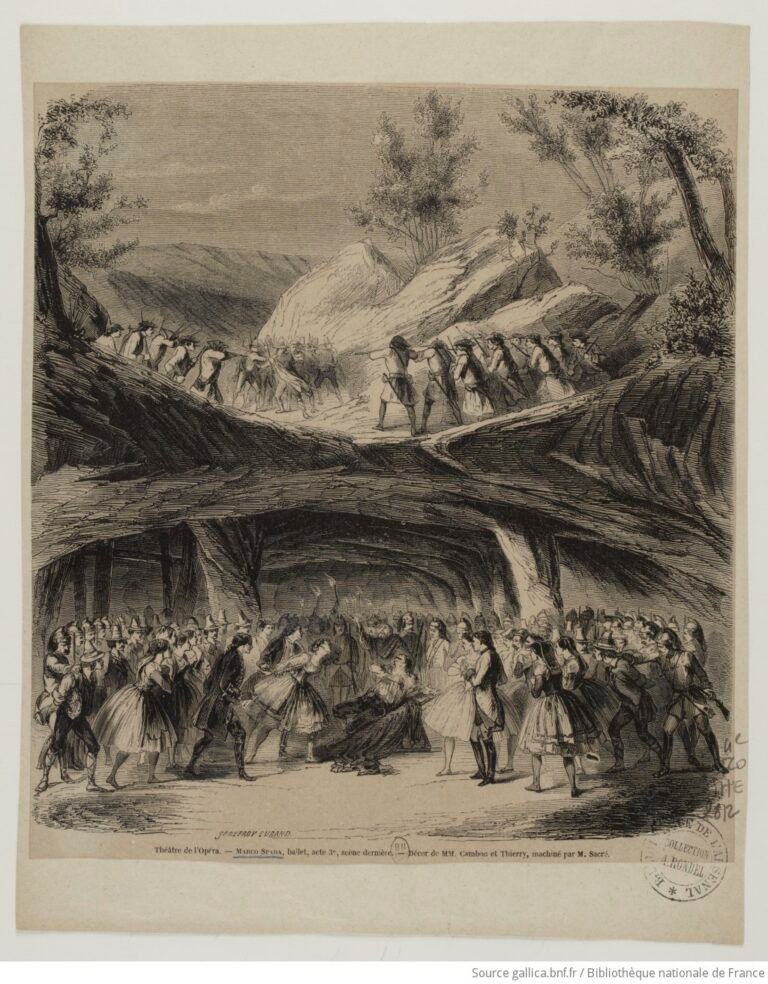
The upper portion shows the forest, the lower a secret cavern known only to the brigands.
Overhead the dragoons scout through the forest and pass from view. A little later another band of brigands bring the Marchesa and the basket, and descend into the cavern. Pepinelli is released from the basket and the Marchesa is told that she must marry him. When she protests Genario orders his men to level their muskets at her, whereupon she consents. Borromeo is brought in to perform the ceremony. At the same time the wedding procession of the first act passes through the forest overhead. The newly married couple are led to a cavern and a guard placed over them. Angela thanks her father and the brigands join in a number of dances which are interrupted by a series of musket-shots.
Some brigands arrive and inform Spada that the Governor and Federici have entered the forest and are followed at a distance by a strong party of dragoons.
Spada leaves the cavern with a number of his men. Angela listens in fear and presently the sound of firing is heard.
The Governor and Federici are captured by the brigands and forced to descend. Genario, seeing the Governor, orders his companions to shoot him on the spot, but Angela countermands the order.
Further shots are heard and Pepinelli and the Marchesa, seized with fright at the noise, run into the centre of the cavern and are astonished to see the new prisoners. The Marchesa informs Federici that she has been married to Pepinelli by Borromeo.
At the same moment dragoons fill the forest path to be led to the secret cavern by a brigand turned traitor. They tell the Governor that Spada has been mortally wounded. Angela, about to swoon, is caught by Federici.
The dying chief is carried in by soldiers and his daughter runs to his side. To ensure his daughter’s happiness he announces that Angela is not his daughter. “Do you swear that is the truth?” asks Borromeo. “I do,” is the reply.
The Governor gives his consent to the marriage of Federici and Angela, and Spada expires. As the rest of the band are brought in by dragoons, Genario gives a cry of joy, for, before being wounded he had set fire to the forest, which now glows red in the light of the mounting flames.
History
Original Production
Marco Spada ou La Fille du Bandit (Marco Spada or The Bandit’s Daughter) is a ballet pantomime in three acts and six tableaux. It was choreographed by Joseph Mazilier to a score by Daniel Auber. The ballet premièred on 1 April 1857 at the Théâtre de l’Académie Impériale de Musique, Paris.
The ballet was originally created for Carolina Rosati, who arrived at the Paris Opéra with her fellow Italian Amalia Ferraris in 1855 as the Opéra’s new prima ballerinas, taking the slot that had been left vacant by Fanny Cerrito after her retirement. It was for both Rosati and Ferraris that Mazilier created his last ballets: La Fonti (1855) and Le Corsaire (1856) for Rosati, Les Elfes (1856) for Ferraris and Marco Spada, in which both ballerinas appeared.
Marco Spada was based on Auber’s opera of the same name that premièred on 21 December 1852 at the Salle Favart, the home of the Opéra Comique. According to the critic of La France Musicale, the music was arranged from airs taken from Auber’s operas, including Fra Diavolo, La Barcarolle, L’Enfant Prodigue among other operas. The critics were divided as to the success of the production, but most were in agreement that the principal attraction was the balletic duel fought by Ferraris and Rosati.
The critic of La France Musicale stated:
“There are many new settings in Marco Spada, the last in particular achieves a certain effect, but it is far from having the attraction of the famous vessel which was shipwrecked in Le Corsaire.
Apart from the pas danced by the two heroines, M. Mazilier did not tax his imagination. These tarantellas and ensembles which run through the ballet are very crude and prove once more that the management of the Opera must seek out young and intelligent maitres de ballet!”
The critic also gives an interesting description of the dance qualities of the two danseuses:
“[Ferraris is] a feather floating between two breezes. Never have we seen fairies of the dance run sur les pointes so boldly and so gracefully. In one of her pas, La Ferraris circles the stage, grazing the boards with the tips of her toes. This seems like magic. And then you must follow her in all her frolics; she flits like a bird and in two bounds crosses from one side of the stage to the other, to come to rest in front of the footlights; there she pirouettes swiftly and more agile than the fleetest squirrel; she leaves, and, in one bound, falls, quivering, into her partner’s arms. La Ferraris is extraordinary, prodigious; she is one of those marvellous ideal beings which pursue you in dreams, and whose existence you cannot credit when you see them with eyes open. The whole house greeted the great artist with a thousand acclamations. La Ferraris can never have been present at a more beautiful festival.
Rosati, too, was amazing, extraordinary, wonderful. In style quite different from Ferraris, she has fascination, irresistible allurement. At the close of the ballet she dances, musket in hand, with a dexterity, poise, and artistry that are truly fairy-like. And what a charming mime is La Rosati! She was overwhelmed with applause.”
The ballet’s most spectacular scene was the transformation between the second and third scenes of the third act, where the landscape on which the second scene took place was raised, with soldiers still on it, to reveal the bandits’ cavern below in which the third scene took place.
London Revivals
1882 Revival
In 1882 the ballet was revived by William Thompson for Marguerite Lemoine.
The 1882 season marked the first time that Thompson was permitted to present two ballets rather than only one, as he had done since 1877. This was in no small part due to the success of the revival of The Corsair of the previous season, where Isabella Velluti was praised in her portrayal of Médora and the attendance of the Duchess of Connaught resulted in the ballet becoming a fashionable part of the London Season.
From the time Thompson had begun at Her Majesty’s Theatre in 1877, he had worked primarily with Velluti as his première danseuse. This was because, even though Thompson had worked with Lemoine prior to Her Majesty’s Theatre (indeed she was a leading danseuse of his company at the Linden Theatre) he did not believe her capable of carrying a full-length, multi-act dramatic ballet in the “Parisian style”. Thus, he staged his first revivals for Velluti with Lemoine relegated to secondary rôles, though he did revive the one-act diversion Diavolina for Lemoine.
To soothe Lemoine’s frustration at being sidelined, Thompson wished to revive Griseldis for her in 1879. However, she decided to take a leave of absence to return to France, resulting in Giselle being revived for Velluti instead. Griseldis was eventually revived the following year in 1880 with Lemoine as the titular heroine, but the production was not very popular.
Thus, since in 1882 Thompson could now revive two ballets he no longer needed to favour Velluti at Lemoine’s expense. It was decided to revive The Fairies’ Goddaughter for Velluti and Marco Spada for Lemoine.
Marco Spada was well known for having two principal ballerina roles as opposed to one: with the rôles of Angela and the Marchesa being created by the celebrated Carolina Rosati and Amalia Ferraris at the ballet’s 1857 première. As Lemoine and Velluti were the two premières of Her Majesty’s at the time, it was expected that Lemoine (as the ballet was revived for her) would dance Angela and Velluti the Marchesa.
However, Lemoine refused to share the stage with Velluti in ‘her’ ballet, instead championing the case of Emma Ashfield, then a coryphée, to dance alongside her. Though Ashfield had not yet danced a lead rôle, she had danced several featured rôles, including Moyna in Giselle (1879), La Moldave in The Corsair (1881) and the Pas de Quatre in Diavolina (1881). Lemoine continued to promote her in favour of Velluti, speaking incessantly to Thompson about her talent, her successes in her featured roles and that she seemed ready to tackle more substantial parts. Though Thompson had cast Ashfield as Caroline in the Pas de Cinq of The Fairies’ Goddaughter, he was reluctant to cast her as the Marchesa as while the rôle of Caroline required Ashfield to appear in a divertissement and dance a variation, the rôle of the Marchesa would require her to contribute substantially to the progression of the plot. However, Lemoine was insistent, even going so far as to offer to work with Ashfield to share her experience of stage presence and dramatic mime. Thompson eventually relented, ostensibly to prevent a quarrel but he is alleged to have confided in Bardet that he had somewhat been convinced that Ashfield could handle the rôle of the Marchesa.
Marco Spada was moderately successful, though not as much as either Lemoine or Thompson would have hoped. The critics enjoyed the score and dances but seemed reluctant to embrace the subject matter. Despite the mixed reviews, the revival launched Ashfield’s career out of the shadows where it had been thus far, culminating in her promotion to première in 1885 and her success as Marguerite in the 1889 revival of Faust, revived for her benefit during the season prior to her retirement.
1882 also marked the first season of Rafael Caravetti, who joined that year as a sujet and danced the rôle of Pepinelli, partnering Ashfield.
Rôles
Angela: Marguerite Lemoine
Marchesa Sampietri: Emma Ashfield
Prince Federici: Johann Faber
Comte Pepinelli: Rafael Caravetti
Musical Revisions
TBC
Résumé des Scènes et Danses
TBC